English

Germany
Germany is a country in Central Europe known for its rich history of influential thinkers and inventors…
Reads at Grades 6–8 Listens at Grades 4–8
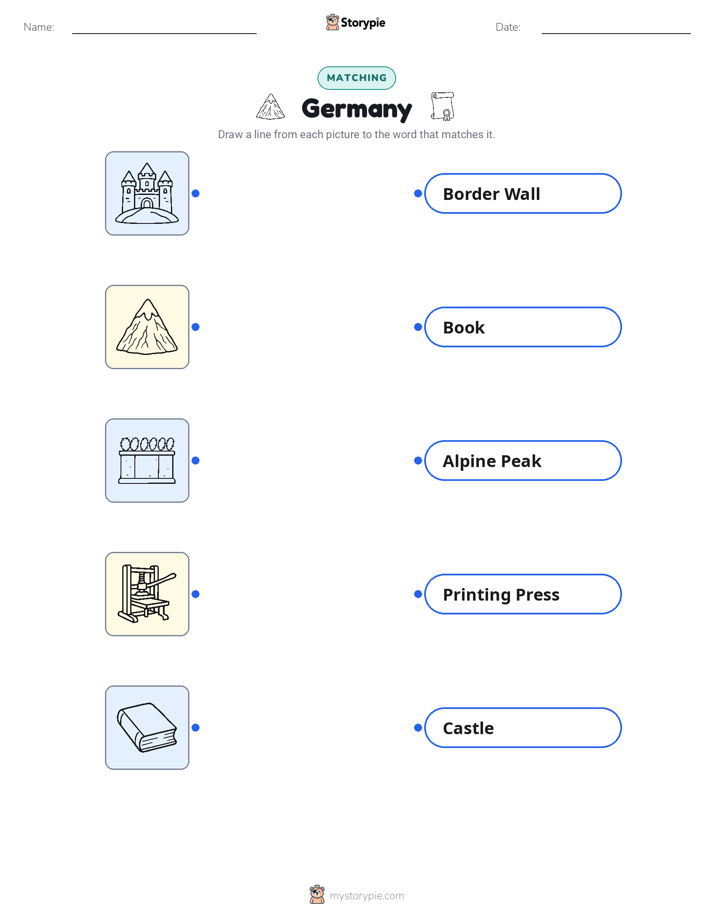
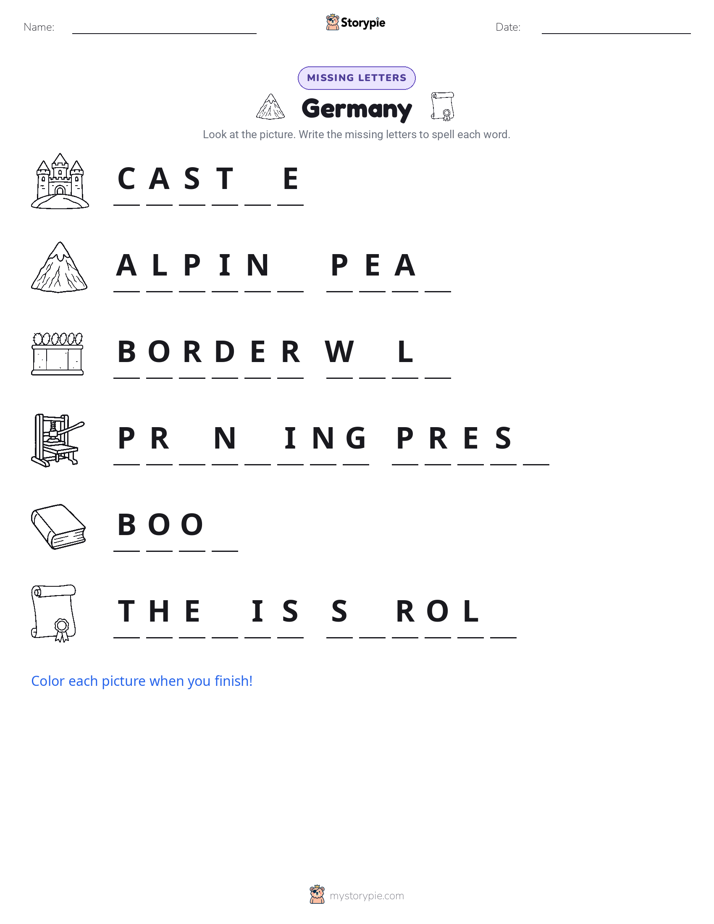
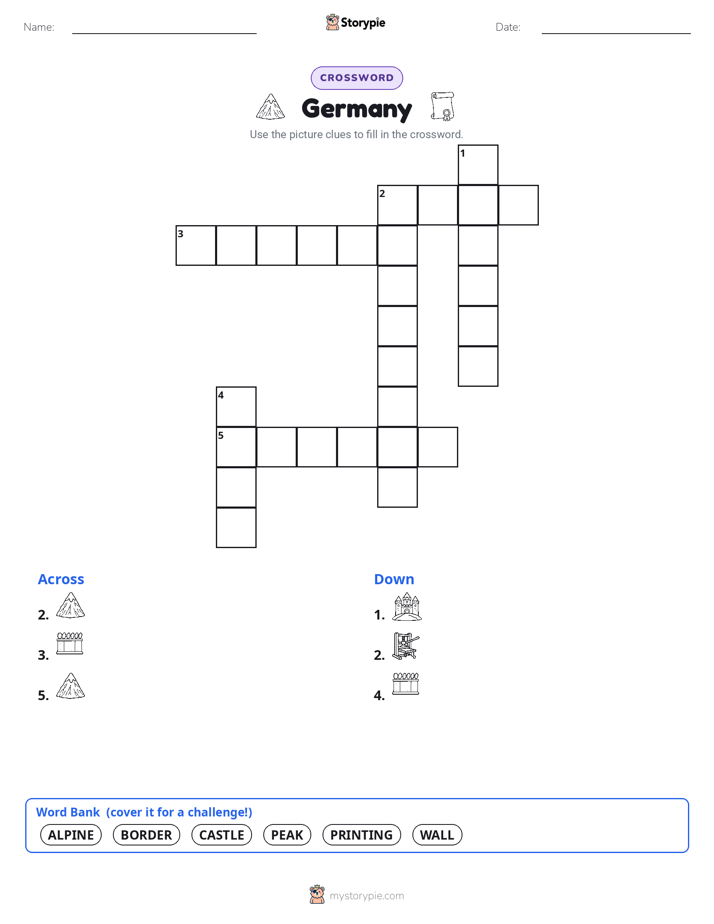
Print & create
Answer keys·No prep·Free with an account
28 worksheets · answer keys · full story · quiz · Ages 10-12 · CEFR B2
Plus adds 280,000+ more stories in 27 languages, audio for every one, and printables for all of them.
Just want Germany?
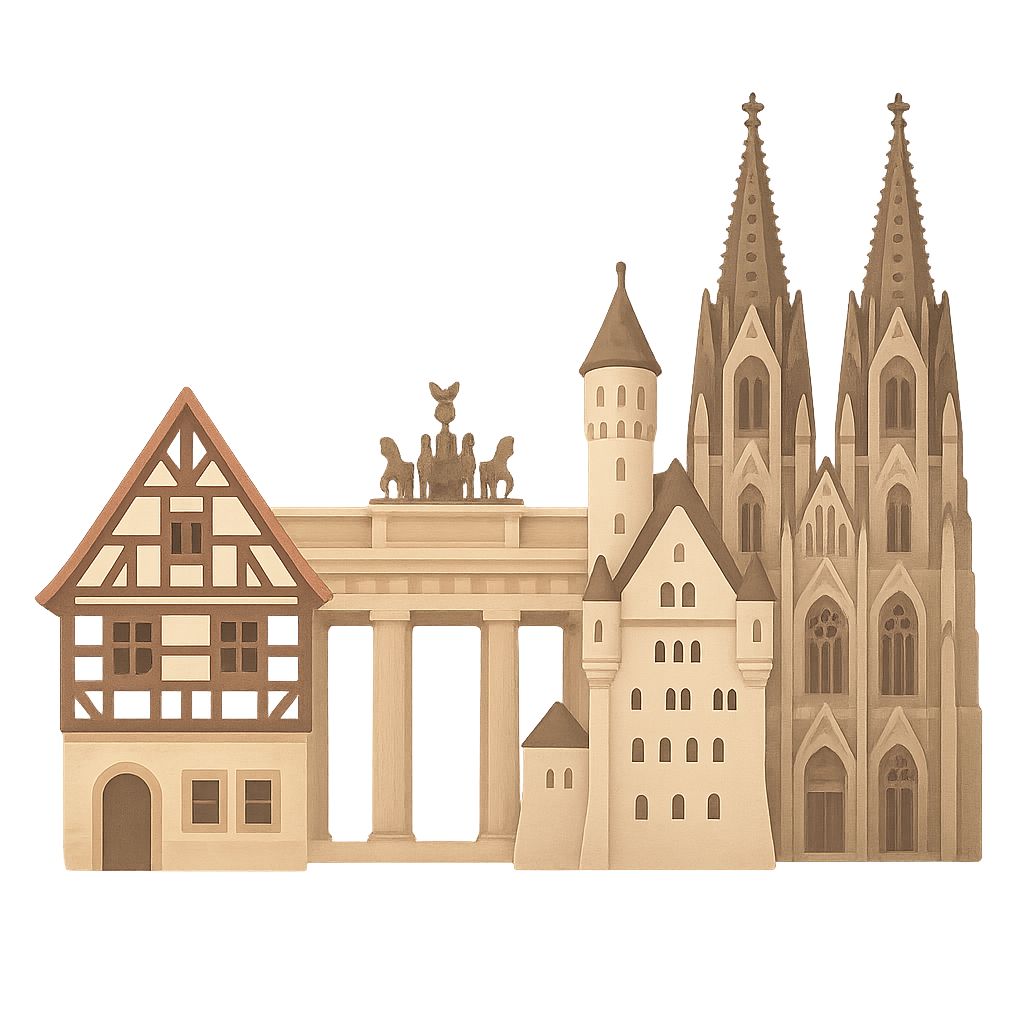
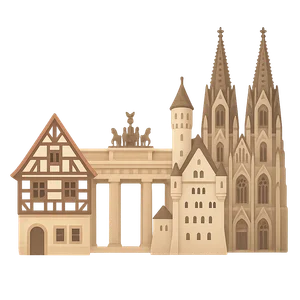
Imagine a land in the very heart of Europe, a place of deep, enchanting forests where sunlight dapples through ancient trees. Picture powerful rivers like the Rhine and the Danube carving paths through the landscape, flowing past storybook castles perched on hilltops. To the south, snowy Alpine peaks touch the sky, while in other places, the hum of modern cities buzzes with energy and new ideas. For centuries, I have been a crossroads of people, art, and history. My forests have whispered fairy tales, my halls have echoed with groundbreaking music, and my workshops have produced inventions that changed the world. I am a land woven from countless threads of the past, a place that has known great unity and deep division, profound beauty and immense sorrow. I am Germany, a heartland of stories waiting to be told.
My story begins long ago, with the ancient Germanic tribes who lived and hunted in my dense forests. They were fierce and independent, and even the mighty Roman Empire could not fully conquer them. Around the 1st century CE, the Romans built a long, fortified border called the Limes Germanicus to separate their world from the tribes they called barbarians. For hundreds of years, I was not one place, but many. Then came a great king, Charlemagne. On Christmas Day, December 25th, 800 CE, he was crowned Emperor in Rome, uniting many different peoples under his rule and laying the foundation for what would become the Holy Roman Empire. But even then, I was not a single country. For the next thousand years, I was a colorful patchwork quilt of duchies, kingdoms, principalities, and free cities. Each piece of the quilt had its own ruler, its own customs, and its own magnificent castles, making me a land of incredible diversity and constant change.
The Story of Germany: A Heartland of Stories
Imagine a land in the very heart of Europe, a place of deep, enchanting forests where sunlight dapples through ancient trees. Picture powerful rivers like the Rhine and the Danube carving paths through the landscape, flowing past storybook castles perched on hilltops. To the south, snowy Alpine peaks touch the sky, while in other places, the hum of modern cities buzzes with energy and new ideas. For centuries, I have been a crossroads of people, art, and history. My forests have whispered fairy tales, my halls have echoed with groundbreaking music, and my workshops have produced inventions that changed the world. I am a land woven from countless threads of the past, a place that has known great unity and deep division, profound beauty and immense sorrow. I am Germany, a heartland of stories waiting to be told.
My story begins long ago, with the ancient Germanic tribes who lived and hunted in my dense forests. They were fierce and independent, and even the mighty Roman Empire could not fully conquer them. Around the 1st century CE, the Romans built a long, fortified border called the Limes Germanicus to separate their world from the tribes they called barbarians. For hundreds of years, I was not one place, but many. Then came a great king, Charlemagne. On Christmas Day, December 25th, 800 CE, he was crowned Emperor in Rome, uniting many different peoples under his rule and laying the foundation for what would become the Holy Roman Empire. But even then, I was not a single country. For the next thousand years, I was a colorful patchwork quilt of duchies, kingdoms, principalities, and free cities. Each piece of the quilt had its own ruler, its own customs, and its own magnificent castles, making me a land of incredible diversity and constant change.
As the centuries passed, my patchwork of lands became a fertile ground for ideas that would reshape the world. In the city of Mainz, a brilliant man named Johannes Gutenberg was working on a secret project. Around 1440 CE, he perfected his invention: the printing press with movable type. Suddenly, books and knowledge could be created and shared faster than ever before. This machine was like a spark in a dry forest. Just a few decades later, on October 31st, 1517, a thinker and monk named Martin Luther used this new technology to spread his ideas. He posted his 95 Theses, questioning the practices of the church, and his words, printed and reprinted, traveled across my lands and all of Europe, sparking the massive shift in faith known as the Protestant Reformation. My spirit also soared through music. Composers like Johann Sebastian Bach created intricate and beautiful melodies for churches, while Ludwig van Beethoven, who slowly lost his hearing, composed powerful and emotional symphonies that could express everything from quiet sorrow to explosive joy. His music still thunders in concert halls today, a testament to the creative fire that burned within me.
For so long, I was a collection of states, but a dream of unity grew stronger. On January 18th, 1871, in the Hall of Mirrors at the Palace of Versailles in France, the German Empire was proclaimed, and I finally became one unified nation. It was a moment of immense pride and celebration, a time when it felt like anything was possible. But my journey in the 20th century was filled with darkness and difficulty. I must tell you, with great sadness, about the two World Wars. These were times of terrible mistakes, aggression, and unimaginable loss that brought suffering to millions of people across the globe. After the second of these devastating wars ended in 1945, I was left defeated and in ruins. The victorious countries divided me into two parts: West Germany and East Germany. This division was not just a line on a map. It became a physical barrier when, on the night of August 13th, 1961, the government of East Germany began building the Berlin Wall. It was a scar of concrete and wire that tore right through the middle of my biggest city, separating families, friends, and a nation that was once whole. It stood as a grim symbol of a world divided by mistrust.
But even the strongest walls cannot stand forever against the human desire for freedom and unity. For nearly thirty years, the Berlin Wall stood as a cold, gray reminder of my division. Then, on the incredible night of November 9th, 1989, something miraculous happened. The gates in the wall were opened. People from East and West Berlin, who had been separated for a generation, streamed through, laughing, crying, and hugging one another. They climbed onto the wall and danced in celebration. This joyful night marked the beginning of my journey back to being one country again. Today, I am a place of innovation, known for my engineering, my science, and my commitment to a peaceful and united Europe. I have not forgotten any part of my past, neither the brilliant ideas nor the terrible mistakes. I carry these memories as lessons, believing that understanding all of history is the only way to build a better, more compassionate future. My castles still stand, my cities thrive, and my heart is open, inviting everyone to explore my stories and learn from my journey.
Wow facts
About
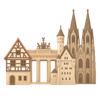
Germany is a country in Central Europe known for its rich history of influential thinkers and inventors, fairytale castles, the Black Forest, and modern technological innovation.
Take a Quiz
Question 1 of 5
The story describes the Berlin Wall as a 'scar of concrete and wire.' What does the word 'scar' suggest about the wall's impact?
Explore next

Want to do even more?
Go beyond exploring. Unlock tools that turn every story into real learning.

Storypie Plus for families
Full stories, quizzes, and printables. Nights and car rides, sorted.
- Unlimited audio stories
- Create Mode: your child stars in the story
- Offline downloads
- Printable worksheets & coloring pages

Why Storypie for Schools
Students engaged. Prep in seconds. Evenings back to you.
- Worksheets & Quizzes
- Classroom Management
- Formative Assessment
- Custom Curriculum & Lesson Plans
- 27 Languages

Why Storypie for Homeschool
Curriculum done. They'll ask for more. Hours back in your day.
- Worksheet Generator
- First-Person Audio Stories
- Built-in Comprehension Quizzes
- Custom Curriculum & Lesson Plans
- Print & Go Activities