English

The Lake District
A mountainous region in North West England, known for its glacial lakes, rugged fells…
Reads at Grades 6–8 Listens at Grades 4–8
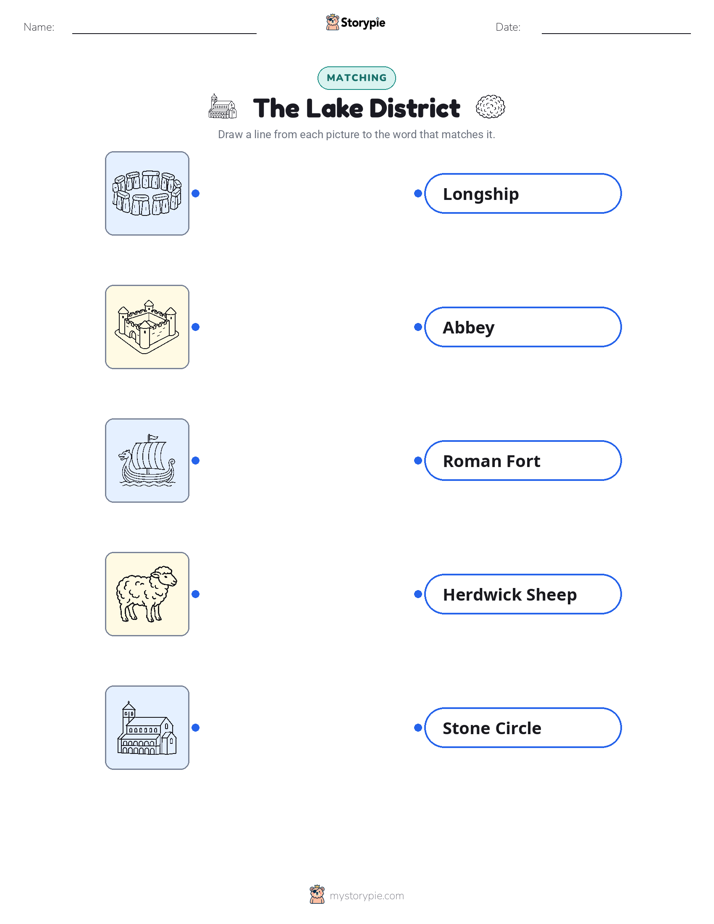
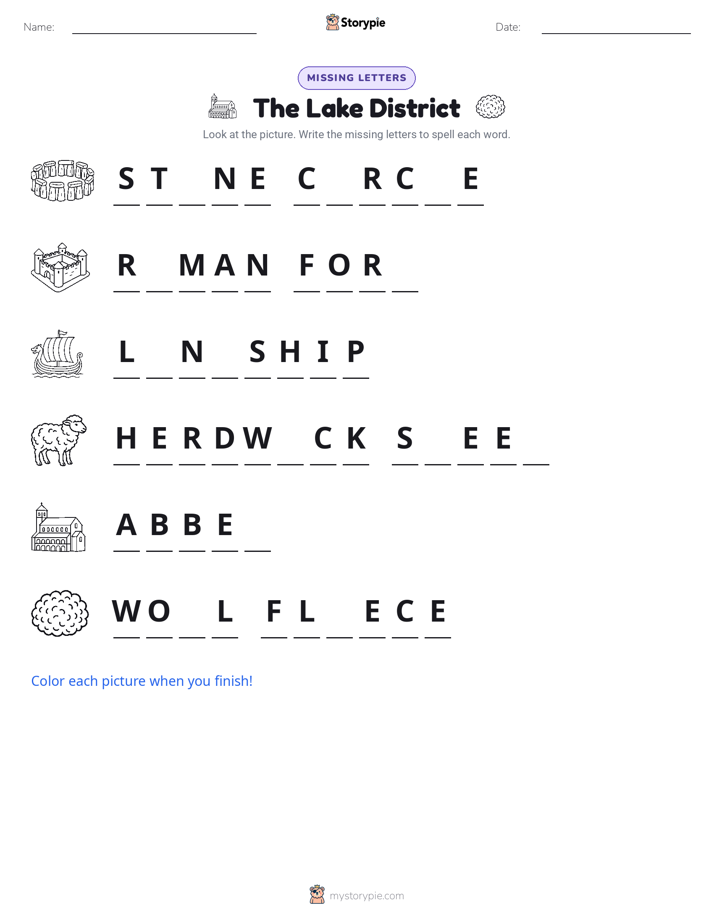
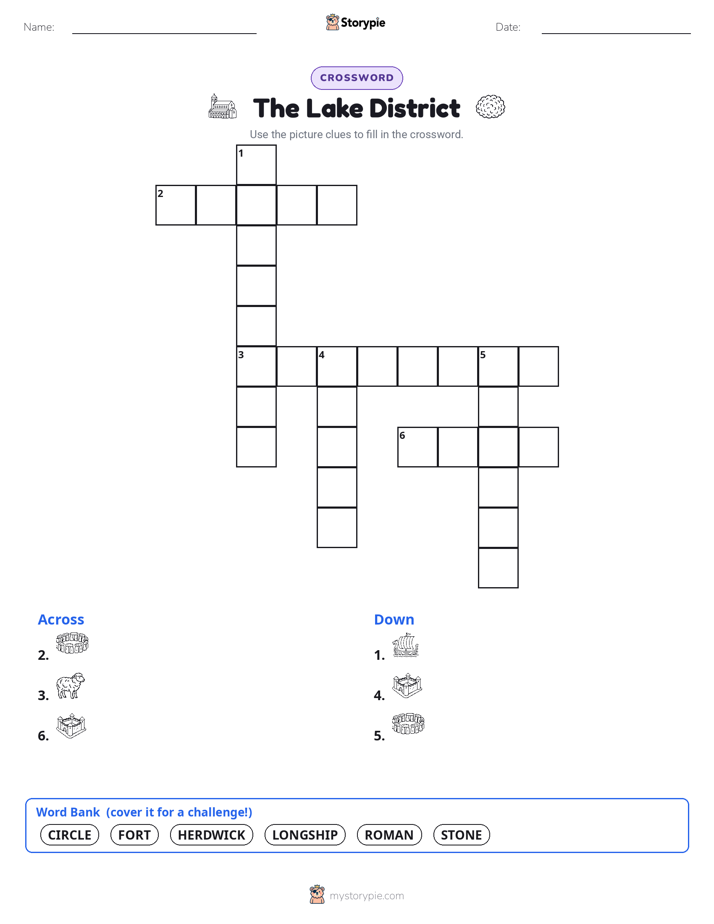
Print & create
Answer keys·No prep·Free with an account
28 worksheets · answer keys · full story · quiz · Ages 10-12 · CEFR B2
Plus adds 208,000+ more stories in 27 languages, audio for every one, and printables for all of them.
Just want The Lake District?
Cool mist settles on my highest peaks, which people call fells, and trickles down my stone-faced slopes to feed the dark, still lakes that fill my valleys. These are my meres and waters, reflecting the endless sky like deep, thoughtful eyes. For thousands of years, I have been a land of towering mountains and quiet dales, tucked away in the northwest of England. My story is written in stone, water, and the hearts of those who have walked my paths. Before they gave me a name, I was simply a feeling—a sense of ancient peace and wild beauty. I am the Lake District.
My story begins not with people, but with ice. Around 15,000 years ago, during the last Ice Age, my entire landscape was buried beneath enormous glaciers. These immense rivers of ice ground slowly but powerfully across the land, acting like giant carving tools. They scraped and sculpted my mountains, giving them their sharp, dramatic peaks, and gouged out the deep U-shaped valleys that cradle my lakes today. When the climate warmed and the ice finally retreated, these vast hollows filled with meltwater and rain, becoming the sixteen main lakes I am now famous for. The first people who came here after the ice left saw a raw, new land. Around 3000 BCE, they gathered my stones and arranged them into great circles, like the one at Castlerigg, creating calendars of rock to map the movements of the sun, moon, and stars across my skies.
Millennia later, the sound of marching sandals echoed through my passes. Around 120 CE, the Romans arrived. They saw me as a rugged frontier to be controlled, and they built impressive stone forts high on my mountain passes, like the one at Hardknott, to guard the roads they engineered across my challenging terrain. After the Roman Empire crumbled and their legions departed, new visitors came. During the 9th and 10th centuries, Viking longships sailed into the estuaries to my west. These Norse settlers were not soldiers but farmers, seeking a new life. They saw a landscape that reminded them of their homeland and gave me many of the names I still carry today. A mountain was a 'fjall,' which became 'fell.' A valley was a 'dalr,' which became 'dale.' A small mountain lake was a 'tjorn,' which became 'tarn.' They also brought with them the hardy Herdwick sheep, whose descendants still roam my hillsides, their grey fleece a part of my very fabric.
The Story of the Lake District
Cool mist settles on my highest peaks, which people call fells, and trickles down my stone-faced slopes to feed the dark, still lakes that fill my valleys. These are my meres and waters, reflecting the endless sky like deep, thoughtful eyes. For thousands of years, I have been a land of towering mountains and quiet dales, tucked away in the northwest of England. My story is written in stone, water, and the hearts of those who have walked my paths. Before they gave me a name, I was simply a feeling—a sense of ancient peace and wild beauty. I am the Lake District.
My story begins not with people, but with ice. Around 15,000 years ago, during the last Ice Age, my entire landscape was buried beneath enormous glaciers. These immense rivers of ice ground slowly but powerfully across the land, acting like giant carving tools. They scraped and sculpted my mountains, giving them their sharp, dramatic peaks, and gouged out the deep U-shaped valleys that cradle my lakes today. When the climate warmed and the ice finally retreated, these vast hollows filled with meltwater and rain, becoming the sixteen main lakes I am now famous for. The first people who came here after the ice left saw a raw, new land. Around 3000 BCE, they gathered my stones and arranged them into great circles, like the one at Castlerigg, creating calendars of rock to map the movements of the sun, moon, and stars across my skies.
Millennia later, the sound of marching sandals echoed through my passes. Around 120 CE, the Romans arrived. They saw me as a rugged frontier to be controlled, and they built impressive stone forts high on my mountain passes, like the one at Hardknott, to guard the roads they engineered across my challenging terrain. After the Roman Empire crumbled and their legions departed, new visitors came. During the 9th and 10th centuries, Viking longships sailed into the estuaries to my west. These Norse settlers were not soldiers but farmers, seeking a new life. They saw a landscape that reminded them of their homeland and gave me many of the names I still carry today. A mountain was a 'fjall,' which became 'fell.' A valley was a 'dalr,' which became 'dale.' A small mountain lake was a 'tjorn,' which became 'tarn.' They also brought with them the hardy Herdwick sheep, whose descendants still roam my hillsides, their grey fleece a part of my very fabric.
For many centuries that followed, my primary story was one of wool. In the Middle Ages, powerful monks from grand abbeys, like Furness Abbey founded on July 15th, 1123, became my greatest sheep farmers. They raised enormous flocks, and my wool became famous across Europe. Despite this industry, most people viewed me as a wild, untamed, and even dangerous place—something to be crossed quickly, not admired. That perception began to change dramatically in the late 18th century, thanks to poets and artists. A young man named William Wordsworth, who had grown up nearby, returned to live at a small cottage called Dove Cottage on December 20th, 1799. He walked my paths for hours every day, composing poetry that captured my spirit. He wrote of my golden daffodils, my lonely clouds, and the power of my stormy peaks. His words taught people a new way of seeing. He showed the world that my wildness was not something to fear, but a source of profound inspiration, peace, and spiritual renewal.
Wordsworth’s poetry opened my heart to the world, and another creative soul soon found refuge and inspiration here. In 1905, a writer and illustrator named Beatrix Potter used the earnings from her famous little books, like 'The Tale of Peter Rabbit,' to buy her first farm, Hill Top. I watched as she sat in my fields and farmyards, sketching the pigs, ducks, and cottages that would become characters and settings in her beloved stories. But Beatrix was more than an artist; she became a dedicated farmer and a fierce protector of my traditions. She learned how to raise Herdwick sheep and understood that my true beauty lay not just in my dramatic scenery, but in the balance between my working farms and the wild fells. She passionately believed this way of life had to be preserved. When she died in 1943, she performed one last act of love for me, leaving over 4,000 acres of farmland and fifteen farms to the people of England, ensuring that my heritage would be protected forever.
The seeds planted by Wordsworth and Potter grew into a powerful movement for my preservation. Their love for my landscape inspired others to fight for my future. This dedication bore fruit on May 9th, 1951, when I was officially designated a National Park, a special place protected for the benefit of everyone, forever. The story did not end there. My unique history—a landscape shaped by ice, cultivated by thousands of years of farming, and immortalized by artists and poets—was given global recognition. On July 9th, 2017, I was named a UNESCO World Heritage Site. Today, I am a living, breathing landscape where people still farm, write, and paint. My paths are always open, inviting you to wander, to dream, and to discover the inspiration that lies within my valleys and upon my fells, just as countless others have done for thousands of years.
Wow facts
About
A mountainous region in North West England, known for its glacial lakes, rugged fells, and association with the 19th-century Romantic poets and author Beatrix Potter. It is a National Park and a UNESCO World Heritage Site.
Take a Quiz
Question 1 of 5
What is the central theme of the Lake District's story?
Explore next



Want to do even more?
Go beyond exploring. Unlock tools that turn every story into real learning.

Storypie Plus for families
Full stories, quizzes, and printables. Nights and car rides, sorted.
- Unlimited audio stories
- Create Mode: your child stars in the story
- Offline downloads
- Printable worksheets & coloring pages

Why Storypie for Schools
Students engaged. Prep in seconds. Evenings back to you.
- Worksheets & Quizzes
- Classroom Management
- Formative Assessment
- Custom Curriculum & Lesson Plans
- 27 Languages

Why Storypie for Homeschool
Curriculum done. They'll ask for more. Hours back in your day.
- Worksheet Generator
- First-Person Audio Stories
- Built-in Comprehension Quizzes
- Custom Curriculum & Lesson Plans
- Print & Go Activities