

 English

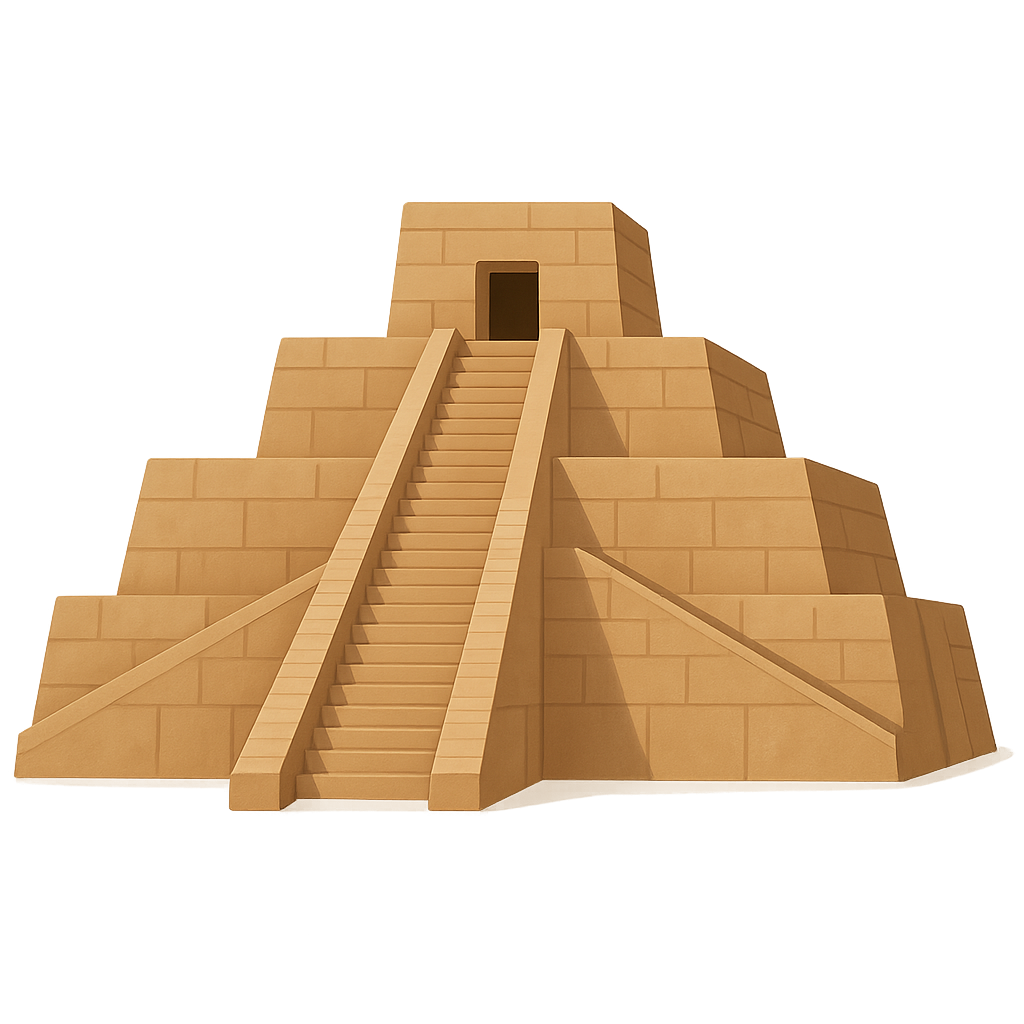
The Ziggurat of Ur: A Stairway to the Stars
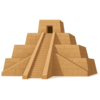
I stand like a layered cake made of earth, my giant steps climbing toward a blazing sun. My home is a hot, dry land nestled between two great rivers, the Tigris and the Euphrates, where one of the world's very first cities once hummed with life. I am not a smooth-sided pyramid with a sharp, pointy top reaching for a single spot in the sky. Instead, I am a terraced mountain built by human hands, a solid, wide bridge between the earth below and the heavens above. For thousands of years, I have watched the moon and stars travel across the night sky, feeling like an old friend to them. The people who built me believed I was a special connection, a place where the world of humans could touch the world of the gods. They saw me as a man-made mountain, a symbol of their devotion and their power. My shape was intentional, with each level smaller than the one below it, creating a series of grand terraces. From a distance, I looked like a staircase fit for giants. I have felt the feet of priests on my steps and heard prayers whispered on the wind. My bricks, made from the very soil of this land, hold the memory of a civilization that dreamed big. I am the Great Ziggurat of Ur.
My story begins a very long time ago, in an age of bronze and new empires, around the 21st century BCE. The world was a different place then, and in the land of Mesopotamia, the Sumerian people were masters of innovation. They invented writing, the wheel, and laws to govern their great cities. One of their most ambitious rulers was a king named Ur-Nammu. He wanted to build a monument that would last forever, a special place to honor the patron god of his magnificent city, Ur. That god was Nanna, who sailed across the night sky as the moon. King Ur-Nammu envisioned me as the religious and administrative heart of his capital, a structure that would show everyone the piety and power of his kingdom. My creation was a monumental task. Millions of mud bricks were formed and laid by countless workers under the powerful sun. My core is made of simple, sun-dried bricks, but my builders were clever. They knew the rains could wash me away, so they gave me a thick outer skin of kiln-fired bricks, baked hard in an oven to make them waterproof. They layered these outer bricks with bitumen, a natural tar that acted as mortar and sealed me from moisture. Three enormous staircases met at a grand gate on my first level, but only the priests were allowed to continue the journey upward. They would climb to the temple at my very top, a sacred shrine that is now lost to time, to be closer to Nanna, making offerings and studying the movements of the stars. I was not just a silent temple. I was a bustling center of Sumerian life where commerce, government, and faith all came together.
After centuries of being the proud center of Ur, my world began to change. New empires rose, like the Babylonians and the Persians, and the course of the Euphrates River shifted away from the city. Slowly, people left Ur, and the once-bustling streets fell silent. The desert, patient and persistent, began to reclaim its land. Winds blew sand over my walls and staircases, and over thousands of years, I disappeared from sight. I slept under a blanket of earth, becoming just a lumpy hill in the vast landscape, my grand history forgotten by the world. For nearly two millennia, my secrets were safe. Then, in the 1920s and 1930s, a new kind of explorer arrived. They didn’t carry swords or crowns, but shovels and brushes. A British archaeologist named Sir Leonard Woolley and his dedicated team had heard ancient stories about the lost city of Ur. They began to dig into the hill that I had become. I felt the gentle scraping of their tools and the careful sweep of their brushes. It was like being woken from the longest dream. Slowly, they brushed away the sand of ages, and my mighty staircases and strong walls saw the sun for the first time in thousands of years. The world was amazed by what they found. The archaeologists weren't just digging up bricks. they were uncovering the story of a civilization, and I was their greatest storyteller. Sir Leonard Woolley and his team carefully mapped my structure, pieced together my history, and shared my story with a new world eager to learn about its ancient past.
Today, my temple at the top is gone, and my bricks are weathered by time, but my massive foundation remains, a powerful testament to the people who built me. I stand proudly in modern-day Iraq, a reminder of the incredible ingenuity, faith, and ambition of the ancient Sumerians. I am a bridge not just to the heavens, but to the past. I show how, for thousands of years, humans have looked up at the sky with questions, wonder, and a deep desire to connect with something greater than themselves. When visitors look at me today, they see more than an ancient ruin. they see one of the first great dreams of civilization, a dream of reaching for the stars. I hope I inspire them to keep asking big questions, to learn from the past, and to build their own bridges to the future, with the same courage and creativity that my builders had so long ago.
Activities
Take a Quiz
Test what you learned with a fun quiz!
Get creative with colors!
Print a coloring book page of this topic.










 Free for Educators