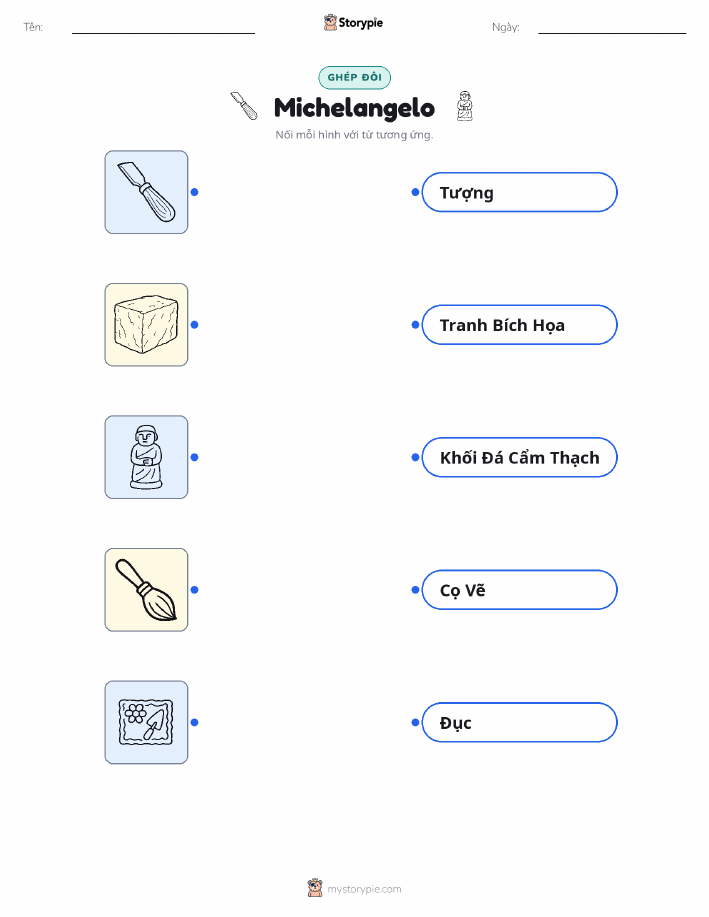
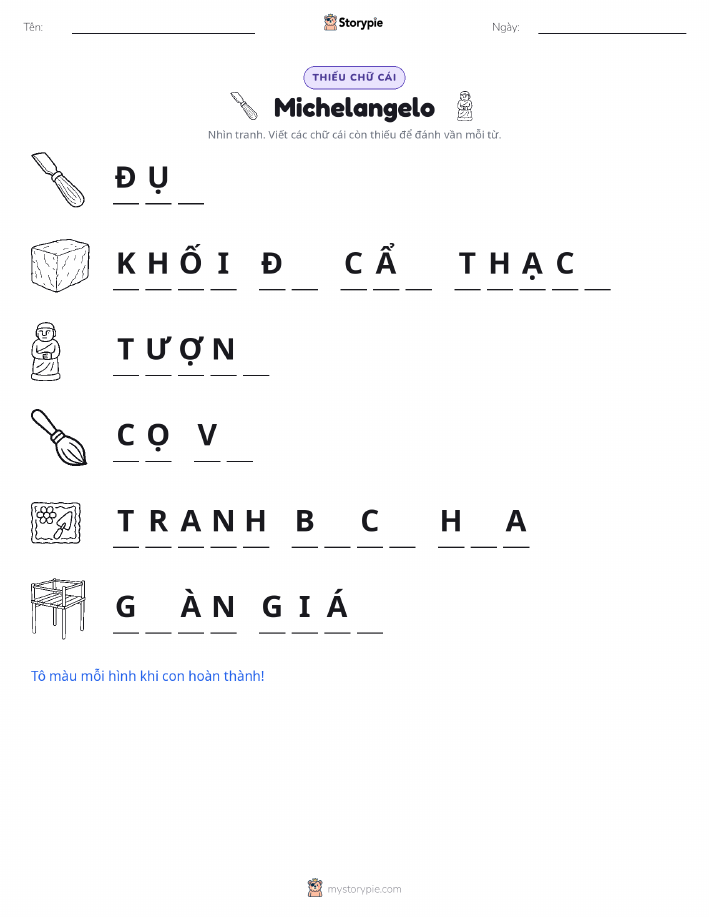
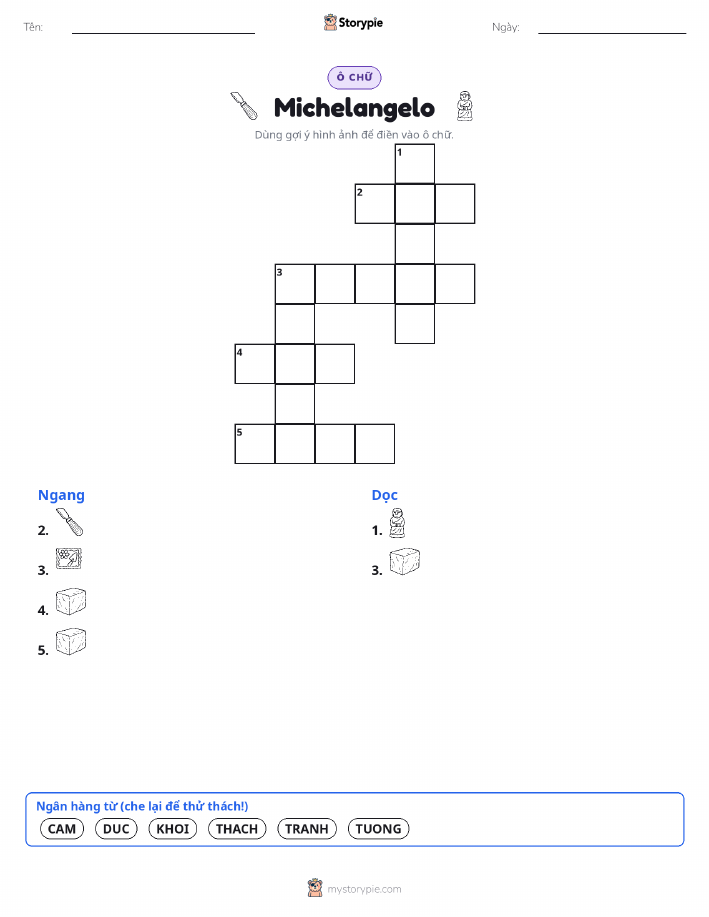
Tiếng Việt


Michelangelo di Lodovico Buonarroti Simoni
Một nhà điêu khắc, họa sĩ, kiến trúc sư và nhà thơ người Ý thời Phục hưng đỉnh cao…
Đọc tại Lớp 3–5 Nghe tại Lớp 1–5
In & tạo ra
Chìa khóa trả lời·Không cần chuẩn bị·Miễn phí với tài khoản
27 bảng làm việc · chìa khóa trả lời · câu chuyện đầy đủ · trắc nghiệm · Độ tuổi 8-10 · CEFR B1
Thêm 280,000+ câu chuyện nữa trong 27 ngôn ngữ, âm thanh cho từng câu chuyện, và tài liệu in cho tất cả.
Chỉ muốn Michelangelo di Lodovico Buonarroti Simoni?
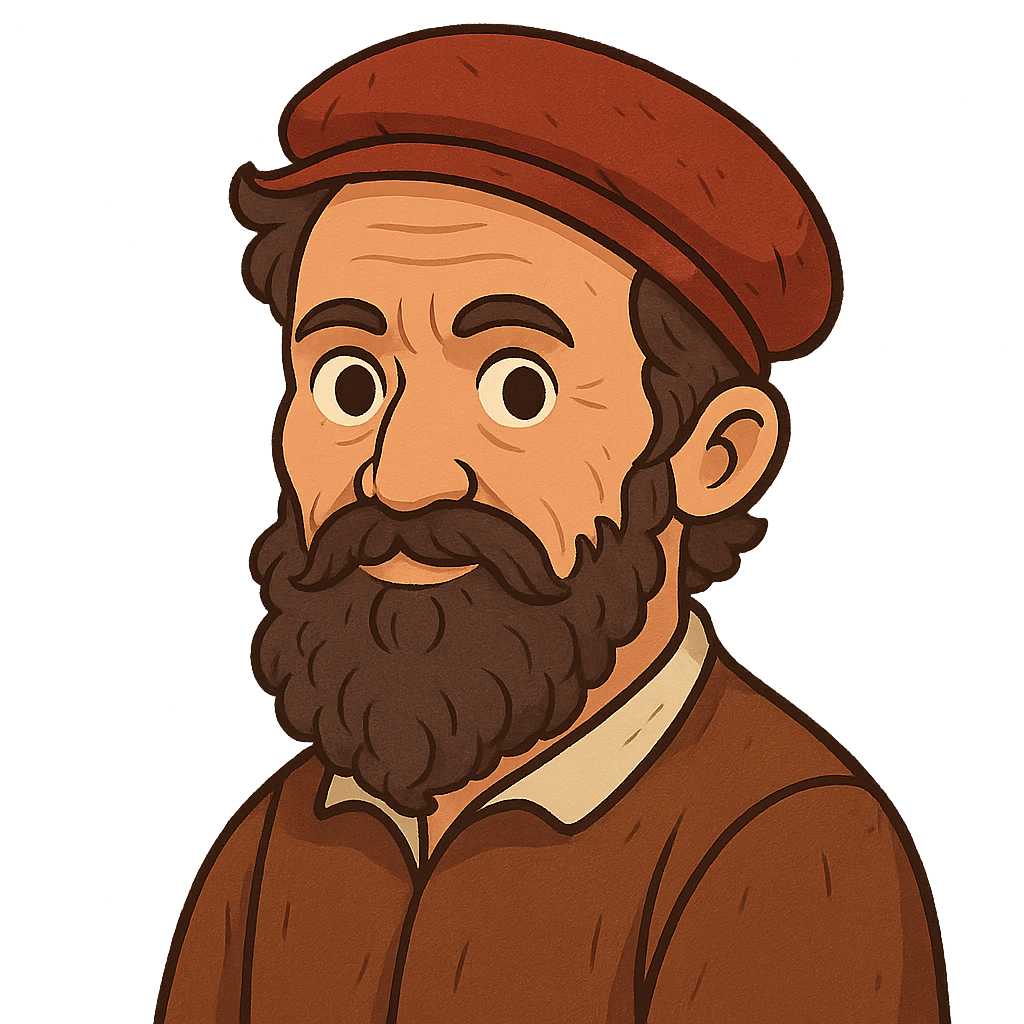
Hello! My name is Michelangelo Buonarroti, and I was an artist. I was born on March 6th, 1475, in a small town in Italy. Even as a little boy, I didn’t want to play games like the other children. I just wanted to draw. My father wanted me to study grammar, but my heart belonged to art. When I was 13 years old, in 1488, I finally got my wish and became an apprentice to a famous painter named Domenico Ghirlandaio in the great city of Florence. Florence was a place full of art and learning during the Renaissance, a time when people were rediscovering ancient ideas and creating amazing new things. I learned how to mix paints, prepare canvases, and draw from life.
In Florence, something amazing happened. Around 1490, the powerful ruler of the city, Lorenzo de' Medici, noticed my talent. He invited me to live in his palace. It was like a dream. I was surrounded by the most brilliant artists, poets, and thinkers of the time. I studied ancient Roman and Greek statues and learned everything I could about carving marble. It was here that I realized my true passion was for sculpture—freeing the figures I could see trapped inside the stone. I learned about anatomy, the structure of the human body, which helped me make my sculptures look so real and lifelike. This special time with Lorenzo de' Medici helped shape me into the artist I would become.
Soon, I was ready to create my own great works. I traveled to Rome and, by 1499, I had carved a sculpture called the 'Pietà'. It shows Mary holding Jesus and is known for its beauty and sad, peaceful feeling. A few years later, back in Florence, I was given a giant block of marble that other artists thought was ruined. From that stone, I carved my most famous statue, 'David', which I finished in 1504. He stood tall and brave, a symbol for the city. Creating these sculptures was very hard work, requiring great strength and a deep understanding of the stone and the human form. The 'Pietà' was my first major commission in Rome, and the 'David' became a symbol of Florentine strength.
Michelangelo Buonarroti
Hello! My name is Michelangelo Buonarroti, and I was an artist. I was born on March 6th, 1475, in a small town in Italy. Even as a little boy, I didn’t want to play games like the other children. I just wanted to draw. My father wanted me to study grammar, but my heart belonged to art. When I was 13 years old, in 1488, I finally got my wish and became an apprentice to a famous painter named Domenico Ghirlandaio in the great city of Florence. Florence was a place full of art and learning during the Renaissance, a time when people were rediscovering ancient ideas and creating amazing new things. I learned how to mix paints, prepare canvases, and draw from life.
In Florence, something amazing happened. Around 1490, the powerful ruler of the city, Lorenzo de' Medici, noticed my talent. He invited me to live in his palace. It was like a dream. I was surrounded by the most brilliant artists, poets, and thinkers of the time. I studied ancient Roman and Greek statues and learned everything I could about carving marble. It was here that I realized my true passion was for sculpture—freeing the figures I could see trapped inside the stone. I learned about anatomy, the structure of the human body, which helped me make my sculptures look so real and lifelike. This special time with Lorenzo de' Medici helped shape me into the artist I would become.
Soon, I was ready to create my own great works. I traveled to Rome and, by 1499, I had carved a sculpture called the 'Pietà'. It shows Mary holding Jesus and is known for its beauty and sad, peaceful feeling. A few years later, back in Florence, I was given a giant block of marble that other artists thought was ruined. From that stone, I carved my most famous statue, 'David', which I finished in 1504. He stood tall and brave, a symbol for the city. Creating these sculptures was very hard work, requiring great strength and a deep understanding of the stone and the human form. The 'Pietà' was my first major commission in Rome, and the 'David' became a symbol of Florentine strength.
In 1508, Pope Julius II gave me my biggest challenge yet. He asked me to paint the ceiling of the Sistine Chapel in Rome. I told him, 'But I am a sculptor, not a painter!' He insisted. For four long years, from 1508 to 1512, I lay on my back on high scaffolding, with paint dripping into my eyes, to cover the huge ceiling with scenes from the Bible. It was the hardest work of my life, but it became one of my greatest achievements. The ceiling is filled with hundreds of figures, including the famous 'Creation of Adam'. Despite my initial reluctance, I poured all my energy into this monumental task.
Even after the Sistine Chapel, I didn't stop creating. I designed buildings, including becoming the chief architect for the magnificent St. Peter's Basilica in Rome in 1546. I also wrote hundreds of poems about my feelings, my art, and my faith. I believed that art was a way to show the beauty of the world and connect with something divine. My architectural work continued for many years, and my poems offered a glimpse into my inner thoughts and beliefs. I wanted my creations to inspire awe and devotion.
I lived a very long and busy life, filled with art and passion. I lived to be 88 years old. Today, millions of people still travel to Italy to see the 'David', the 'Pietà', and the Sistine Chapel ceiling. I hope that when people see my work, they feel a sense of wonder and are reminded of the incredible things we can create with our hands and our hearts.
Sự thật thú vị
Giới thiệu
Một nhà điêu khắc, họa sĩ, kiến trúc sư và nhà thơ người Ý thời Phục hưng đỉnh cao, người đã có ảnh hưởng vô song đến sự phát triển của nghệ thuật phương Tây.
Tham gia Quiz
Câu hỏi 1 của 5
What did Michelangelo want to do when he was a little boy instead of playing games?
Khám phá tiếp theo





Bạn muốn làm nhiều hơn nữa?
Vượt ra ngoài việc khám phá. Mở khóa các công cụ biến mỗi câu chuyện thành một bài học thực sự.

Storypie Plus cho gia đình
Câu chuyện đầy đủ, câu đố và tài liệu in. Những đêm và chuyến đi xe, đã được sắp xếp.
- Câu chuyện audio không giới hạn
- Chế độ Tạo: con bạn là nhân vật chính trong câu chuyện
- Tải xuống ngoại tuyến
- Tài liệu in và trang tô màu

Tại sao chọn Storypie cho Trường Học
Học sinh tham gia. Chuẩn bị trong vài giây. Buổi tối trở lại với bạn.
- Bảng tính & Trắc nghiệm
- Quản lý lớp học
- Đánh giá hình thành
- Chương trình giảng dạy & Kế hoạch bài học tùy chỉnh
- 27 Ngôn ngữ

Tại sao chọn Storypie cho giáo dục tại nhà
Chương trình học đã hoàn thành. Chúng sẽ yêu cầu thêm. Giờ trở lại trong ngày của bạn.
- Trình tạo bảng tính
- Câu chuyện âm thanh từ góc nhìn người kể
- Bài kiểm tra hiểu biết tích hợp sẵn
- Chương Trình Giảng Dạy & Kế Hoạch Bài Học Tùy Chỉnh
- Hoạt động In & Đi