
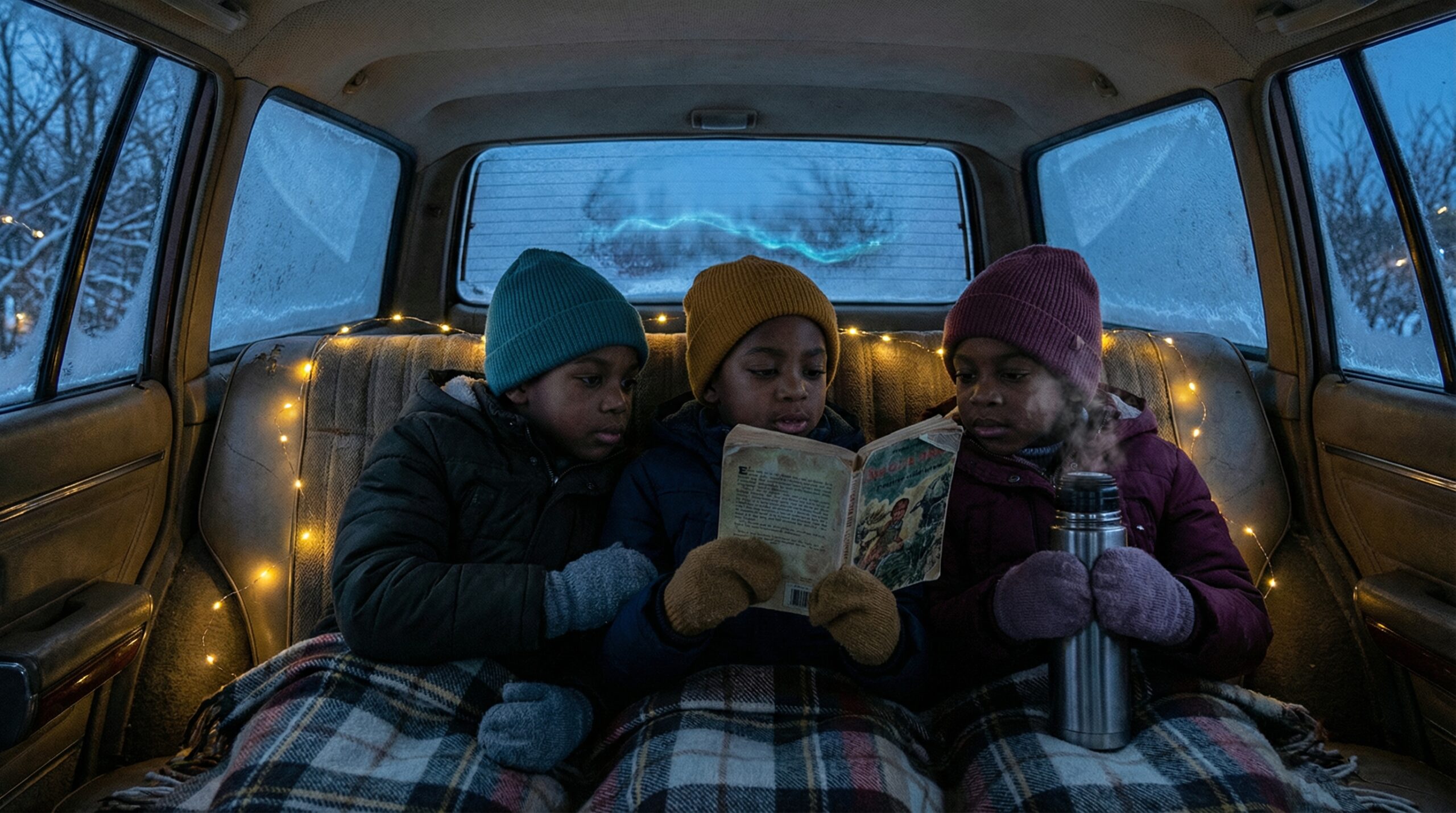
I still remember the night I read A Wrinkle in Time (novel) aloud to my family. It was snowing outside. My child gasped at a line and then fell silent. That little pause changed the room. Stories can do that. They make ordinary nights feel important and a bit magical.
Why A Wrinkle in Time (novel) still matters
Madeleine L’Engle published A Wrinkle in Time on January 1, 1962. It won the 1963 Newbery Medal. The book reads like a brave, heart-tugging dream. Meg Murry, her gifted brother Charles Wallace, and their friend Calvin set out to rescue Mr. Murry. He is their missing father. Along the way, three strange helpers appear: Mrs. Whatsit, Mrs. Which, and Mrs. Who.
L’Engle mixes science words with myth and warmth. The tesseract is the central image. It folds space and time. It sounds scientific and feels magical at once. Because of that mix, readers hold a tool and a mystery together. That feeling can make reading thrilling. As of 2012, A Wrinkle in Time had sold over 10 million copies, underscoring its enduring popularity and influence over the decades.
What kids can take away
The novel teaches courage and the power of love. Meg’s stubbornness turns into self-acceptance. Charles Wallace shows that sensitivity can be strength. Calvin brings steady loyalty. Against them, the story places vivid villains. The Black Thing eats light. The planet Camazotz enforces sameness. Those darker scenes can scare young readers. However, they also open honest family talk.
Quick facts you can use
- Author and year: Madeleine L’Engle, 1962. Winner of the 1963 Newbery Medal.
- Audience: Middle-grade readers and family read-alouds.
- Series: First book in L’Engle’s Time Quintet.
- Adaptations: Radio, stage, TV, and a feature film in 2018.
These quick facts make it easy to recommend A Wrinkle in Time (novel) at school or at home. Teachers and parents often use them as a handy intro.
A short prompt to try tonight
Play one chapter. Then ask your child: What would you brave? Let them answer in one sentence. Listen closely. Record that sentence if you can. That tiny act makes the story their story.
Classroom and family activities
Here are two simple ideas. Both are quick and meaningful.
- For older kids: Work in pairs. Describe Camazotz in three words. Then rewrite one rule to make it kinder.
- For younger children: Focus on characters. Ask who looked after whom and how they showed love.
These exercises build empathy and critical thinking. Plus they are playful and gentle.
A gentle note on challenges
The novel has stirred debate. Some schools have challenged it for spiritual elements. In fact, in 2023, there were 1,247 documented demands to censor library books, with A Wrinkle in Time being one of the challenged titles. Many educators still praise it, calling it a conversation starter about bravery, difference, and resisting conformity. The ALSC notes that A Wrinkle in Time has been challenged ever since its publication, ranking #23 on ALA’s “most challenged” list for 1990–1999. So weigh your community and your child when you pick it.
Read or listen to a story about A Wrinkle in Time (novel) now: For 3-5 year olds, For 6-8 year olds, For 8-10 year olds, and For 10-12 year olds.
If you want a cozy late-winter listen, try a chapter tonight. Ask that single question: What would you brave? Then let the book become one of your family’s tiny traditions. Find this classic on Storypie at Read or listen to a story about A Wrinkle in Time (novel) now.