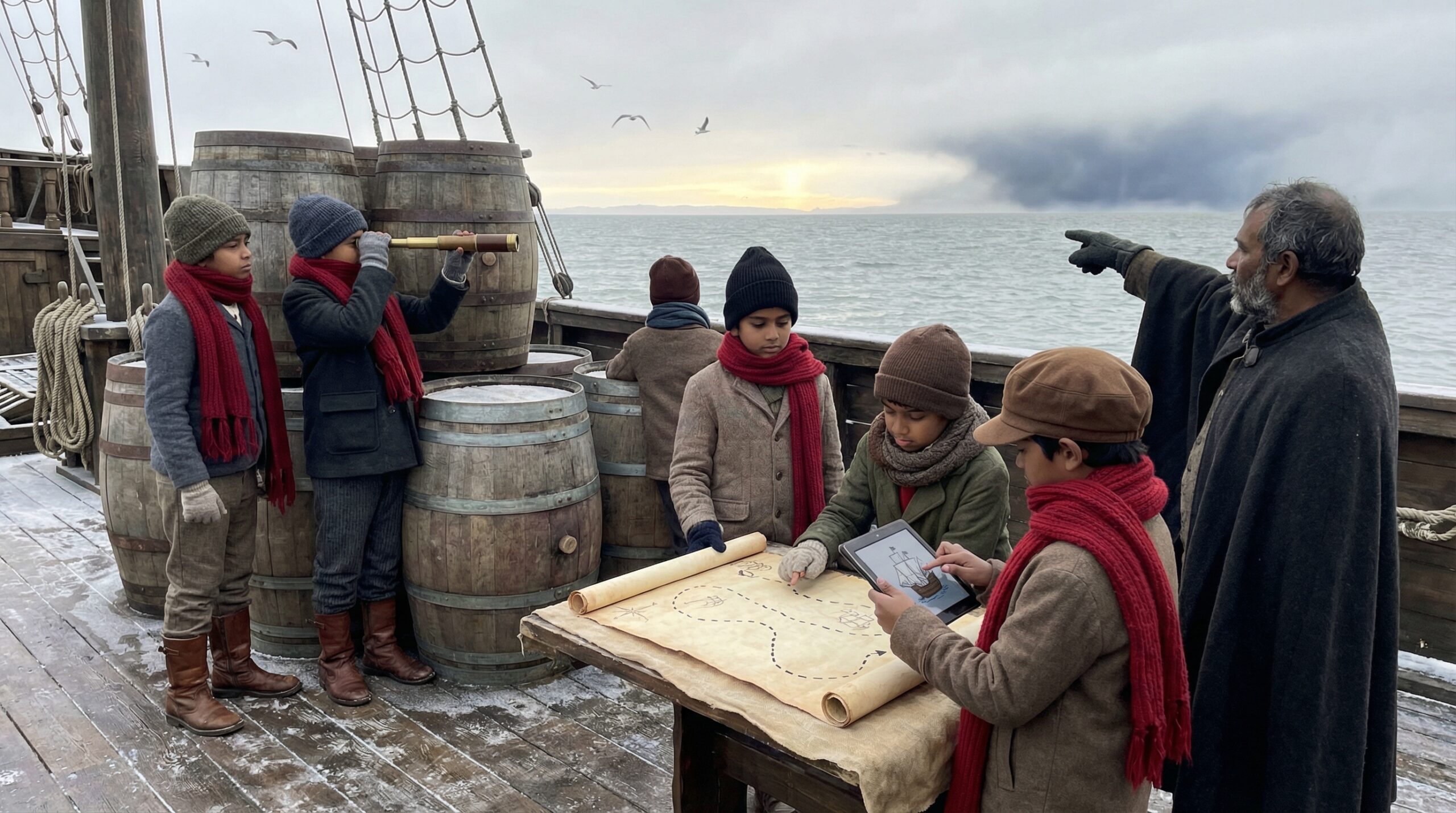
I love telling kids about Age of Discovery for kids because the stories are thrilling and full of human detail. This winter morning, let them sail with Magellan on Storypie. Play it on car rides and pause to ask, “What would you explore?”
Who set sail and why
About 500 years ago, European sailors left home to map the world by sea. Portugal and Spain led the rush. Later England, France, and the Netherlands joined in. They sailed for trade, rivalry, faith, and curiosity. Also, spices and new trade routes mattered a great deal. In fact, the Portuguese navigator Pedro Álvares Cabral discovered Brazil in 1500 while en route to India, claiming it for Portugal and expanding European influence in the New World.
Famous explorers and bold feats
I name the big players in one breath. Prince Henry of Portugal backed voyages along Africa. Bartolomeu Dias rounded Africa’s tip in 1488. Vasco da Gama embarked on a groundbreaking voyage in 1497 that successfully established a sea route to India, reaching Calicut (now Kozhikode) on India’s west coast, marking a major milestone in the Age of Discovery. Christopher Columbus made contact with islands in the Caribbean in 1492. Ferdinand Magellan launched the 1519 voyage that circled the globe, leaving Spain with five ships and approximately 270 men. After three years, only one ship, Victoria, returned to Spain on September 6, 1522, with about 17–21 European survivors from the original fleet. Magellan died in the Philippines, and then Juan Sebastián Elcano finished the trip in 1522 with one ship and 18 survivors from the original fleet. Wow worthy, right?
Ships, tools, and maps
Ships and instruments made the journeys possible. The caravel moved like an ocean car: small, nimble, and quick to turn. The larger carrack carried more cargo. Sailors used the magnetic compass, the astrolabe, and the cross-staff to find latitude. Also, better charts and the Mercator projection helped navigation. In 1511, the Portuguese established a base at Malacca (now Melaka, Malaysia), commanding the straits into the China Sea, which was a strategic point for controlling trade routes in Southeast Asia.
How lives and food changed
The Age of Discovery for kids shows how foods moved across oceans. For example, potatoes, maize, tomatoes, cacao, and tobacco reached Europe. Meanwhile wheat, rice, sugarcane, horses, and cattle came to the Americas. These swaps reshaped diets worldwide.
Hard truths to tell
However, not all change was good. The Columbian Exchange also spread deadly diseases. Many Indigenous peoples suffered catastrophic loss. European colonization expanded. The Atlantic slave trade grew brutal and vast. I tell wonder and harm in the same breath. Honesty matters when we share these stories with children.
Quick glossary
- Caravel
- Circumnavigate
- Treaty of Tordesillas
- Columbian Exchange
- Navigator
Short ways to share tonight
Try these playful, five-minute activities.
- Map game: mark Portuguese routes around Africa and Columbus’s route to the Americas.
- Story beat: pick one explorer and tell a six-sentence first-person tale. Problem. Try. Fail. Learn. Return.
Read or listen to a story about Age of Discovery now: Read or listen to a story about Age of Discovery now, For 3-5 year olds, For 6-8 year olds, For 8-10 year olds, and For 10-12 year olds.
Try a quick kid action
Ask this in five minutes: “If you were sailing, what three things would you bring?” Celebrate wild answers. Then listen and imagine together. That playful thinking is the best kind of learning.
Questions from kids are welcome. Ask one tonight and see what they invent.