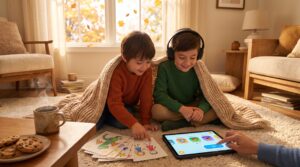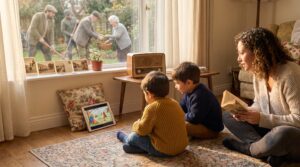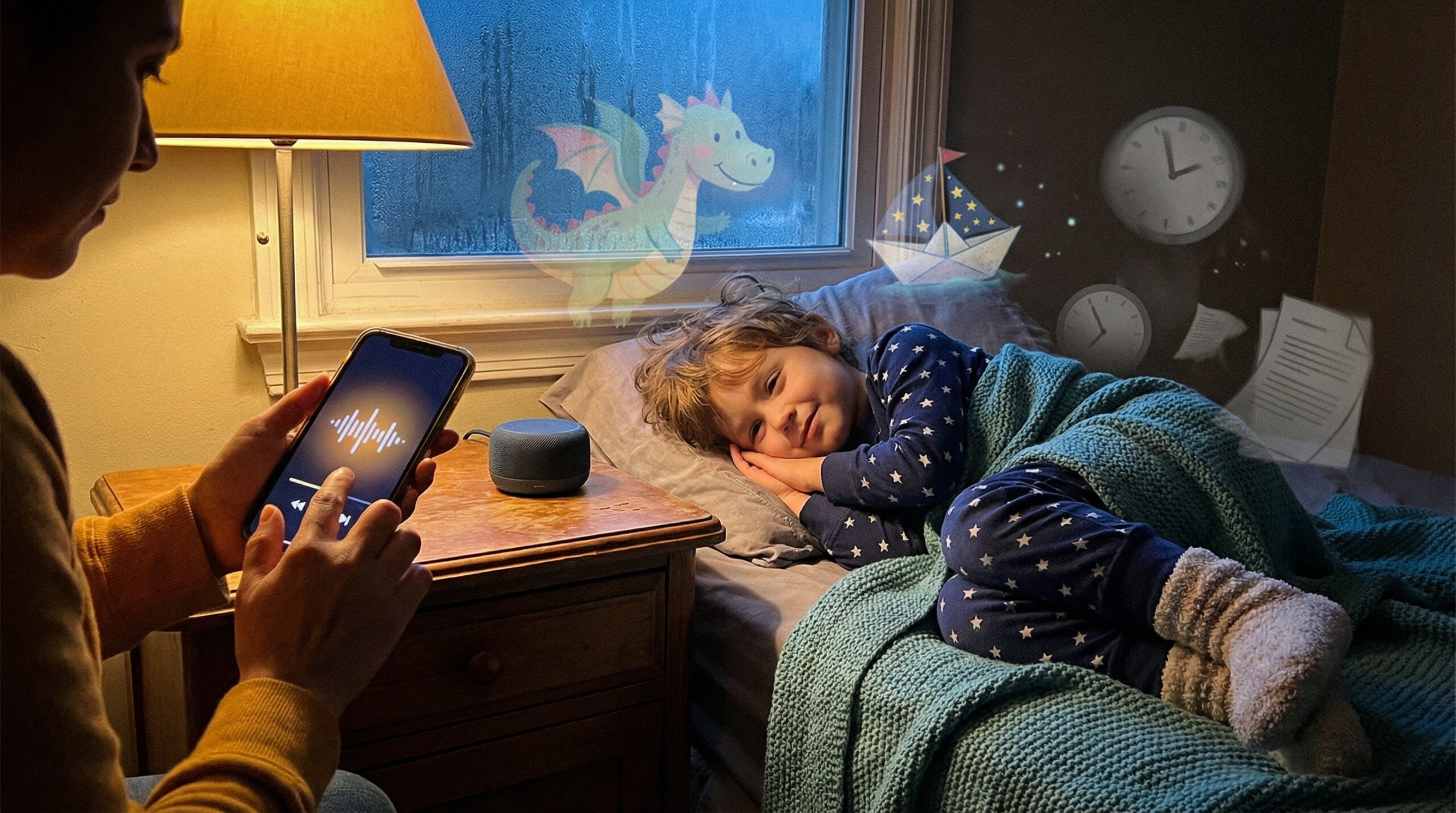
I switched to audio-first stories for kids on chilly evenings. They do two simple, powerful things. They reduce the brain’s busywork and invite rich imagination. The room quiets. Attention settles. A child builds a scene from words.
Why audio-first stories for kids work
First, audio removes visual clutter. This frees working memory to follow plot and feeling. Next, listening asks the child to create images inside their mind. Also, spoken language supports vocabulary and listening skills in real time. Research from a 2024 study demonstrated that EEG-based cognitive load estimation achieved a peak F1-score of 0.98 when assessing psychoacoustic parameters, indicating a strong correlation between audio characteristics and cognitive load.
Three quick reasons it helps
- Less to process: audio cuts visual noise so memory can focus.
- Imagery inside the child: listening invites the brain to paint scenes.
- Language in motion: concentrated speech boosts vocabulary faster than scanning text.
How audio lowers cognitive load
Cognitive Load Theory groups mental effort into three parts. Visual media often adds extraneous load through images and motion. In contrast, audio-only reduces that noise. Therefore listeners can use more capacity for comprehension. A 2024 experimental study found that removing sound from subtitled videos significantly increased self-reported cognitive load, illustrating how audio can reduce cognitive load and reinforcing the benefits of audio-first approaches.
Dual Coding Theory shows that minds handle verbal and visual codes differently. By prioritizing spoken word, audio-first stories for kids encourage internal imagery. The modality effect also suggests auditory presentation helps process complex ideas more comfortably. A 2024 fNIRS study found that speaker–listener neural coupling correlated with semantic features of speech, demonstrating that high-level properties of spoken narratives track inter-brain coupling associated with comprehension.
Neuroscience finds speaker-listener neural coupling during narrative listening. In other words, brains sync during shared attention. This sync links to stronger comprehension and memory. Research on early language exposure also connects rich spoken input to larger vocabularies and reading readiness.
Bedtime, routine, and imagination
At bedtime, audio-first stories for kids often calm the household. Short, predictable episodes lower sensory stimulation. They also support a steady routine and help children settle. Across cultures, oral storytelling has been central to learning and play. A 2025 Scientific Reports experiment showed that participants who listened to short instrumental soundtracks reported detailed imagined movie-scene properties, demonstrating that audition alone can reliably evoke rich, structured mental imagery.
Studies show listening can activate visual and sensorimotor brain areas. Thus an audio story often sparks similar mental imagery as watching a scene. Yet it does so with less cognitive friction and fewer distractions.
Practical limits and accessibility
Audio is not a cure-all. Fast narration or noisy backgrounds can still overwhelm young listeners. Nor does audio replace visual literacy practice with books. However audio-first stories for kids offer important access benefits.
Narrated content supports children with dyslexia, visual impairment, or limited reading ability. It also helps second language learners hear natural speech rhythm. In short, audio opens inclusive learning pathways. Podcast/audio adoption is large and growing; Edison Research’s The Infinite Dial 2025 reports that 55% of Americans age 12+ are monthly podcast consumers and 70% have ever listened to a podcast, illustrating the increasing popularity of audio formats.
Where to find gentle audio-first stories
For a gentle start, browse short episodes on Storypie. You can explore calm, age-appropriate stories that encourage imagination. Try a quiet, 20-minute episode and notice how attention and mood shift.
Storypie features narrated episodes made for kids and families. Visit Storypie to see episode choices and quietly stack small imaginative wins.
Note: Listening matters. Audio-first stories for kids lower cognitive load and widen imaginative space. They are a small, powerful way to shape calm, creative evenings.