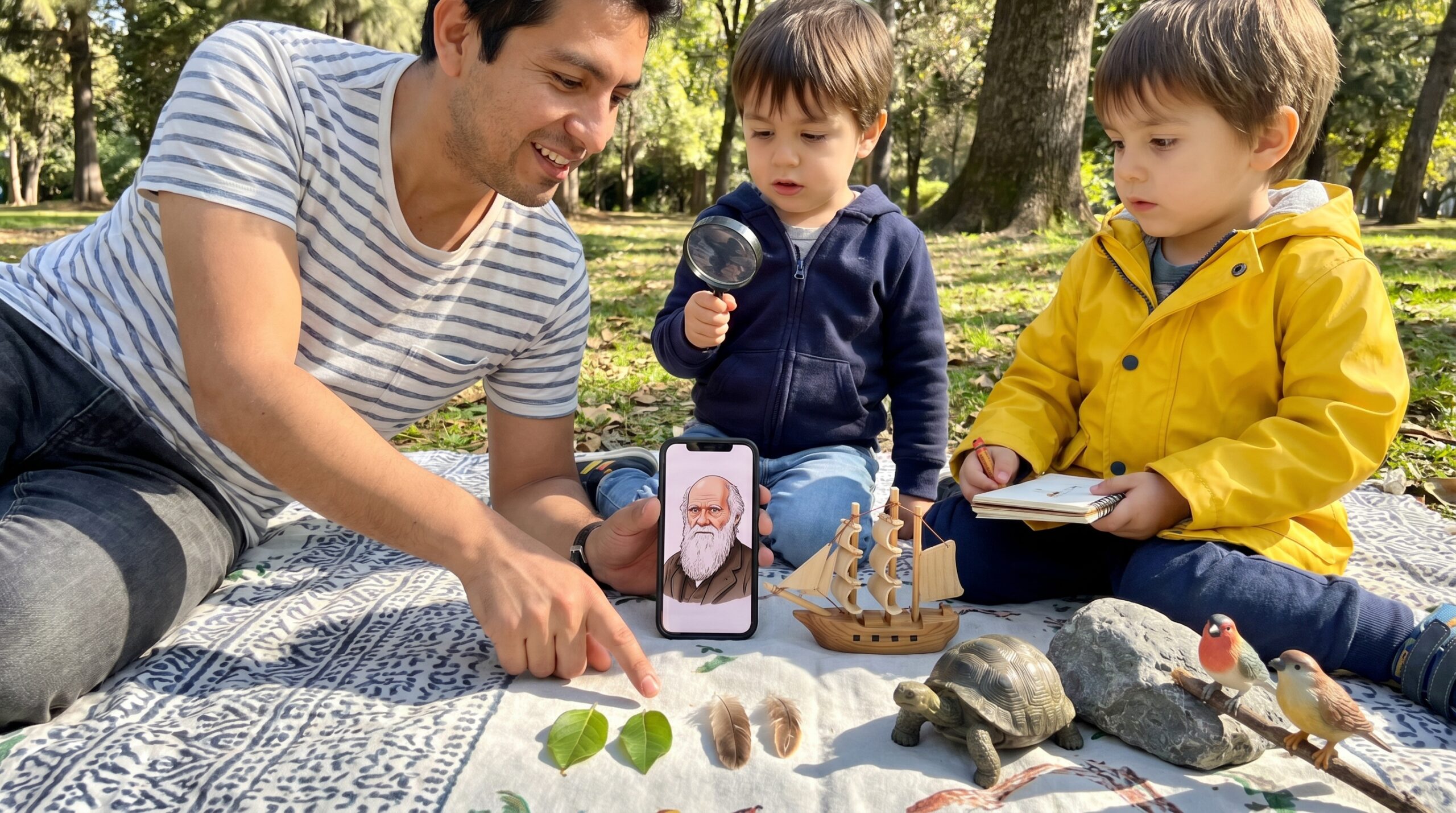
Charles Darwin biography for kids opens a warm, small-window story of curiosity. From the start he loved nature and tiny clues. Also, he kept pockets full of shells and notes, just like a playful detective.
Early life and curious pockets
Charles Robert Darwin was born on February 12, 1809, in Shrewsbury, England, and he lived a rich life until he passed away on April 19, 1882, at the age of 73. He studied at Edinburgh and at Christ’s College, Cambridge. He loved collecting things. I imagine him with pockets full of shells and small treasures. Then he married Emma Wedgwood in 1839 and they raised ten children together.
The Beagle voyage and Galápagos clues
In 1831 he sailed on HMS Beagle as the ship’s naturalist. The trip lasted until 1836, during which Darwin spent approximately 1,200 days on land conducting research and 500 days at sea. He took careful notes on beaches and mountains. He also sent birds, shells and rocks back to England. Later experts like John Gould helped name the birds. The Galápagos islands gave him surprising clues that made him think differently.
Ideas, experiments, and the spark of natural selection
After the voyage, Darwin kept notebooks. He tested ideas and read Lyell on slow geological change. He also read Malthus on population limits. Then he saw a simple rule. Life shows many small differences. Some differences help animals survive and have more young. Those useful traits spread and become common. This idea is natural selection. Say it simply to kids: some animals are born different. If a difference helps, it spreads. Over time new kinds of animals can appear.
Darwin collected many kinds of evidence. Fossils show change over time. Biogeography shows similar animals in different places. Comparative anatomy and embryos show shared plans. Breeders showed how selection changes pigeons and plants. He did tiny detective work. For example, he studied barnacles for years and ran plant experiments. Then he published On the Origin of Species on November 24, 1859, with the first printing consisting of 1,250 copies, and The Descent of Man in 1871. In 1858 Alfred Russel Wallace sent a similar idea and they shared a first presentation.
Life, legacy, and places to visit
His life mixed the ordinary with the heroic. He suffered poor health after the Beagle, but he remained social and curious. He wrote letters to many scientists, and in fact, the Darwin Correspondence Project completed its 30-volume print edition in 2023, containing over 15,000 letters, with about 9,000 held in Cambridge University Library’s Darwin Archive. He was elected Fellow of the Royal Society in 1839. Finally, he was buried in Westminster Abbey in 1882. Schools now mark February 12 as Darwin Day.
You can visit Down House in Kent and the Darwin Centre at the Natural History Museum in London to see his study and specimens. Also, Storypie offers friendly biographies for families.
Read or listen to a story about Charles Darwin now: Read or listen to a story about Charles Darwin now: For 3-5 year olds, For 6-8 year olds, For 8-10 year olds, and For 10-12 year olds.
A tiny activity to try
Be a little detective. Pick one leaf and look for two small differences. Count five minutes. Then tell one short sentence about what you saw. Or compare bird beaks in the park. Sketch two shells that look almost the same and note one small way they differ. Simple curiosity goes far.
Also, explore more stories at Storypie for gentle, curious learning about scientists and history.