
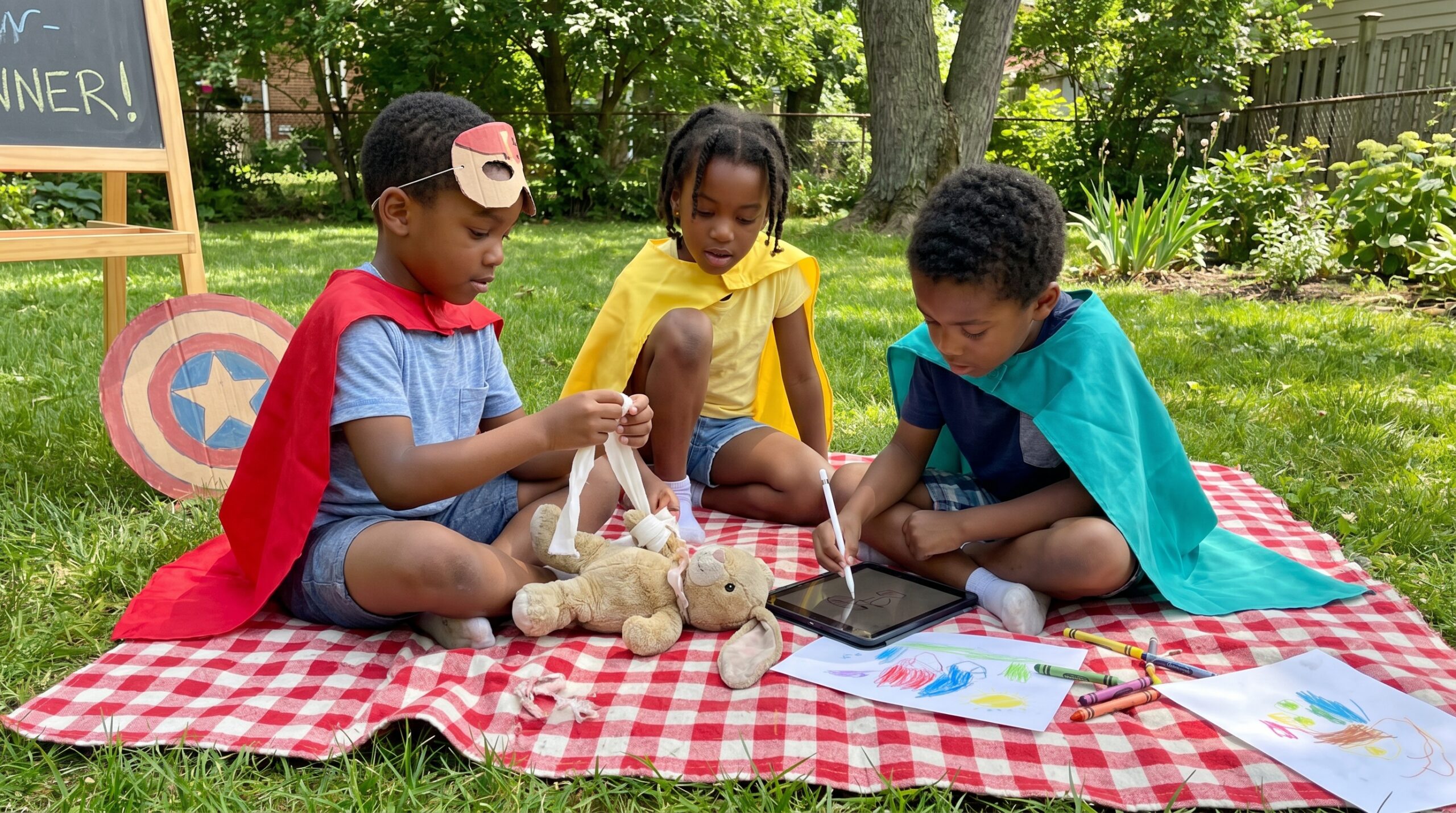
Try a create your own hero weekend challenge with your family. This short project sparks imagination, kindness, and confidence in children. Research published in 2023 indicates that children who use gadgets with siblings or peers have significantly higher imagination flexibility scores than those who play alone or with an adult, making collaborative play essential for this challenge.
What the challenge is
First, the challenge asks children to invent a hero in one afternoon or two short sessions. It focuses on who the hero is, what they do, and one kind thing they would do for someone else. Also, that empathy prompt builds perspective taking in a tiny, mighty way. A 2025 study found that 98% of 5-year-old children scored in the highly creative range on a creativity test, compared to only 2% in adulthood, highlighting the natural creativity in young children and reinforcing the importance of imaginative play in their development.
Why the create your own hero weekend challenge matters
Making heroes is an ancient human habit. From myths to comics, heroes help us name values. In addition, pretend play supports language, symbolic thinking, and social insight. When an adult supports the play, benefits grow. For example, a large-scale school study published in Acta Psychologica found that a pretend-play based training for 5–6-year-olds produced statistically significant improvements in emotion comprehension and a decrease in aggressive behavioral responses. This shows that imaginative play can foster emotional skills and reduce aggression in children. Kids use richer vocabulary, solve problems with creativity, and choose kinder actions.
Core choices that shape each hero
Next, children make five simple choices. These choices give a hero personality and rules.
- Appearance: hair, clothing, and distinctive marks.
- Abilities: a superpower or a helpful everyday skill.
- Values and mission: what the hero stands for.
- Limits: weaknesses or rules that keep stories interesting.
- Tools: gadgets, pets, or a trusty cape.
Age friendly examples
For preschoolers ages 3 to 5, focus on one helping act. For example, “Anna the Raincoat Hero shares umbrellas.” Keep text and drawing simple.
For early school kids ages 6 to 8, add a power and a short backstory. For example, “Leo can calm storms because he once helped a lost kitten.” Draw and label parts.
For middle childhood ages 9 to 12, explore motivation and a gadget. For example, “Maya uses a solar backpack to rescue people and must recharge it.” Try a mini comic or map.
For teens ages 13 plus, tackle ethical choices and cultural roots. For example, “Sam wrestles with fame and chooses community over glory.” Invite a short scene or monologue.
Weekend structure and materials
Then, pick one 60 to 90 minute session, or two 30 to 45 minute sessions. Bring paper, crayons, recycled bits, fabric, and a camera for role play. Also, the child should lead creation while the caregiver prompts and records. For digital capture, save recordings with Storypie to keep and revisit your tales.
Build empathy and inclusivity
Ask one simple question: “What one kind thing would your hero do today?” That prompt asks children to imagine another person. As a result, moral reasoning grows through play. A June 2023 Scientific Reports article found that lifetime exposure to narrative fiction correlates with self-reported empathy and performance on theory-of-mind tasks, illustrating how storytelling and imaginative play can enhance empathy, a key component of the hero creation challenge. Also, invite diverse bodies, backgrounds, and abilities. Celebrate everyday heroes like nurses or neighbors. Finally, avoid stereotypes and ask children where their ideas come from.
Safety, privacy, and sharing tips
Supervise scissors and hot glue. Also, do not use full names in filenames. Turn off location tagging before you photograph costumes. If you share images, get permission and blur faces or crop to remove identifiers. Consider private groups rather than public posts. For safe family sharing, get the app at Storypie and review privacy settings.
Celebrate and reinforce
End with a hero showcase on the fridge, a quick recorded skit, or a postcard sent to a relative. Praise specifics. For example, say, “I love how your hero helps their neighbor.” Clap loudly for brave choices. Give each hero a name and a silly catchphrase. Make it memorable and joyful.
Finally, this create your own hero weekend challenge helps imagination soar and kindness take root. A 2025 meta-analysis revealed that adult-guided play significantly enhances creative outcomes in children, underscoring the importance of adult involvement in imaginative activities. Try it this weekend and watch small ideas become mighty stories.