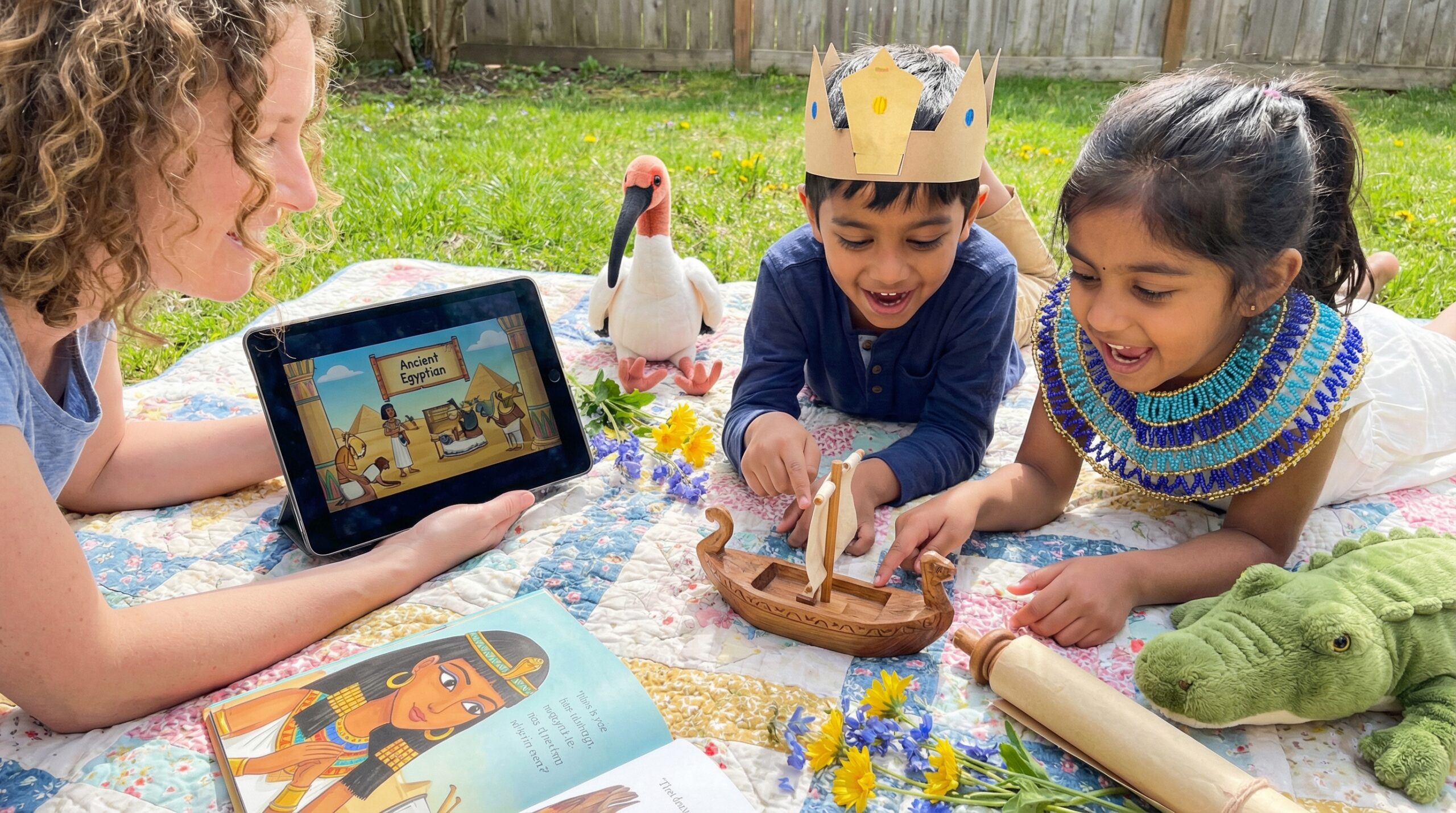
Cleopatra VII for kids is a neat way to meet one of history’s boldest rulers. I love telling children about her clever mind and curious spirit. Also, her story fits a quick after-school spark.
Cleopatra VII for kids: Who was she?
Cleopatra VII Philopator was born around 69 BCE and died on August 30, 30 BCE at the age of 39. She reigned for 21 years, from about 51 BCE until her death in 30 BCE, making her a significant figure in ancient history. In fact, she came from the Ptolemaic dynasty, a Greek royal family set up after Alexander the Great. However, Egypt was her home and heart.
She ruled with her brothers at first. Then she became the sole power in Alexandria. People remember her as a ruler and a smart communicator.
Language, image, and leadership
Cleopatra spoke Greek, and she also spoke Egyptian, making her the first member of her dynasty to learn the Egyptian language in addition to her native Greek. Ancient writers say she learned several languages. For example, she used language to reach people across Egypt and the Mediterranean. She presented herself as the living Isis, which helped Egyptians accept her as pharaoh.
She used religion, language, and image with care. Also, coins and Egyptian reliefs show how she shaped her public image. Archaeological work at the temple site of Taposiris Magna has recovered more than 300 coins bearing Cleopatra’s image and over 2,600 objects dating to her rule (51–30 BCE). Modern historians study these pieces to see her real choices, not just Roman stories.
Alliances and the Roman world
Cleopatra acted as a skilled diplomat. She made alliances with two powerful Romans to protect Egypt. First, Julius Caesar supported her during a civil war in Alexandria in 48 to 47 BCE. They had a son, Ptolemy XV Philopator Philometor Caesar, known as Caesarion.
Later, she joined forces with Mark Antony. Antony and Cleopatra worked together across the eastern Mediterranean. In 34 BCE Antony granted lands to their children, Alexander Helios, Cleopatra Selene II, and Ptolemy Philadelphus, in the Donation of Alexandria. That move worried Roman leaders.
The turning point came at the naval Battle of Actium in 31 BCE. Octavian defeated Antony and Cleopatra there. After they retreated to Egypt, both leaders died in 30 BCE. Consequently, Egypt became a Roman province. Many call Cleopatra the last pharaoh because the Ptolemaic line ended with her.
Stories, sources, and curious facts
Much of what we read comes from Roman historians. They often disliked Cleopatra and painted her as a temptress to weaken her politics. However, coins, inscriptions, and Egyptian art offer a different view. These sources show a ruler who knew how to lead and how to be seen.
- Fun fact: Cleopatra likely spoke many languages and loved learning.
- Fun fact: She used images of gods to connect with Egyptian beliefs.
- Fun fact: Her exact tomb remains a mystery today, like a real-life treasure hunt.
Try a tiny ten-minute activity: pick one short sentence Cleopatra might have said. Say it in a different voice. Then draw one symbol she might use on a coin. Talk about what that symbol says about power. These short exercises build curiosity and brave thinking.
Read or listen to a story about Cleopatra VII now: For 3-5 year olds, For 3-5 year olds, For 6-8 year olds, For 8-10 year olds, and For 10-12 year olds.
Also, visit Storypie for more kid-friendly biographies and gentle listening sessions. Enjoy exploring Cleopatra’s life with curious children.