
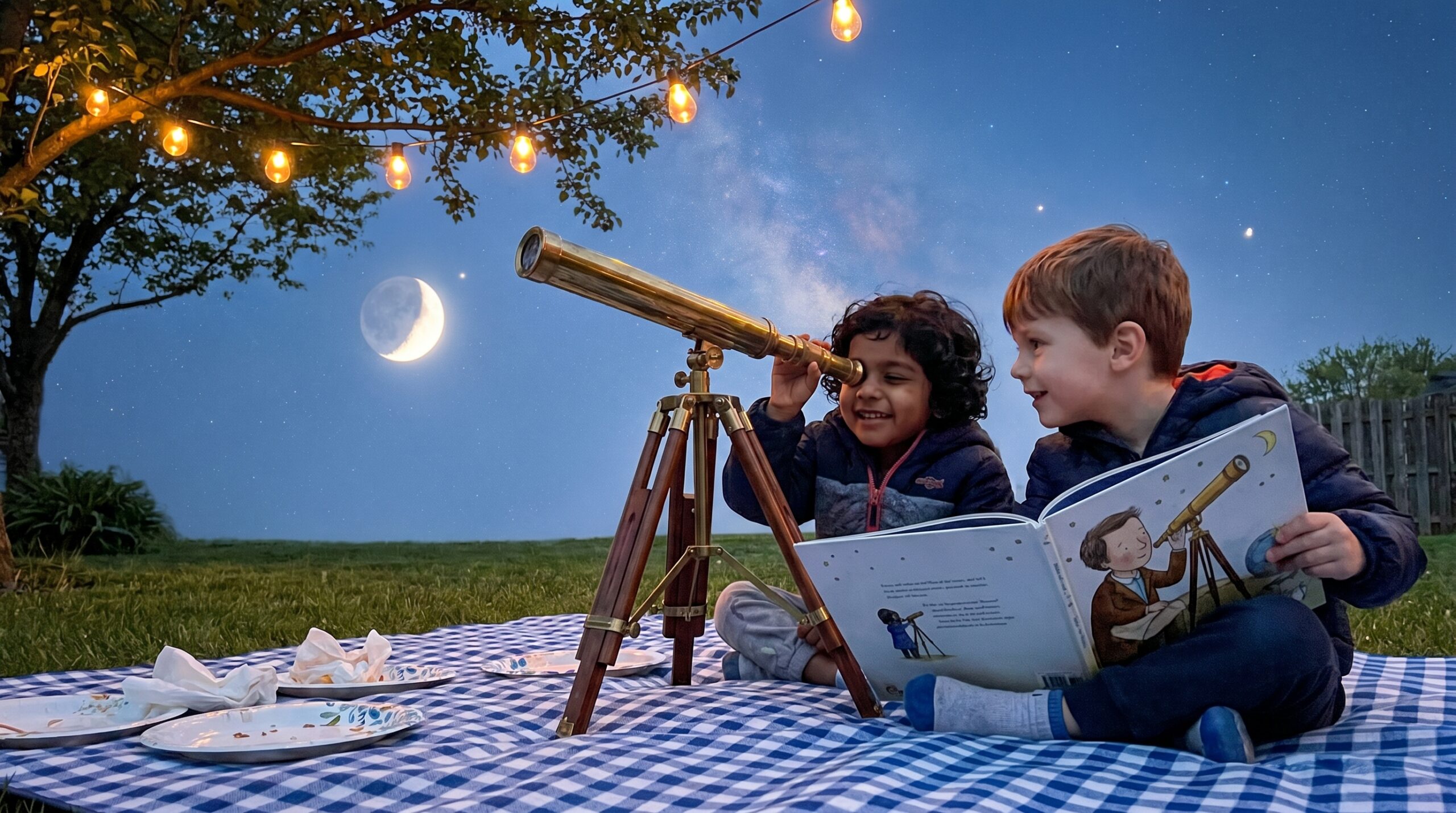
Telescope for families is a small, tactile invitation to wonder. It gathers light and makes distant things look brighter and larger. In fact, the global telescope market was valued at $2.8 billion in 2023 and is projected to reach $5.2 billion by 2030, reflecting a growing interest in astronomy among families.
What is a telescope for families?
A telescope uses lenses or mirrors to focus faint photons into an image your eye can read. Think simple optics: gather light, form an image, then magnify with an eyepiece. In short, it is tiny magic for curious kids and grownups.
Quick history and why it matters
First, Hans Lippershey applied for a patent in 1608. Then, Galileo built an improved perspicillum. In 1610 he described the Moon’s mountains and Jupiter’s moons in Sidereus Nuncius. Later, Isaac Newton solved color problems with a reflecting mirror design. Today, space telescopes such as Hubble and James Webb show skies above Earth’s blur. Notably, NASA’s James Webb Space Telescope recently identified methane and water vapor in the atmosphere of an exoplanet, showcasing the cutting-edge discoveries made possible by modern telescopes.
Types, aperture, and what those numbers mean
Refractors use a front lens. Reflectors use a primary mirror. Catadioptric designs combine lenses and mirrors. Aperture is the single most important number. It is the diameter of the main lens or mirror. Thus aperture controls light gathering and resolution. Light gathering scales with area. For example, a 200 millimeter mirror gathers about four times the light of a 100 millimeter mirror.
Magnification and mounts
Magnification equals telescope focal length divided by eyepiece focal length. However, high magnification does not fix a small aperture or poor seeing. For families, balance aperture, mount, and portability. For quick joy, choose a 70 to 90 millimeter refractor. Alternatively, try a 114 millimeter reflector on an alt az mount. If you want tracking or photography, consider an equatorial or a GoTo system.
What you can see with a family telescope
The Moon is dramatic. Craters, mountains, and shadows appear in clear detail. Jupiter shows cloud bands and its four big moons. Saturn displays rings. Mars can hint at surface features when it is near. Bright star clusters and nebulae are possible with small scopes. Yet faint galaxies need larger apertures and dark skies. The vast amount of data collected by telescopes is impressive; as of 2025, the Mikulski Archive for Space Telescopes (MAST) surpassed 1 billion files, highlighting the importance of telescopes in advancing our understanding of the universe.
Choosing and using a first telescope
Binoculars make a friendly first tool. They are portable and wide field. Also, they suit quick, playful sessions. Keep sessions short and playful. Try a 10 minute backyard stargazing break after dinner and ask, “what do you see?” Let eyes adapt to the dark for 20 to 30 minutes. Use a red flashlight. Bring a warm drink. Above all, safety matters.
- Never look at the Sun through unfiltered optics.
- Use proper solar filters or attend supervised viewing.
- Keep optics covered and avoid touching coatings.
- Collimate reflector mirrors occasionally for best performance.
Family-friendly telescope picks
For ease and smiles, try these simple choices:
- 70–90 mm refractor on a simple alt az mount for quick setup.
- 114 mm reflector for extra light gathering on a budget.
- Binoculars for wide views and fast sessions.
Join a local astronomy club or attend a star party to try different scopes. Share small discoveries with children and let curiosity lead the evening. A short session can create a lifelong love of the sky, perhaps tonight. Moreover, the Vera C. Rubin Observatory, which began operations in early 2026, issued 800,000 astronomy alerts in a single night, showcasing the advanced capabilities of modern telescopes.
Read or listen to a story about Telescope now: Read or listen to a story about Telescope now: For 3-5 year olds, For 6-8 year olds, For 8-10 year olds, and For 10-12 year olds.
Finally, if you want more stories and activities, visit Storypie and explore our collection. Enjoy the sky together.