Congo Rainforest for kids opens a door to tall trees, noisy rivers, and a chorus of frogs. Read about the forest and share wonder with your child today.
Read or listen to a story about Congo Rainforest now: For 3-5 year olds, For 6-8 year olds, For 8-10 year olds, and For 10-12 year olds.
Where the Congo Rainforest sits
The Congo Basin covers millions of square kilometers in central Africa. It spans the Democratic Republic of the Congo and the Republic of the Congo. Also, it reaches into Cameroon, Gabon, the Central African Republic, and Equatorial Guinea. In fact, the Congo Basin rainforest spans approximately 3.7 million square kilometers, an area larger than India, and serves as a critical biodiversity hotspot supporting 75 million people and tens of thousands of plant and animal species.
The Congo Rainforest for kids shows this great green place as lively and huge. Because it is vast, the forest hosts many kinds of life. Families often feel small and amazed in its shade.
Layers and weather in the Congo Rainforest
The forest grows in distinct layers. Tall emergent trees poke into the sky. A shady canopy hosts many birds and monkeys. Under that, the understory holds smaller trees and twisting vines. Finally, damp soil covers the forest floor with leaves and tiny life.
Rainfall stays high all year. Many places get more than 1500 millimeters a year. Warm air and steady rain keep the forest buzzing with life.
Amazing animals and plants
This rainforest is full of incredible animals. Children love hearing about gorillas, bonobos, okapi, and playful chimpanzees. Forest elephants walk slowly and help seeds travel. Colorful hornbills and tiny frogs add sound and color. Between 2013 and 2023, researchers documented 742 new species of plants and animals in the Congo Basin, according to WWF’s 2024 report. Also, scientists still find new species here. Therefore, the Congo remains one of the most exciting places on Earth.
Rivers, peatlands, and the global climate
The Congo River moves like a giant ribbon through the basin. It waters floodplain forests and supports local fish. In many spots, wet peat soils store huge amounts of carbon. The Congo Basin contains the world’s largest tropical peatland complex, covering about 167,600 square kilometers and storing approximately 30 gigatons of carbon, equivalent to two years of global greenhouse gas emissions. Because of that, the Congo Rainforest helps regulate our climate and local weather.
People, history, and caring for the forest
Millions of people live in and near the forest. Indigenous groups such as the Aka, Baka, and Mbuti keep deep forest knowledge. Colonial eras changed lives here. Today people balance development with protecting the land. However, in 2024, the Democratic Republic of Congo (DRC) lost approximately 590,000 hectares (1.5 million acres) of pristine rainforest, marking the highest annual forest loss on record. Modern threats include farming, logging, mining, and hunting. However, parks like Salonga and community forest programs offer hope. Many families and leaders work to protect the forest for future children.
Simple, child-friendly ways to explore
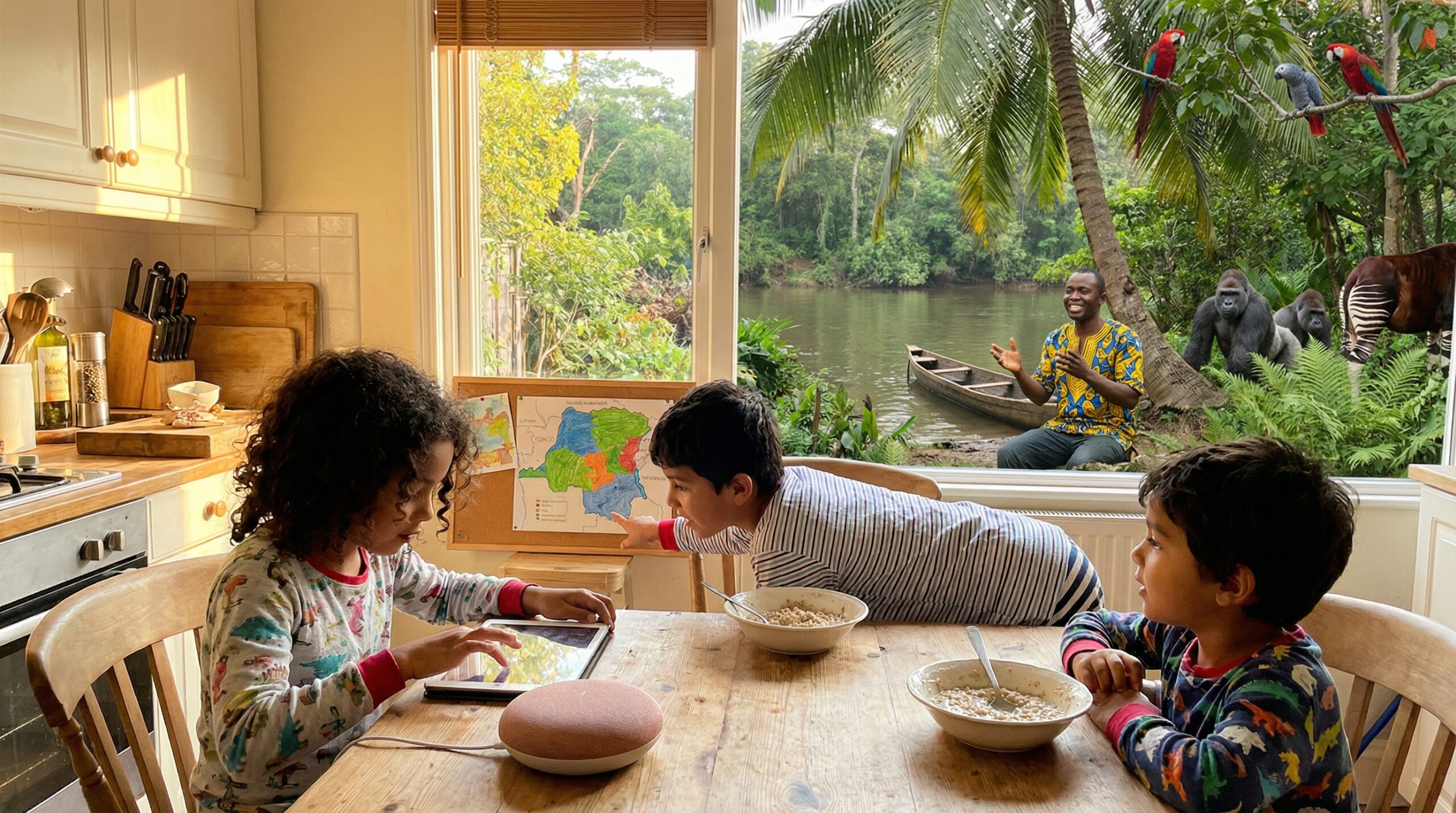
- Map time: Trace the Congo River and color the basin.
- Animal cards: Make matching fact cards about gorillas and okapi.
- Rainforest in a jar: Build a tiny terrarium to feel the humidity.
- Listen and imagine: Play a short audio story at breakfast to spark curiosity.
Try this playful prompt with your child. Say “Congo Rainforest for kids” aloud, close eyes, and sketch the sounds you hear together.
Final thought
Keep explanations gentle and hopeful. Focus on wonder, like tall trees and tiny beetles. Also, try simple actions: learn more, choose sustainable products, and support trusted conservation efforts. In 2024, the Congo Basin lost an estimated 780,000 hectares of primary forest—about 0.44% of the basin’s primary-forest area—an increase from 0.38% in 2023.
Explore more with Storypie for cozy, heartwarming stories about the Congo Rainforest. Explore more with Storypie.