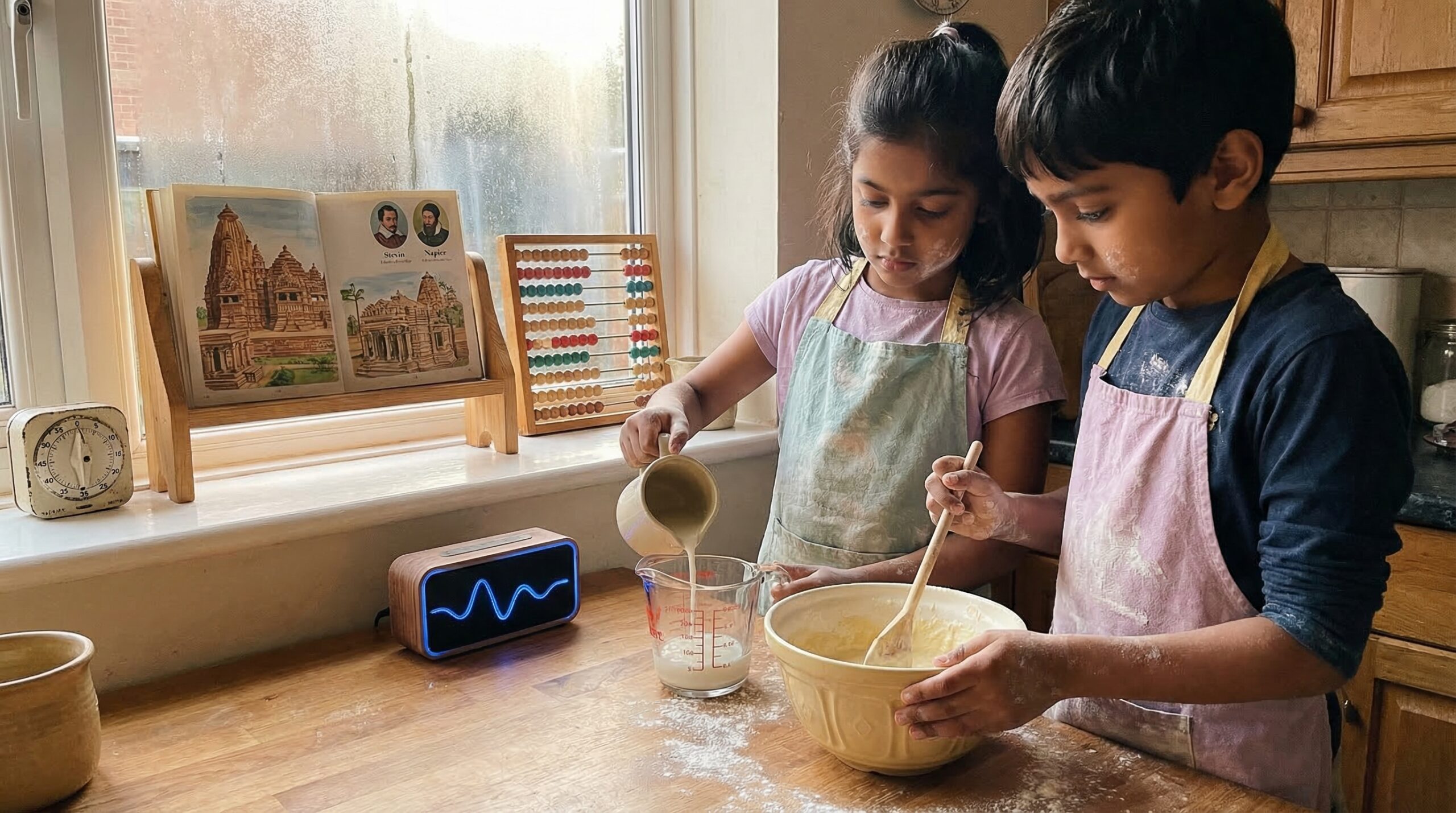
I love the small bright moments when math stops being a rule and becomes a tiny miracle. Decimal for kids appears in those moments. I often steal ten minutes during baking to show a child how 0.5 cup looks and feels. That five seconds of measuring becomes a joyful memory.
Read or listen to a story about Decimal now: For 3-5 year olds, For 3-5 year olds, For 6-8 year olds, For 8-10 year olds, and For 10-12 year olds.
What a decimal is – Decimal for kids
Decimals are place value numbers based on ten. In fact, the decimal numeral system, also known as the base-ten positional numeral system, is the global standard for denoting integer and non-integer numbers. Digits left of the decimal point are whole numbers. Digits right of the point show parts of a whole. For example, tenths are one tenth, hundredths are one hundredth, and thousandths are one thousandth. So 0.5 means five tenths or one half. Also, 0.25 means twenty five hundredths or one quarter.
Some fractions create repeating decimals. For example, 1/3 equals 0.333…. A fun fact children enjoy is that 0.999… equals 1. It looks odd, but it is true. The decimal system allows for the representation of both terminating and repeating decimals, enabling precise representation of rational numbers.
History in a tiny timeline
The ideas behind decimals began in ancient India with place value and a zero symbol. Then the concept traveled through the medieval Islamic and Persian world. Mathematicians there refined decimal fractions. In 1585, Simon Stevin published ‘De Thiende,’ which introduced decimal fractions to European mathematics, advocating for their widespread use. John Napier and other early modern thinkers made calculation easier. Finally, these ideas reached your kitchen table.
Notation and everyday life
English uses a decimal point. Many countries use a decimal comma. That matters when your family reads books in more than one language. The decimal system uses ten digits (0 through 9) and a decimal separator (dot or comma) to represent numbers. Decimals are everywhere. For instance, money uses two places for cents. Metric units scale by tens. Science records precision with decimal places.
In computing, surprises sometimes happen. Many machines use binary floating point. Because of this, 0.1 + 0.2 can show as 0.30000000000000004 on some calculators. That result is a quirk of storage, not bad math.
Quick hands-on ideas – short and sweet
Try one of these ten to twenty minute moments. They turn decimal for kids into joyful practice.
- Baking trick: let your child measure 0.5 cup. I measure and they beam.
- Coin game: line up ten pennies to show tenths. Then group by hundreds for hundredths.
- Meter stick split: mark a meter stick into tenths. Show decimeters and centimeters.
Common parent questions
Q: How do I round safely? A: Look at the next digit. Five and up rounds up. In cooking a small rounding is fine. However, in medicine or building use exact tools and follow required significant figures.
Q: Why do some decimals repeat? A: Rational numbers either terminate or repeat in base ten. That explains repeating patterns like 0.333….
Glossary and quick terms
- Decimal point: the symbol separating whole numbers from fractions.
- Place value: the value of digits based on position.
- Terminating decimal: a decimal that ends, like 0.75.
- Repeating decimal: a decimal that cycles, like 0.333…
- Rounding: simplifying a number to a nearby value.
Try this tonight
Pick one quick measure. Then tell a two line story in an I voice. Finally, let your child do the pouring. That turns a number into a moment. Above all, it helps decimal for kids feel friendly.
Get the Storypie app to listen anytime.