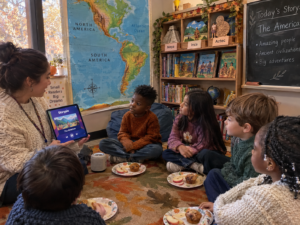

Education through storytelling ages 3-12 explains why tales capture attention, memory, and feeling in young children. For parents and teachers, this idea matters because stories help ideas land and stick. A recent national survey shows that 59.7% of U.S. children ages 0–5 had a family member read, sing, or tell stories to them every day during the past week, emphasizing the prevalence and importance of storytelling in early childhood.
Why narrative fits the mind
Stories match how memory organizes events. First, the brain stores sequences and contexts more easily than isolated facts. Then, emotion helps lock memories in place. In short, narrative links cause, agent, and motive so complex ideas feel sensible. Research indicates that in controlled experiments, participants recalled information from stories 61.61% of the time compared to only 28.70% for statistics, highlighting the effectiveness of storytelling for memory retention according to a recent study.
Brain mechanics made simple
The hippocampus remembers sequences. Also, the amygdala strengthens memories when feeling appears. Researchers such as Jerome Bruner described a narrative mode of thought that sits naturally with human memory. As a result, children recall stories more reliably than disconnected facts. A 2025 meta-analysis of 25 interactive-reading experiments found an overall moderate positive effect of interactive/shared reading on children’s narrative ability, with the largest effect for 4–5-year-olds, further underscoring the value of storytelling in early education.
Developmental stages and storytelling
Education through storytelling ages 3-12 maps onto predictable growth. Young children move from simple plots to nuance across these years. This progression makes narrative a flexible tool across childhood.
Typical patterns look like this:
- Ages 3 to 4 enjoy simple sequences and repeated phrases.
- Ages 5 to 7 form clear beginnings, middles, and ends.
- Ages 8 to 10 follow subplots and make inferences.
- Ages 11 to 12 notice multiple perspectives and moral nuance.
Language and literacy benefits
Repeated stories build vocabulary, grammar, and listening skills. Also, narrative exposure predicts stronger reading outcomes later on. For many children, hearing the same story forms mental patterns that support reading comprehension. A longitudinal study published in May 2024 found that storytelling connectedness in children ages 5–8 predicted phonological awareness and reading comprehension measured 3–4 months later, demonstrating the long-term benefits of storytelling on literacy skills.
Social learning, history, and cultural roots
Stories teach social rules and emotional recognition through character choices. Historically, communities used tales to pass on survival skills, values, and identity. Today, modern platforms continue that long tradition. Research shows that storytelling contributes 68.2% to the improvement of early childhood empathy skills, especially at the age of 5–6 years, illustrating its role in fostering essential social-emotional development.
Because narratives show characters making choices, children practice perspective taking in safe, concrete ways. Moreover, plots embed moral questions that invite thinking about consequences and fairness.
What makes this approach lasting
Education through storytelling ages 3-12 lasts because it combines sequence, feeling, and meaning. Retrieval practice also helps. For example, when children retell events, they strengthen long-term recall. Studies on the testing effect show that retrieval makes memory more durable.
Finally, narrative scales with age. It starts simple and grows richer. As children mature, stories can hold more detail and more emotions. This makes storytelling one of the most adaptable learning pathways.
Storypie and the storytelling tradition
Storypie is a modern storytelling platform built for families and classrooms. The app collects recorded tales, family memories, and read-alouds in one place. Also, Storypie focuses on clear audio, simple sharing, and child-friendly navigation.
Founded to keep stories alive in busy lives, Storypie brings practical features that reflect the long tradition of narrative learning. For teachers and parents who value story-based learning, Storypie offers a cozy, reliable home for stories. Try Storypie to keep your favorite tales close: Get the app.
In short, education through storytelling ages 3-12 works because it follows how children think and grow. Stories organize facts into sequence, tug at feeling, and invite practice. Above all, they help kids remember, understand, and connect.