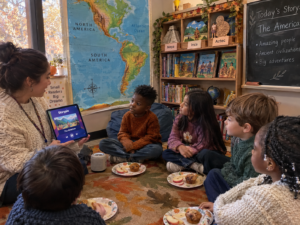

Education through storytelling ages 3-12 makes ideas memorable and meaningful. Stories catch attention, spark imagination, and make learning stick. In short, narrative helps kids remember more and care more.
Why stories stick
Stories provide a clear scaffold for learning. A hero has a goal, a problem appears, and a solution follows. As a result, children chunk events into tidy, memorable units.
Moreover, research shows narrative transportation boosts focus and persuasion. Brain studies show stories light up language, memory, and social thinking centers. Therefore, a child inside a story learns more with less effort.
Age-specific wins: preschool to upper primary
Education through storytelling ages 3-12 supports different skills at different stages. Each stage gains unique benefits from narrative.
- Preschool (3-5): Big gains in vocabulary and joint attention. Short stories help children sequence two to four events and practice retelling.
- Early primary (6-8): Better comprehension and inference. Stories connect spoken language to decoding and early reading skills.
- Upper primary (9-12): Complex plots build moral reasoning, critical thinking, and cross-curricular links in history and science.
Language and literacy outcomes
Shared reading and dialogic talk reliably increase vocabulary and richer sentence use. Furthermore, stories introduce rare words in context, so meanings stick faster than rote lists. A 2025 meta-analysis of interactive/shared reading interventions reported a moderate aggregate effect on children’s narrative ability, highlighting the effectiveness of interactive storytelling in enhancing narrative skills, which are crucial for educational development.
Regular narrative exposure also predicts stronger phonological awareness and later reading comprehension. In short, story time now helps with reading later.
Social and emotional learning
Characters model feelings and choices. Thus, hearing many perspectives builds empathy and theory of mind.
Also, predictable story routines support self-regulation. For example, a calm bedtime tale can reduce arousal and help children settle for sleep.
Memory, curriculum fit, and classroom use
Causal chains and emotional hooks aid recall. Children remember plots with clear causes and emotional turns better than isolated facts.
Consequently, narrative works well inside English and early years curricula. Teachers can meet curriculum goals with short, focused stories that remain joyful.
Practical session lengths and routines
Short and steady wins. Ten to fifteen minute stories match attention spans for many three to eight year olds. Additionally, a nightly 10 to 15 minute story boosts vocabulary and calms energy before bed.
For simple help, try Storypie. The Storypie app offers age-appropriate stories and narrated audio that fit routines without replacing adult talk. Visit the Storypie app to explore options.
Equity, digital tools, and the adult role
Access matters. Diverse, relatable narratives increase engagement and identity development. Story programs can help close early language gaps where books or readers are scarce.
Well-designed digital stories can model fluent reading and widen access. However, they work best when they supplement live shared reading and adult conversation. Decades of research in development and education support this approach.
Make it simple
- Start with one vivid line.
- Ask one prediction question.
- Repeat one new word.
- Keep it to 10 to 15 minutes.
Education through storytelling ages 3-12 is low cost and high impact. Short, bright stories build language, memory, empathy, and self-control. So start tonight: tell or play a story and watch the learning stick.