
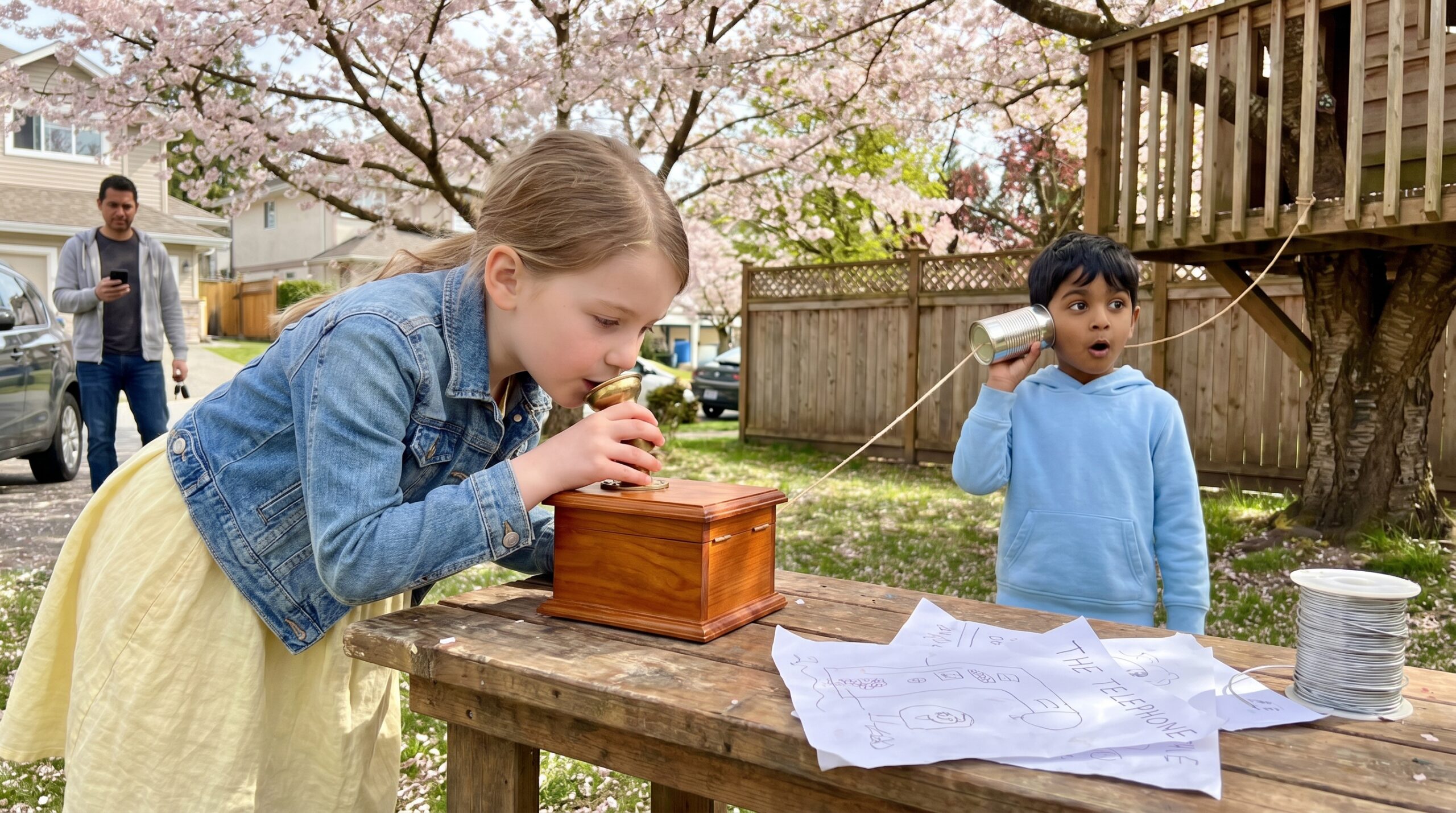
The telephone history for kids begins with a small, brilliant spark. It made the world smaller and family voices closer. Above all, it started with curiosity and a clear sentence that changed communication.
telephone history for kids: The first spark
On March 10, 1876 Alexander Graham Bell spoke to his assistant Thomas Watson. He said, “Mr. Watson, come here I want to see you.” That short sentence became the first clear telephone call we still tell. Bell had filed a patent three days earlier. Then the Bell Telephone Company formed in 1877. Meanwhile other inventors also contributed. Philip Reis had built tone transmitters decades before. Antonio Meucci and Elisha Gray enter the story too. History is messy and human, and it feels delightfully simple with a string phone.
How the telephone works, simply
A telephone changes sound into electricity. First, a microphone senses voice vibrations. Then an electrical signal rides along a wire or through the air. Finally, a receiver turns the signal back into sound. Early phones used diaphragms and carbon transmitters. In short, it was science you could hear.
Timeline and modern change
Key moments help tell the telephone history for kids in quick steps:
- 1876: Bell patent and the first clear call.
- 1877: Bell Telephone Company formed.
- Late 1870s: First exchanges and switchboard operators.
- Mid 1900s: Rotary dials, then touch tone in the 1960s.
- 1973: Martin Cooper placed the first public handheld mobile call.
- 1990s–2000s: VoIP and internet calling appear.
- Today: Tiny supercomputers in our pockets make voice and video easy. In fact, by 2025, 98% of U.S. adults own a cellphone, with 91% owning a smartphone, highlighting the evolution of communication technology.
Why the telephone matters
Phones changed how we get help, share news, and run businesses. For example, emergency numbers like 911 (U.S.) and 999 (U.K.) made rescue faster. Also, phones created jobs, labs, and more inventions. Bell Labs later helped invent the transistor and many other breakthroughs. The impact of telephony is global; by the end of 2023, 5.6 billion people subscribed to a mobile service, representing 69% of the global population, showcasing how connected we all are today.
Try this with kids
Make a cup-and-string phone using two paper cups and tight string. Then speak into one cup while a friend listens on the other. Try a tin can version too. These small experiments make the science visible and surprisingly loud. You will grin.
Three phone rules for families
- Respect quiet hours. Keep calls short near bedtime.
- Teach safety. Use emergency numbers only when needed.
- Privacy matters. Ask before you share someone else on a call.
A tiny human story
Bell taught the deaf and loved sound. His care, curiosity, and a few lucky accidents led to the first call. There are tales of spilled batteries and surprise transmissions. Those stories make history feel like a person, and they invite questions like, “What would you invent?” Today, it’s important to note that about 76.0% of U.S. adults and 86.8% of U.S. children live in wireless-only households, showing how far we’ve come from landline phones.
Read or listen to a story about The Telephone now: Read or listen to a story about The Telephone now: For 3-5 year olds, For 6-8 year olds, For 8-10 year olds, and For 10-12 year olds.
For a gentle listen on a drive home, try Storypie. It offers short stories and friendly facts for families.