
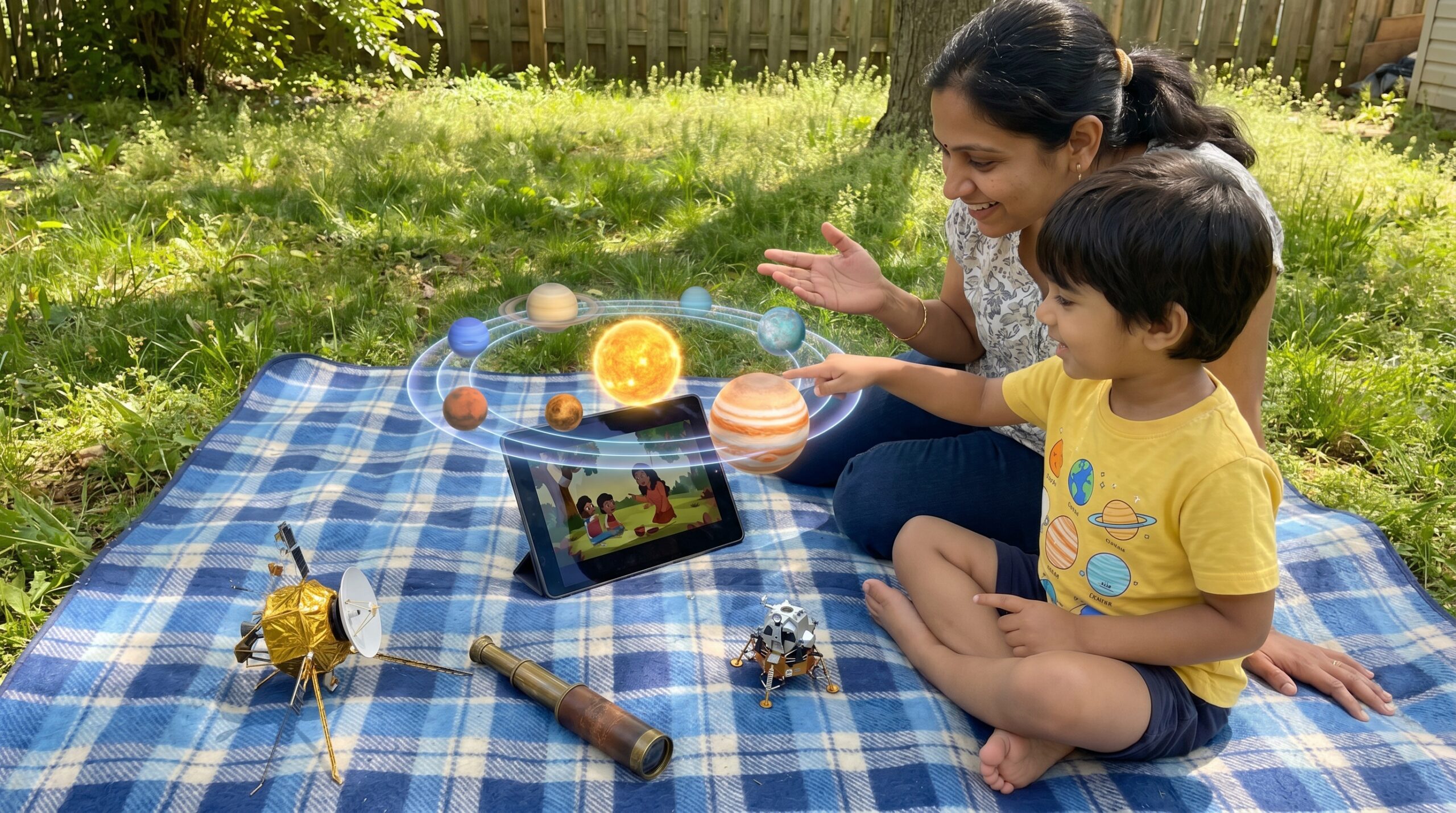
The solar system for kids begins about 4.6 billion years ago with a spinning cloud of gas and dust. According to research published in Nature Geoscience, the Solar System formed 4.5682 billion years ago based on Pb–Pb dating of the oldest meteoritic calcium–aluminum-rich inclusions (CAIs). From that cloud, the Sun and the planets formed. What a delightful origin story to share with curious young minds.
Simple map for curious hands
First, think in two groups. Close to the Sun are four rocky planets: Mercury, Venus, Earth, and Mars. Did you know that Venus is the hottest planet in our Solar System, with an average surface temperature of 464°C (867°F)? This fact can spark children’s curiosity about planetary conditions. Next, farther out, are four giants: Jupiter and Saturn, the gas giants, and Uranus and Neptune, the ice giants. A fun mnemonic helps: My Very Educated Mother Just Served Us Noodles.
Also, tiny Ceres lives in the asteroid belt between Mars and Jupiter. Beyond Neptune are Pluto and other icy dwarf planets and Kuiper Belt objects. Far beyond them lies the distant Oort Cloud, a spherical reservoir of long-period comets. The variety feels like a cosmic family reunion: rings, magnetic shields, and odd tilts that surprise and delight. It’s fascinating to note that the Sun accounts for approximately 99.86% of the total mass of the Solar System, highlighting its dominance and gravitational influence.
Moons, small bodies, and early events
Hundreds of moons orbit the planets. For example, our Moon shapes tides and nights. Jupiter’s Galilean moons Io, Europa, Ganymede, and Callisto are bright highlights. Saturn’s Titan and Enceladus amaze with thick atmospheres and icy plumes. Jupiter, the largest planet in our Solar System, has a volume that could contain about 1,000 Earths, illustrating the vast size difference between Jupiter and Earth.
Early events shaped the whole system. Planetary differentiation, the late heavy bombardment, and a giant impact likely formed our Moon. Comets and asteroids are leftover pieces from planet building. Meteorites let scientists date the system at about 4.56 to 4.6 billion years.
Why Earth feels hospitable
Earth sits in the Sun’s habitable zone where liquid water can persist. This placement matters for life as we know it. Scientists also watch icy moons for hidden oceans and possible life. Seasons come from a planet’s tilt, tides mostly from the Moon, and day-night cycles from rotation. These everyday links make astronomy personal and practical.
Scale, models, and stargazing
Distances in the solar system are vast. One astronomical unit or 1 AU equals the Earth-Sun distance of about 150 million kilometers. A kid-friendly model helps. For instance, if the Sun were a beach ball, Earth might be a pea several meters away and Jupiter a soccer ball much farther out. Our Solar System orbits the center of the Milky Way galaxy at about 515,000 mph (828,000 kph) and takes approximately 230 million years to complete one orbit, providing context for its dynamic nature.
- Try a backyard scale walk to feel the distances.
- Then, look up on clear nights to spot the Moon and bright planets.
- Never look directly at the Sun; use eclipse glasses for solar events.
Exploration stories to share
People explored the solar system with new ideas and bold machines. From Copernicus and Galileo to Newton, knowledge grew. Human and robotic milestones include the Apollo Moon landings in 1969 and probes such as Voyager, Cassini, Rosetta, and New Horizons. These missions turned distant dots into rich landscapes.
Read or listen to a story about The Solar System now: Read or listen to a story about The Solar System now: For 3-5 year olds, For 6-8 year olds, For 8-10 year olds, and For 10-12 year olds.
Read together, wonder together
At Storypie we tell the Solar System’s story from a cloud of gas and dust 4.6 billion years ago through Copernicus, Galileo, and Voyager to the Moon landing. Ask one simple what-if tonight. For example, what if Earth had no Moon? Then watch imagination begin. Playful, plain, and curious, that is how little scientists learn.