
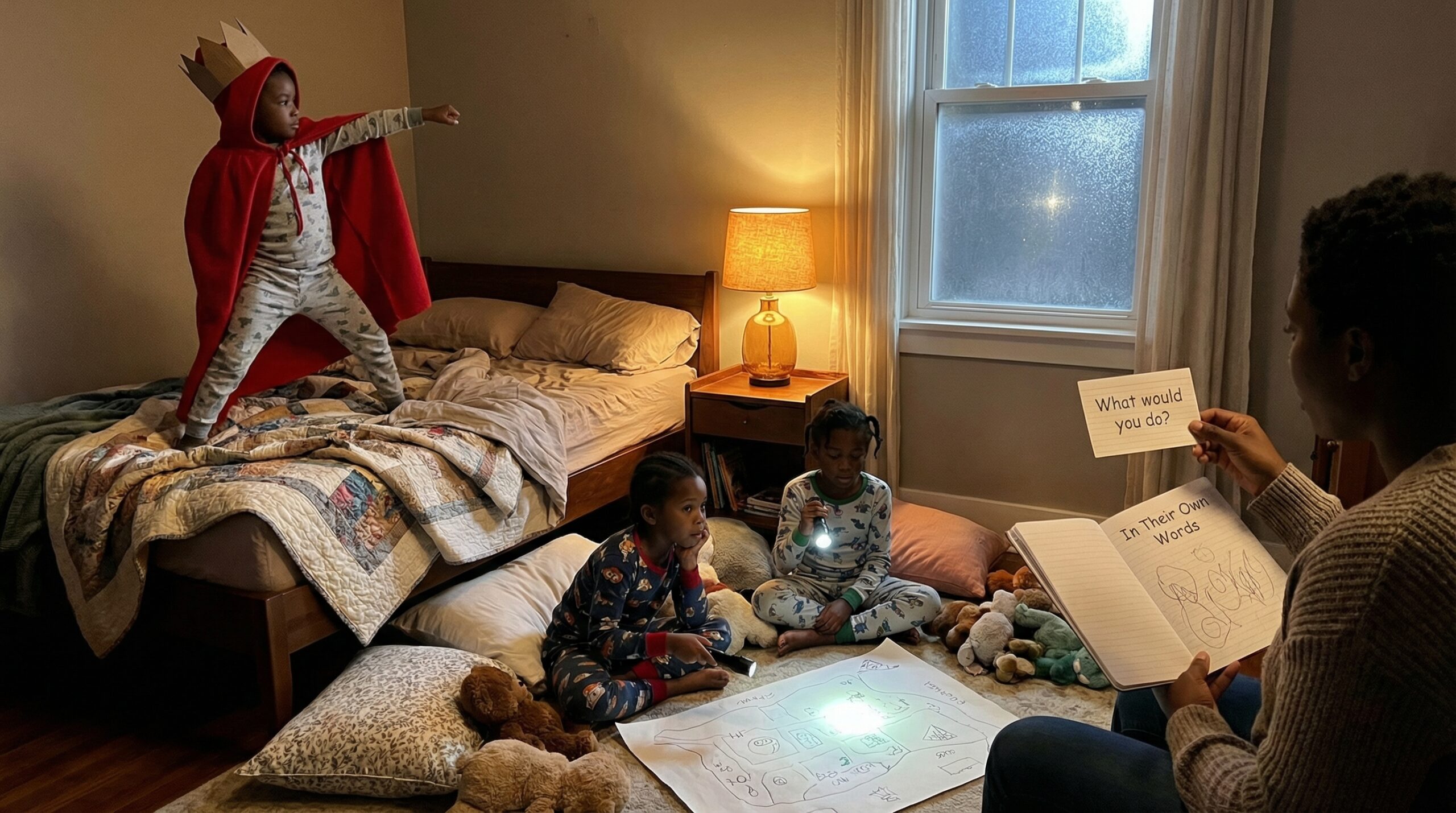
How kids become the hero when they lead a story. It starts with choice and a small brave act. Children make decisions. They try solutions. They feel proud.
What being the hero means
Being the hero centers the child. They set the goal and face obstacles. Then they decide how to solve problems. This practice builds agency, confidence, and narrative identity. In fact, between 2014 and 2024, the World Bank’s investments in early childhood development increased significantly, emphasizing the importance of quality preschool education for children’s growth and agency.
Child-centered goals and moral choices
For example, a child picks a goal, meets a challenge, and narrates the ending. As a result they rehearse feeling words and cause and effect. Also, they try on courage in a safe space. A recent study published in 2023 found a significant negative correlation between children’s anxiety and self-efficacy, highlighting that higher self-efficacy helps children feel more capable of facing challenges.
How kids become the hero by age
Toddlers act with single moves. They rescue a toy and repeat the action. Preschoolers stage short scenes and use feeling words. School-age children plan multi-step stories with clear problems and solutions. Next, adolescents explore identity across longer tales. During the 2022–2023 program year, Head Start programs served nearly 800,000 children, including those with disabilities, reinforcing the importance of inclusive early education in empowering all children to become heroes in their own stories.
Why this matters
Research shows child-led narratives boost language and literacy. They sequence events and use causal words. Executive function improves, including planning and impulse control. Also, emotion regulation and resilience grow. Furthermore, a 2023 survey of educators indicated that 63% believe fostering a growth mindset enhances students’ self-efficacy, leading to better academic outcomes.
Representation matters too. When the hero reflects a child’s gender, culture, or ability, the child sees more possibilities. Therefore diverse heroes widen imagination and belonging.
Design rules for grownups
Start with choice, not control. Offer two endings and let the child pick one. Keep props simple. For instance, use one plush, one hat, or one cardboard map. Celebrate mistakes as plot twists, not failures.
- Offer clear choices and brief prompts.
- Keep props easy to use and safe.
- Notice when the child returns to play on their own.
Three quick vignettes
Toddler, 2 years: a stuffed fox falls. The child saves it and beams. Language grows.
Preschooler, 4 years: a pirate map with three steps. The child chooses the route and negotiates with a sibling. Planning gets practice.
School-age, 8 years: a character must share or keep treasure. The child explains motive and consequence. Moral reasoning deepens. A randomized controlled trial found that positive feedback on self-efficacy significantly reduces cheating, illustrating the importance of encouragement in nurturing children’s heroic journeys.
How to shape a hero moment
Offer agency. Offer two choices. Add a tiny ritual like a cape or a basket for props. Then use short prompts such as, What do you try first? Praise effort, not the outcome. Small rituals make scenes feel real.
Try this tonight
Ask one What would you do? question after a story. Then let your child narrate the ending. You will see them lead. Also, try a quiet ritual before lights out to mark the hero moment.
Share and explore
On a cozy evening, Storypie turns bedtime into a stage where kids lead. For friendly tools and ideas, visit the Storypie app and our homepage.
Finally, start small and notice growth. Tiny choices lead to big learning. A hat, a warm lamp, and a small notebook make scenes delightfully real.