
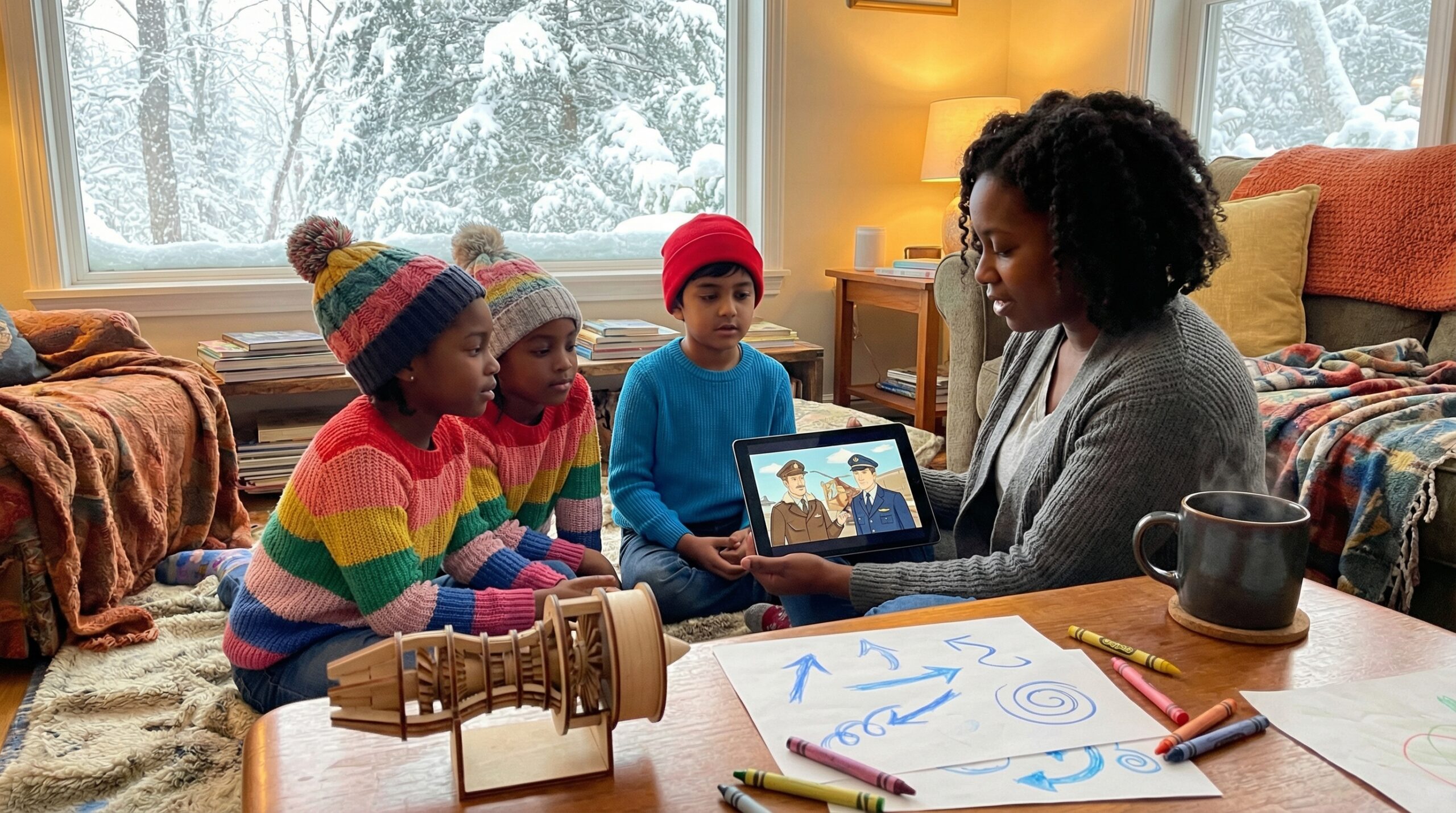
Jet engine for kids brings a small, powerful world to curious little ones. It feels cozy and a little bit magical.
Read or listen to a story about Jet Engine now: For 3-5 year olds, For 3-5 year olds, For 6-8 year olds, For 8-10 year olds, and For 10-12 year olds.
How a jet engine for kids works
Think of four easy steps: intake, compression, combustion, and exhaust. First, air comes in through the intake. Next, the compressor squeezes the air to make it dense. Then fuel mixes with the air and burns, making hot gas. Finally, the hot gas rushes out the nozzle and pushes the airplane forward. In short, the engine pushes air backward and the airplane moves forward. In 2023, major engine Original Equipment Manufacturers (OEMs) produced over 9,200 new engines, driven by demand from fleet modernization and expanding low-cost carrier networks, showcasing the industry’s growth.
Key parts you can picture
- Intake and fan. The big round face at the front that hums.
- Compressor. A stack of blades like a metal accordion.
- Combustion chamber. A tube where fuel meets fire, though we never play with flames at home.
- Turbine. A wheel turned by hot gas that sounds like a strong wind.
- Nozzle. A funnel where the air blasts out with a whoosh.
A brief, cozy history
Early inventors changed how the world traveled. For example, Hans von Ohain powered the first turbojet flight in 1939. Also, Frank Whittle flew a British prototype in 1941. Together, these pioneers helped jets shrink long journeys into hours. The global aircraft engine market is projected to grow from USD 153.69 billion in 2024 to USD 279.76 billion by 2032, at a Compound Annual Growth Rate (CAGR) of 7.77% during the forecast period, indicating robust growth opportunities.
Different engine types you may see
Turbofans are the friendly giants on airliners. Turbojets are early and fast. Turboprops and turboshafts drive propellers and helicopter rotors. Ramjets and scramjets work at very high speeds without compressors.
Simple family activities
These short activities help kids feel the ideas behind a jet engine.
- Draw how a jet pushes air. Give your child 10 minutes and crayons.
- Try a balloon rocket race along a string, under supervision.
- Compare a thrown paper airplane with one blown by a small electric fan to feel different air movement.
Safety note: do not try real combustion or experiments with fast spinning parts.
Flight, noise, and our planet
Jet engines make noise and emissions. In 2023, Sustainable Aviation Fuel (SAF) production was 600 million liters, representing 0.2% of global jet fuel use. Today, engineers build high bypass turbofans and pursue cleaner fuels. For instance, on 9 March 2023, Airbus flew an A321neo with both engines powered by 100% unblended sustainable aviation fuel (SAF) as part of its VOLCAN test campaign to collect in‑flight data on emissions and contrails, marking a significant milestone in eco-friendly aviation technology. Additionally, they improve efficiency to make flying quieter and greener.
Cozy sign off
Storytime makes science feel snug and fun. For more tales and age-friendly pages, visit Storypie. Explore our Jet Engine story to keep the wonder going.
Visit Storypie for more stories and learning activities.