
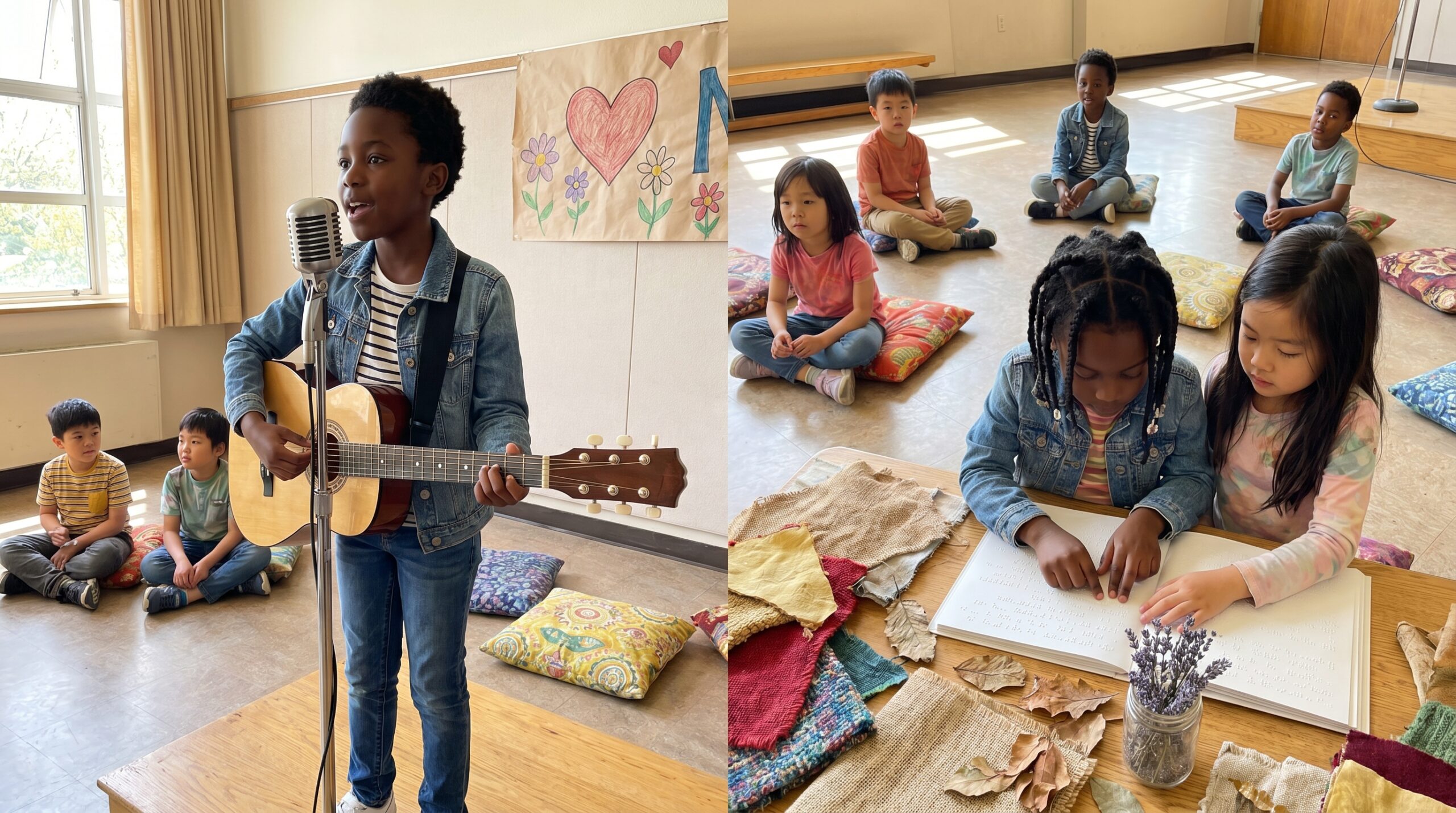
I tell this Louis Braille biography for kids because I want curiosity to stick. I first felt braille at a museum and felt wowed. It feels magical. Tiny raised dots can become a whole book under your fingertips.
Louis Braille biography: Early life
Louis Braille was born on January 4, 1809, in Coupvray, France, and lost his sight at the age of five due to an accident with an awl in his father’s workshop. When he was three he hurt one eye in his father’s harness workshop. Then an infection made him blind in both eyes. At age ten he went to the Royal Institute for Blind Youth in Paris. There he learned music and later taught it.
Inventing braille dots
As a teen Louis studied a tactile military code by Charles Barbier. He simplified that code into neat, clever patterns of raised dots. By about age 15, in 1824, he developed the Braille system—a tactile reading and writing method using raised dots—which he later refined and published in 1829. The Institute adopted his system in 1854. UNESCO declared World Braille Day on January 4 in 2018, following a resolution by the United Nations General Assembly that recognized this date as a celebration of accessibility for the blind community.
How braille works
Braille uses a cell of six positions. Picture two columns of three dots. The dots are numbered 1 to 3 on the left and 4 to 6 on the right. That gives 64 patterns, including the blank. Those patterns make letters, punctuation, numbers, and formatting marks.
- Grade 1 Braille spells letters one for one.
- Grade 2 Braille uses contractions to save space and speed reading.
- There are special codes for math and music, like the Nemeth Code.
Louis Braille biography: Music and teaching
Louis was also an organist and teacher. He adapted the code for music so blind musicians could read scores. That change was a game changer. At first, people resisted the new idea. Yet over time braille spread around the world and has been adapted to almost every known language, making it a universal tool for the blind. It adapted to many languages and scripts.
Modern tools and lasting impact
Today many tools bring braille to screens and paper. Mechanical slates, braille typewriters, embossers, and refreshable braille displays help people read. The Perkins Brailler and electronic displays made access easier. Even with audio tools, braille still matters. It teaches spelling, punctuation, and layout. Therefore it supports full literacy and independence.
Explore more
Read or listen to a story about Louis Braille now: Read or listen to a story about Louis Braille now: For 3-5 year olds, For 6-8 year olds, For 8-10 year olds, and For 10-12 year olds.
Try a small, playful action tonight. Press three dots to make a letter, say its sound, and do a tiny victory dance. It turns learning into a joyful habit. Also visit your local library’s braille collection or try a braille app. Get the Storypie app at Storypie.
Spring mornings remind us that curiosity changes lives. Louis Braille made a simple dot code that opened books to millions.