Galileo Galilei biography for kids begins with one simple habit: look up. Galileo was born in Pisa on February 15, 1564, in Italy, and he died on January 8, 1642, at the age of 77. He enrolled at the University of Pisa in 1581. Then he switched from medicine to mathematics and became a professor in 1589. He taught in Padua from 1592 to 1610. Later he moved to Florence under Medici patronage. I like to say his life began with curiosity and ended in stubborn wonder.
Galileo Galilei biography for kids – Telescopes and discoveries
In 1609, Galileo heard about a Dutch telescope. So he built better versions, improving the telescope’s magnification up to 30 times. His best instruments reached about 20 times magnification. In January 1610, using the telescope he had improved, he discovered the four largest moons of Jupiter—Io, Europa, Ganymede, and Callisto. He published that news in Sidereus Nuncius, the Starry Messenger. He named those bodies the Medicean Stars to honor his patrons. Also, he watched the phases of Venus. Those observations helped show Venus orbits the Sun. He mapped the Moon and found mountains and craters. The Moon was not a perfect smooth sphere. He tracked sunspots and found the Sun turns. Suddenly the Milky Way looked far richer and more mysterious. What a thrill for a curious mind!
Galileo Galilei biography for kids – Experiments and motion
Galileo did more than stare at stars. He set up simple experiments. For example, he rolled balls down inclined planes to slow motion. He measured carefully and he wrote down results. He showed that distance grows with the square of time under steady acceleration. In other words, d is proportional to t squared. He challenged old Aristotelian ideas about falling bodies. He mixed observation, repeatable testing, and mathematics. That approach helped found modern science. Two New Sciences, published in 1638 while he lived under confinement, collects his work on motion and materials. Meanwhile, Dialogue Concerning the Two Chief World Systems came out in 1632 and stirred controversy.
Why Galileo matters and a tiny stargazing idea
Galileo supported the Copernican idea that planets orbit the Sun. In 1633, Galileo was tried by the Roman Catholic Church and found ‘vehemently suspect of heresy’ for advocating the heliocentric model, leading to his house arrest for the remainder of his life. Stories about him saying “E pur si muove” are probably apocryphal. He lost much of his sight and became blind by about 1638. He died in Arcetri near Florence in 1642.
Why he matters is simple and wonderful. He is often called the father of modern observational astronomy and a founder of modern physics. His work has had such an impact that, according to a 2024 article in the journal Galilæana, over 60% of the works printed after 1610 contain either a direct or indirect connection to Galileo and his associates. He taught us to test ideas, to measure, and to let evidence lead. Museums and books celebrate him. The Vatican later acknowledged problems in how the Church handled his case.
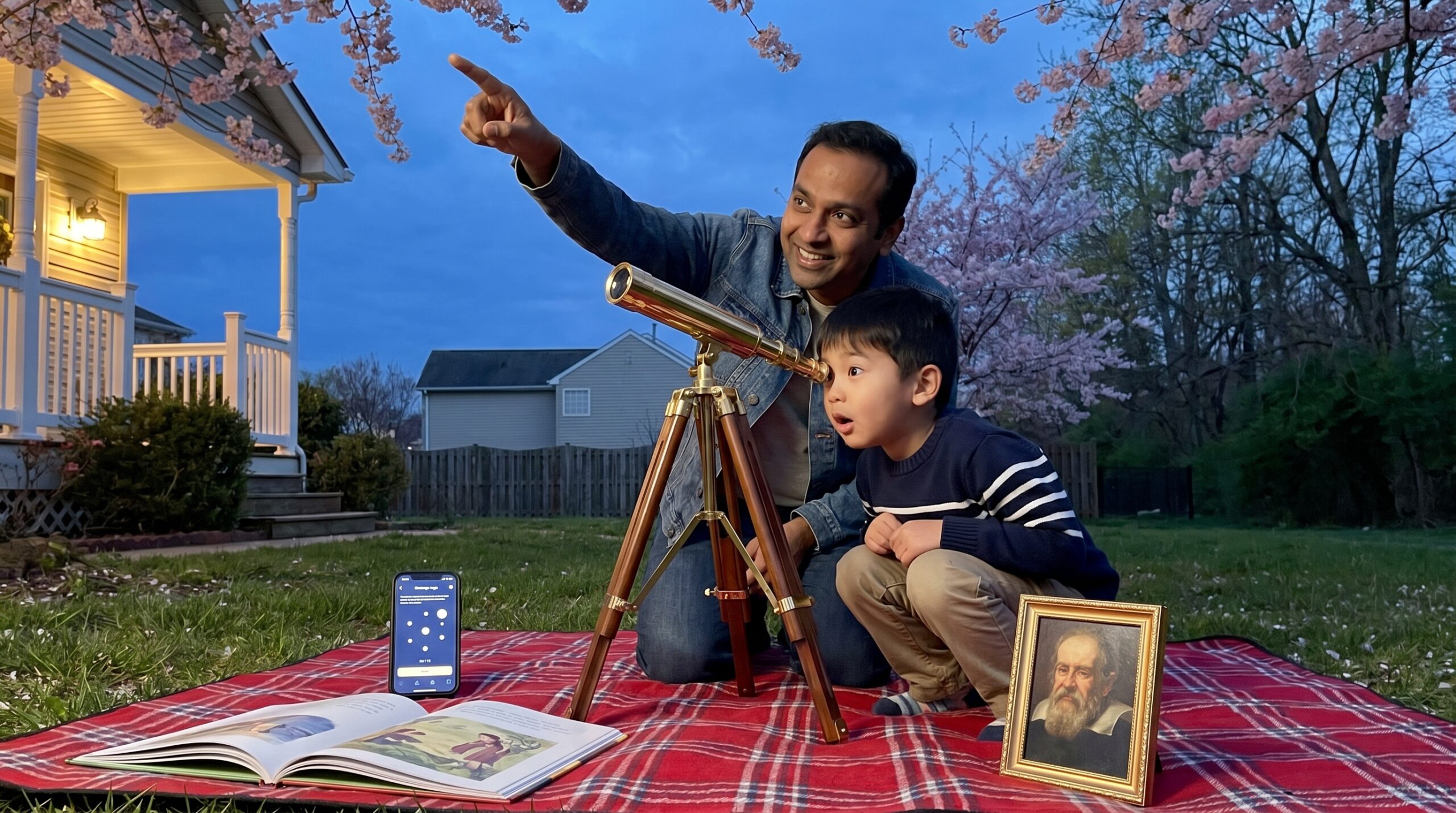
Tonight, try a tiny stargazing adventure with a child. First, look for a bright object that does not twinkle. It may be a planet. Also, use binoculars or a small telescope when you can. Never look directly at the Sun without a certified solar filter. For daytime solar viewing, use proper equipment and take extreme caution.
Storypie: This spring afternoon meet Galileo, who improved the telescope and taught us to ask why. Tip: Tonight, spend five minutes stargazing and ask your child one curious question. Try the Storypie app.
Read or listen to a story about Galileo Galilei now: For 3-5 year olds, For 6-8 year olds, For 8-10 year olds, and For 10-12 year olds.