Wave power generator for kids is a tiny idea that grows big. First, picture a bobbing buoy. Next, imagine that buoy as a tiny power station. I first saw a bobbing buoy at the beach with my niece. I asked what it could power. She said a lighthouse. I said, or your night light. We both grinned.
Wave power generator for kids: simple examples
Put simply, a wave power generator captures ocean motion and makes electricity. Also, devices come in friendly shapes. Point absorbers bob like a toy. Attenuators bend like sea serpents. Oscillating water columns sing like a bottle blown across. Overtopping devices fill and spill, like pouring from a bucket. Submerged systems feel pressure changes under waves. Those one-line images let kids picture it fast and clearly.
How motion becomes electricity
There are a few simple routes. First, mechanical linkages move gears and spin a generator. Next, hydraulic systems pump fluid to drive a motor. Also, pneumatic systems squeeze air through a turbine. Finally, linear generators convert up-and-down motion directly to current. In all cases something moves, and then electrons flow. That makes motion useful energy.
Real prototypes and a quick size comparison
People have built many prototypes. For example, Pelamis was a famous snake-shaped machine tested in Scotland. Oyster and Limpet also began experiments there. Carnegie in Australia built CETO. Test centers like EMEC in Orkney host trials. Also Wave Hub in Cornwall supports experiments.
To picture size, compare energy at home. A 1 megawatt wave farm running all the time would produce 8,760 megawatt hours a year. At a realistic 30 percent capacity factor it yields about 2,628 megawatt hours. That could power roughly 730 UK homes. Imagine lighting a whole street with waves. Pretty awesome, right? In fact, as of 2024, the total installed ocean power capacity worldwide was approximately 513 megawatts (MW), with 1.6 MW of new capacity added that year, showcasing how wave energy is becoming a more significant player in our energy landscape according to the REN21 Global Status Report.
Benefits and the sea’s challenges
Waves often pack more power than wind or sun in the same spot. Also, waves can be more predictable day to day. Sometimes visual impact stays small when devices sit offshore. However, the sea is harsh. Salt, storms, and animals that cling to structures raise costs. Repairs can be hard. Therefore, careful environmental checks protect whales, fish, and seabeds. According to the IEA-OES ‘Ocean Energy and Net Zero’ roadmap, developing ocean energy could create about 680,000 jobs and prevent over 500 million tonnes of CO2 by 2050, highlighting the sustainable potential of harnessing wave and tidal energy.
Playful sparks and a gentle activity
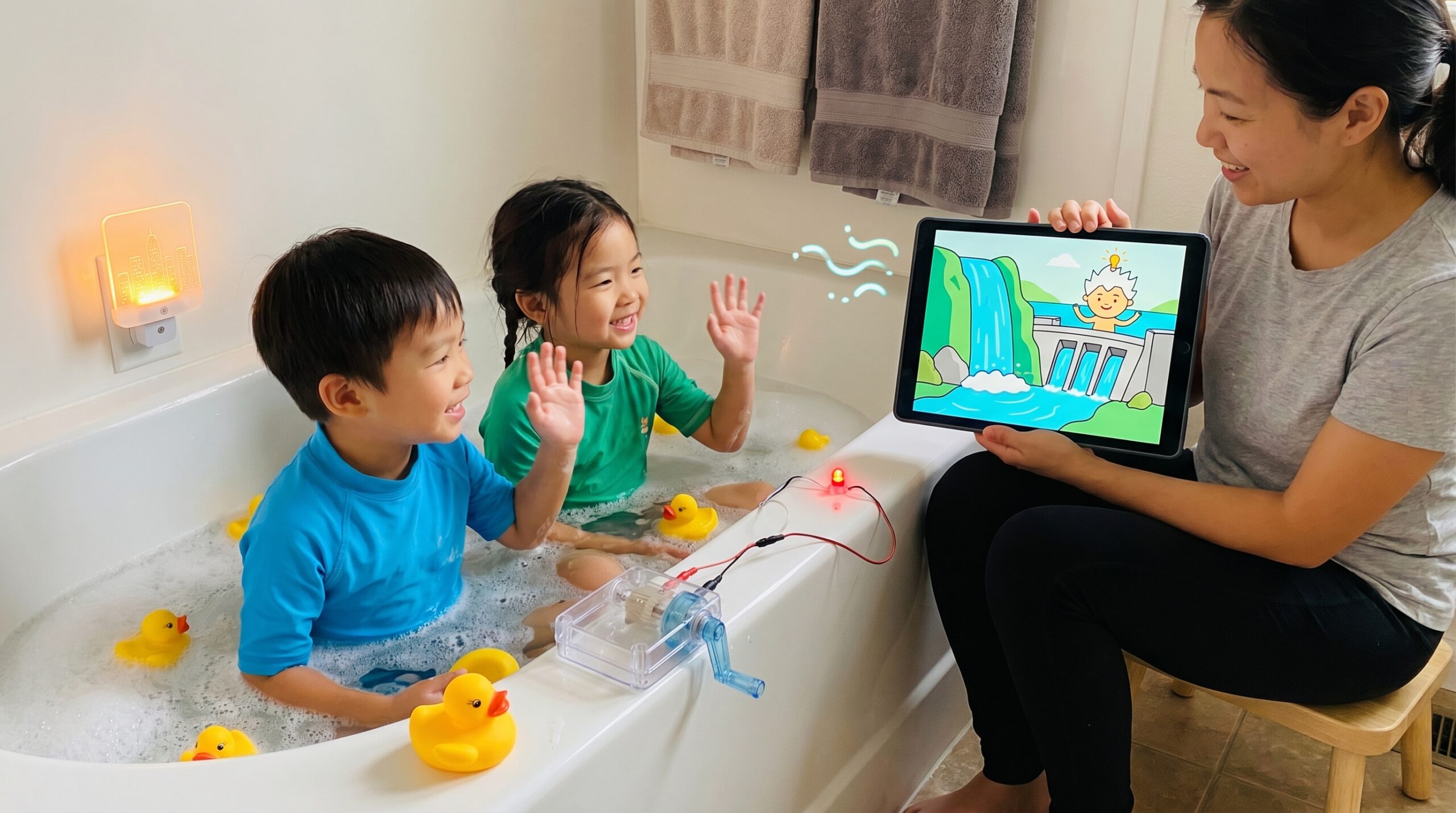
This Earth Day I like to tell the story back to Faraday. From his 1831 spark to waterfalls that lit cities, motion to electricity has a brave arc. For a quick tub activity, float a cork and gently push waves. Or build a cardboard paddle wheel to turn a small motor and light an LED with grown-up help. Those tiny experiments spark curiosity.
Read or listen to a story about Wave Power Generator now: For 3-5 year olds, For 3-5 year olds, For 6-8 year olds, For 8-10 year olds, and For 10-12 year olds.
Finally, if you enjoy a short question-and-answer at bedtime, try this: what would you power with ocean waves? Ask tonight and listen. Then, let those answers grow into curiosity. Explore more on Storypie for gentle stories and ideas at Storypie.