English

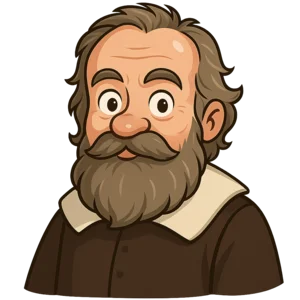
Galileo Galilei
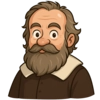
Galileo Galilei was an Italian astronomer, physicist…
Reads at Grades 3–5 Listens at Grades 1–5
Print & create
Answer keys·No prep·Free with an account
28 worksheets · answer keys · full story · quiz · Ages 8-10 · CEFR B1
Plus adds 280,000+ more stories in 27 languages, audio for every one, and printables for all of them.
Just want Galileo Galilei?
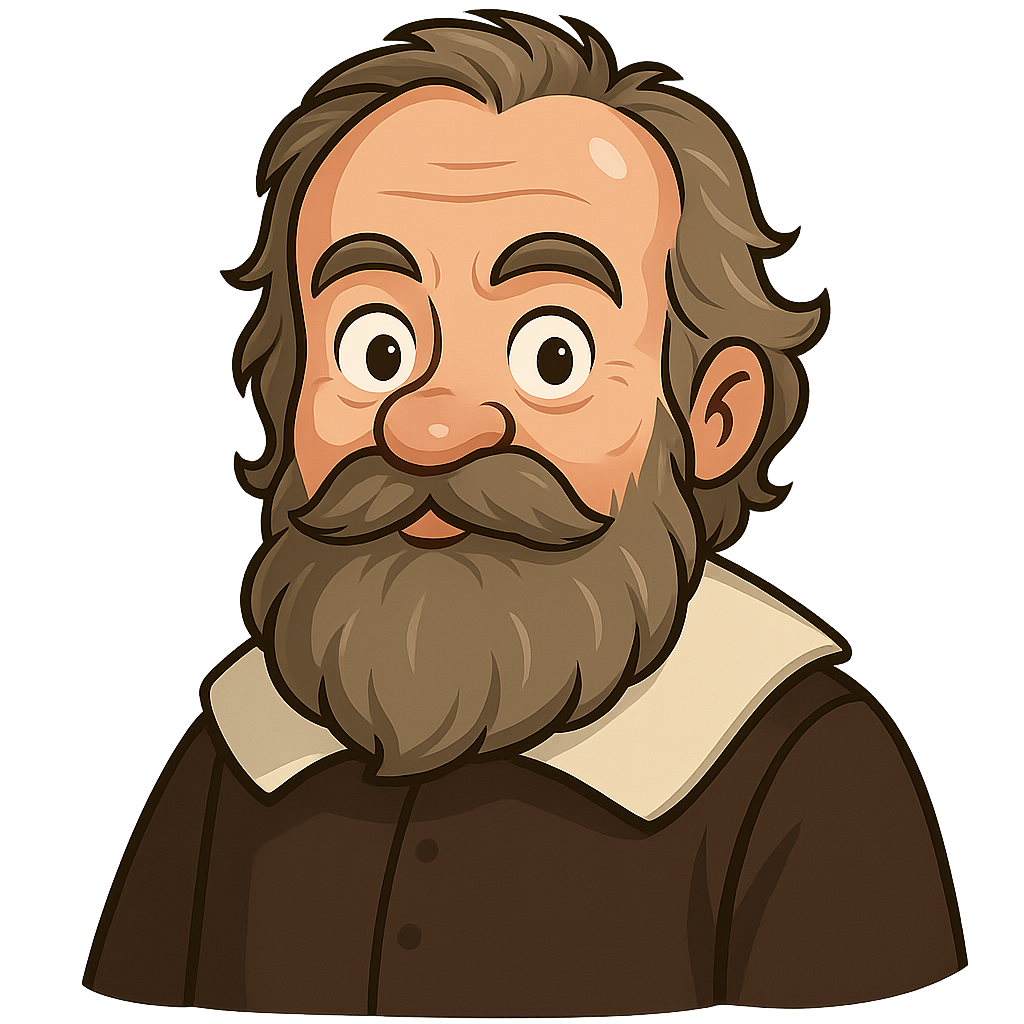
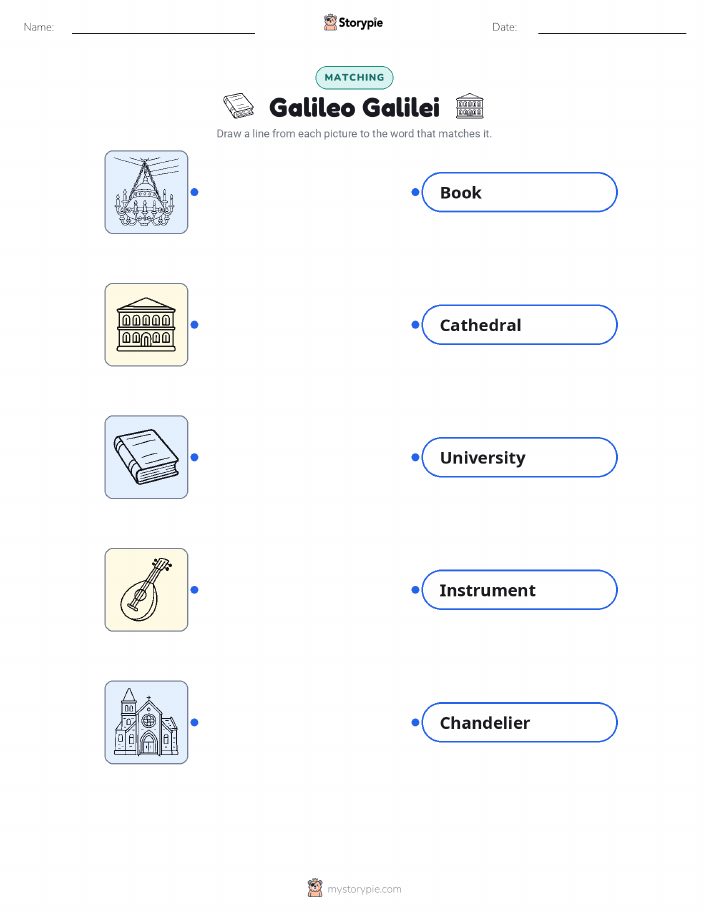
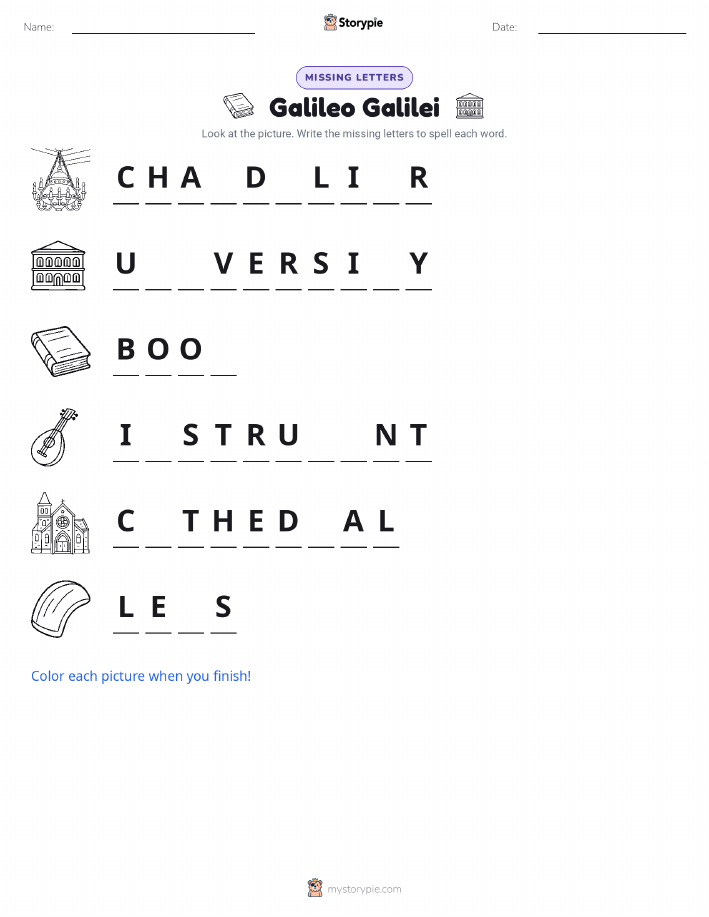
Ciao! My name is Galileo Galilei, and I want to tell you my story. It begins a long time ago in a beautiful city called Pisa, in Italy, where I was born in the year 1564. Even when I was just a boy, my mind was like a spinning top, always full of questions about the world. I would see a leaf fall or watch a bird fly and wonder, 'How does that work? Why does it happen that way?'. My father, Vincenzo, was a talented musician, and he showed me that numbers and mathematics were like secret codes hidden in everything, even in the beautiful melodies he played. One afternoon, I was sitting in the grand cathedral of Pisa when my eyes caught sight of a heavy lamp swinging from a long chain. People walked in and out, but I was fascinated. I used the steady beat of my own pulse to time its swings. I discovered something incredible: whether the lamp swung in a wide arc or a tiny one, it always took the exact same amount of time to go back and forth. This was my very first big scientific discovery, and it lit a fire inside me. I knew then that I wanted to spend my life uncovering the secret rules that our universe follows.
When I grew up, I became a professor at a university, sharing my love for mathematics and science with my students. But my greatest adventure began in 1609 when I heard whispers of a new Dutch invention called a 'spyglass'. It was a tube with lenses that could make faraway things, like ships on the ocean, appear much closer. My mind started racing! I thought, if this device can bring ships closer, what could it show me in the night sky? I was determined to see the stars as no one had ever seen them before. I set to work right away, learning how to grind and polish glass lenses to make them just right. I built my own version of the spyglass, but I made it much, much more powerful. I decided to call it a telescope. The first night I pointed it toward the heavens, on January 7, 1610, my world changed forever. I looked at the Moon, which everyone believed was a perfect, smooth sphere. But it wasn't! It was covered in rugged mountains and deep craters, just like our own Earth. I then turned my telescope to the faint, misty band of light called the Milky Way and saw that it was actually made of millions of individual stars. But the most amazing discovery of all was when I looked at the planet Jupiter. I saw four tiny 'stars' moving around it. They weren't stars at all—they were Jupiter's own moons! This was proof that not everything in the universe circled the Earth.
Galileo Galilei
Ciao! My name is Galileo Galilei, and I want to tell you my story. It begins a long time ago in a beautiful city called Pisa, in Italy, where I was born in the year 1564. Even when I was just a boy, my mind was like a spinning top, always full of questions about the world. I would see a leaf fall or watch a bird fly and wonder, 'How does that work? Why does it happen that way?'. My father, Vincenzo, was a talented musician, and he showed me that numbers and mathematics were like secret codes hidden in everything, even in the beautiful melodies he played. One afternoon, I was sitting in the grand cathedral of Pisa when my eyes caught sight of a heavy lamp swinging from a long chain. People walked in and out, but I was fascinated. I used the steady beat of my own pulse to time its swings. I discovered something incredible: whether the lamp swung in a wide arc or a tiny one, it always took the exact same amount of time to go back and forth. This was my very first big scientific discovery, and it lit a fire inside me. I knew then that I wanted to spend my life uncovering the secret rules that our universe follows.
When I grew up, I became a professor at a university, sharing my love for mathematics and science with my students. But my greatest adventure began in 1609 when I heard whispers of a new Dutch invention called a 'spyglass'. It was a tube with lenses that could make faraway things, like ships on the ocean, appear much closer. My mind started racing! I thought, if this device can bring ships closer, what could it show me in the night sky? I was determined to see the stars as no one had ever seen them before. I set to work right away, learning how to grind and polish glass lenses to make them just right. I built my own version of the spyglass, but I made it much, much more powerful. I decided to call it a telescope. The first night I pointed it toward the heavens, on January 7, 1610, my world changed forever. I looked at the Moon, which everyone believed was a perfect, smooth sphere. But it wasn't! It was covered in rugged mountains and deep craters, just like our own Earth. I then turned my telescope to the faint, misty band of light called the Milky Way and saw that it was actually made of millions of individual stars. But the most amazing discovery of all was when I looked at the planet Jupiter. I saw four tiny 'stars' moving around it. They weren't stars at all—they were Jupiter's own moons! This was proof that not everything in the universe circled the Earth.
Seeing Jupiter's moons with my own eyes made me certain that an old idea from an astronomer named Nicolaus Copernicus was correct. He had suggested that the Earth and all the other planets actually traveled in orbits around the Sun. We call this idea heliocentrism, which means 'sun-centered'. Today, every student learns this as a fact, but in my time, it was a truly shocking and even dangerous idea to believe. For more than a thousand years, everyone, including the very powerful Catholic Church, taught that the Earth was the special, unmoving center of the entire universe. My telescope gave me the evidence I needed to challenge that old belief. I knew I had a duty to share the truth of what I had seen. So, I wrote about my discoveries in a book called 'The Starry Messenger'. When it was published, many scientists and thinkers were incredibly excited. They saw the universe in a new way! But many other people, especially powerful leaders in the Church, were very angry and frightened. My ideas turned their world upside down.
The anger over my ideas grew. Eventually, the leaders of the Church commanded me to stop teaching that the Earth moved around the Sun. They told me it went against their beliefs. I was faced with a terrible choice: should I keep quiet, or should I stand up for the truth that my observations had revealed? I believed so strongly in what my eyes and my mathematical calculations showed me. Years later, I decided to write another book. In it, I presented a conversation comparing the old Earth-centered idea with the new Sun-centered one, showing why the evidence supported Copernicus. This book landed me in very serious trouble. In 1633, I was summoned to Rome to face a trial by the Roman Inquisition. They accused me of heresy, which means holding a belief that goes against the established teachings of the Church. They found me guilty. To avoid a terrible punishment, I was forced to kneel and publicly say that I had been wrong and that the Earth did not move. It broke my heart, but for the rest of my life, I was kept under house arrest, a prisoner in my own home. Even then, I never truly gave up. I continued to think, experiment, and write down my ideas in secret.
I passed away in my home in the year 1642. By then I was an old man, and the same eyes that had peered into the heavens had grown blind. But while my life ended, my ideas could not be locked away forever. The truth that I had seen through my simple telescope slowly spread across the world, sparking a revolution in science and changing how humanity saw its place in the universe. Looking back on my long journey, I hope my story teaches you to always stay curious. Ask big questions, and trust what you can observe with your own eyes. Don't be afraid to challenge old ideas, even when it's difficult, because that is how we discover amazing new things and make the world a more knowledgeable place for everyone.
Wow facts
About
Galileo Galilei was an Italian astronomer, physicist, and engineer whose pioneering use of the telescope led to revolutionary discoveries about the cosmos and provided crucial evidence for the theory that the Earth revolves around the Sun.
Take a Quiz
Question 1 of 5
Why do you think Galileo's idea that the Earth revolved around the Sun was so 'controversial' in his time?
Explore next



Want to do even more?
Go beyond exploring. Unlock tools that turn every story into real learning.

Storypie Plus for families
Full stories, quizzes, and printables. Nights and car rides, sorted.
- Unlimited audio stories
- Create Mode: your child stars in the story
- Offline downloads
- Printable worksheets & coloring pages

Why Storypie for Schools
Students engaged. Prep in seconds. Evenings back to you.
- Worksheets & Quizzes
- Classroom Management
- Formative Assessment
- Custom Curriculum & Lesson Plans
- 27 Languages

Why Storypie for Homeschool
Curriculum done. They'll ask for more. Hours back in your day.
- Worksheet Generator
- First-Person Audio Stories
- Built-in Comprehension Quizzes
- Custom Curriculum & Lesson Plans
- Print & Go Activities