English

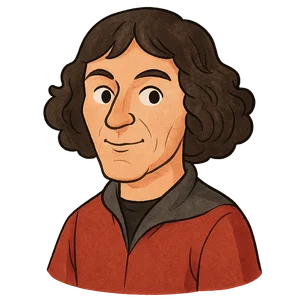
Nicolaus Copernicus
A Renaissance-era mathematician and astronomer who formulated a model of the universe that placed the Sun…
Reads at Grades 3–5 Listens at Grades 1–5
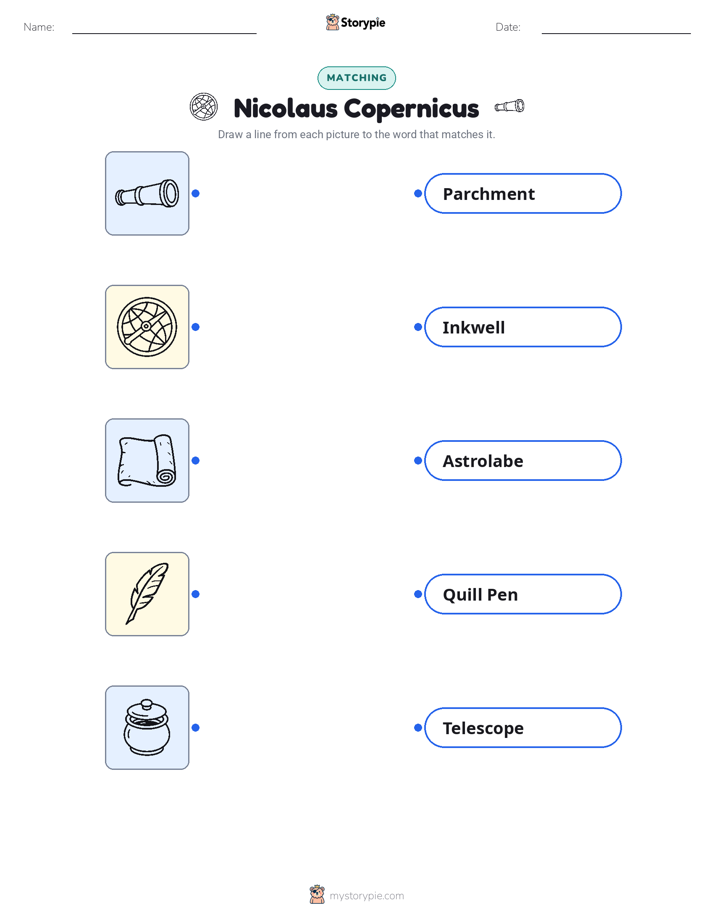
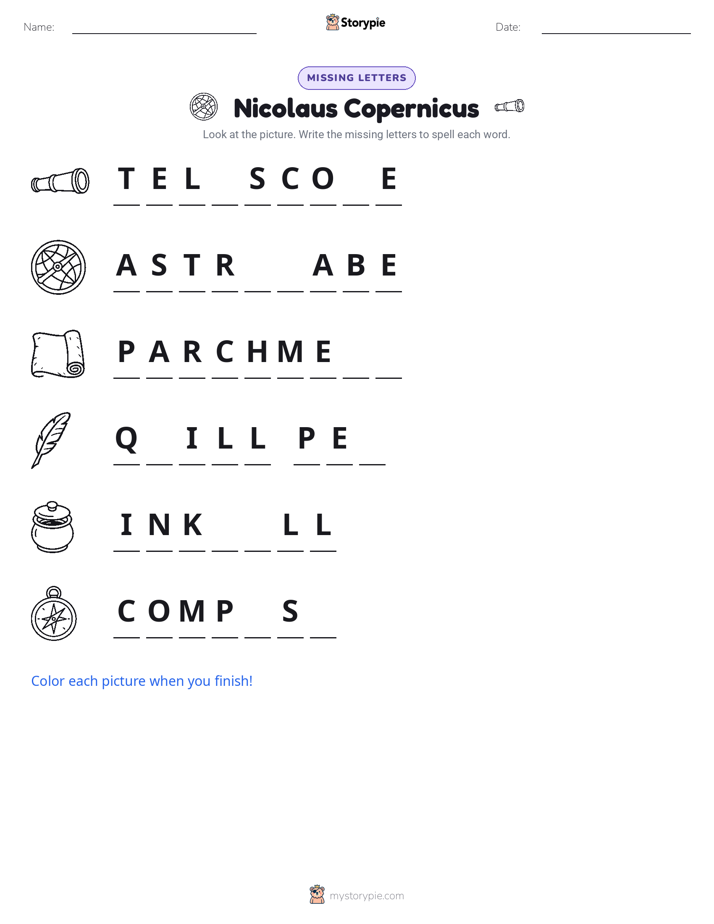
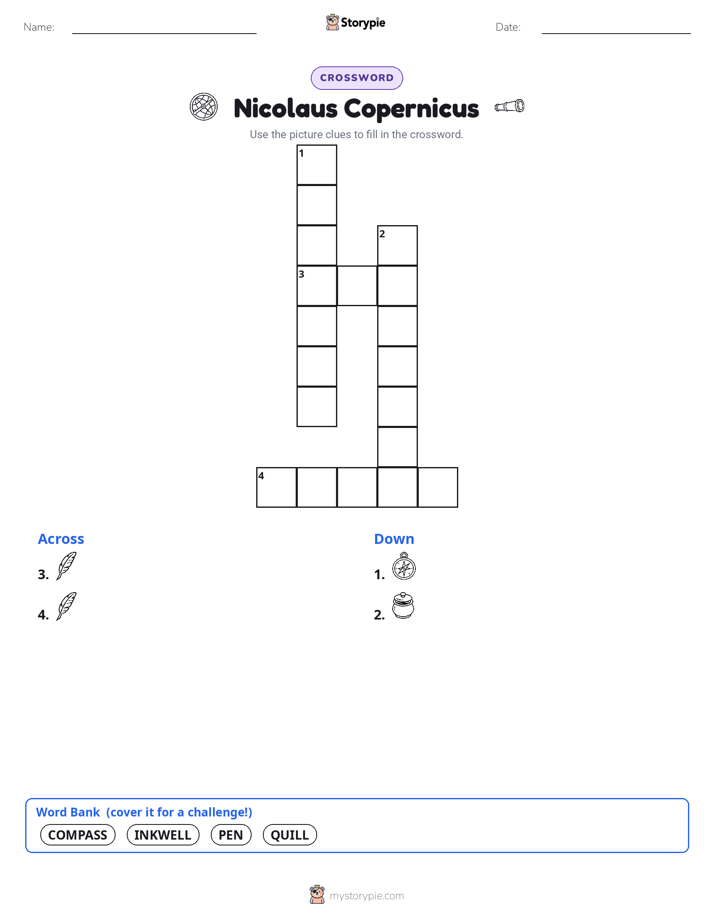
Print & create
Answer keys·No prep·Free with an account
28 worksheets · answer keys · full story · quiz · Ages 8-10 · CEFR B1
Plus adds 102,000+ more stories in 27 languages, audio for every one, and printables for all of them.
Just want Nicolaus Copernicus?
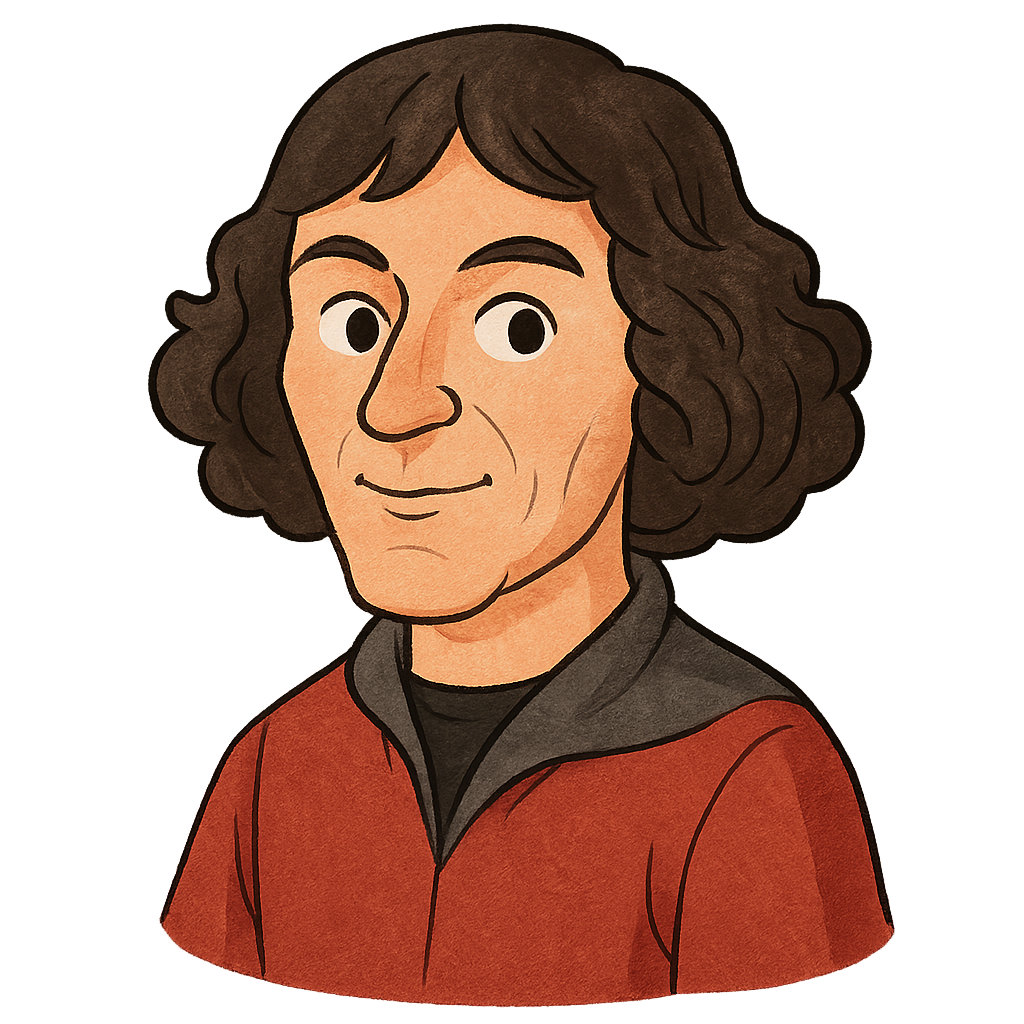
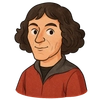
Hello, my name is Nicolaus Copernicus, and I am an astronomer who lived a very long time ago. I was born on February 19th, 1473, in a Polish town called Toruń. My family was loving, but when I was still a boy, my father passed away. It was a sad time, but my kind uncle, Lucas Watzenrode, stepped in to take care of me and my siblings. He saw that I was a curious child with a great love for learning. Even from a young age, I would spend hours looking up at the night sky. The twinkling stars and wandering planets filled my mind with questions, sparking a curiosity about the universe that would last my entire life.
My uncle wanted to make sure I had the best education possible. In 1491, I began my studies at the University of Krakow. It was there that my fascination with the stars and their movements grew even stronger. After my time in Krakow, my uncle sent me to Italy to continue my education. I studied many different subjects, including medicine so I could be a doctor and church law so I could help the church. But no matter what I was studying, my mind always returned to my two favorite subjects: mathematics and astronomy. I spent countless hours in libraries, reading ancient books written by thinkers from long ago. I wanted to learn everything I could about the universe and the ideas people had about it.
After my studies, I returned to Poland and began my job as a canon at the Frombork Cathedral. It was a quiet job that gave me plenty of time to think and study. I worked from a tall tower in the cathedral walls, which gave me a perfect, clear view of the night sky. In my time, almost everyone believed in an idea called the geocentric model. This meant they thought the Earth was the center of everything, and that the Sun, the Moon, and all the planets and stars revolved around us. This idea had been accepted for more than a thousand years. But the more I watched the planets, the more I felt that this explanation didn't quite make sense. Their paths through the sky seemed too complicated and messy for such a simple model.
Nicolaus Copernicus
Hello, my name is Nicolaus Copernicus, and I am an astronomer who lived a very long time ago. I was born on February 19th, 1473, in a Polish town called Toruń. My family was loving, but when I was still a boy, my father passed away. It was a sad time, but my kind uncle, Lucas Watzenrode, stepped in to take care of me and my siblings. He saw that I was a curious child with a great love for learning. Even from a young age, I would spend hours looking up at the night sky. The twinkling stars and wandering planets filled my mind with questions, sparking a curiosity about the universe that would last my entire life.
My uncle wanted to make sure I had the best education possible. In 1491, I began my studies at the University of Krakow. It was there that my fascination with the stars and their movements grew even stronger. After my time in Krakow, my uncle sent me to Italy to continue my education. I studied many different subjects, including medicine so I could be a doctor and church law so I could help the church. But no matter what I was studying, my mind always returned to my two favorite subjects: mathematics and astronomy. I spent countless hours in libraries, reading ancient books written by thinkers from long ago. I wanted to learn everything I could about the universe and the ideas people had about it.
After my studies, I returned to Poland and began my job as a canon at the Frombork Cathedral. It was a quiet job that gave me plenty of time to think and study. I worked from a tall tower in the cathedral walls, which gave me a perfect, clear view of the night sky. In my time, almost everyone believed in an idea called the geocentric model. This meant they thought the Earth was the center of everything, and that the Sun, the Moon, and all the planets and stars revolved around us. This idea had been accepted for more than a thousand years. But the more I watched the planets, the more I felt that this explanation didn't quite make sense. Their paths through the sky seemed too complicated and messy for such a simple model.
I spent years observing and calculating, and one day, I had a big idea. What if the old books were wrong? What if the Sun was the center of the universe, and all the planets, including our own Earth, were the ones moving around it? Today, this is called the heliocentric model. This was a very radical and scary thought to have. It went against everything people had been taught for centuries, and I knew that many would not accept it. Because it was such a huge idea, I wanted to be absolutely sure. I spent nearly 30 years carefully observing the sky, making detailed mathematical calculations, and writing down all of my evidence in a book.
As I grew older, I became very nervous about publishing my work. I worried that people would not understand or would be angry with me for challenging their beliefs. However, my friends knew how important my discoveries were and they encouraged me to share my findings with the world. Finally, when I was an old man, I agreed to have my book published. It was called De revolutionibus orbium coelestium, which is Latin for On the Revolutions of the Heavenly Spheres. In the year 1543, a printed copy of my life's work was brought to me, just as I was nearing the end of my life.
I lived to be 70 years old. Although my heliocentric idea wasn't accepted by everyone right away, it slowly started a huge change in science that is now called the Copernican Revolution. My work helped future scientists, like Galileo Galilei, to better understand our solar system and prove that the Earth was not the center of the universe. I hope my story reminds you to always stay curious, to ask big questions, and to never be afraid to look at the world in a completely new way.
Wow facts
About
A Renaissance-era mathematician and astronomer who formulated a model of the universe that placed the Sun, rather than the Earth, at its center.
Take a Quiz
Question 1 of 5
Why was Nicolaus Copernicus nervous about sharing his heliocentric model?
Explore next



Want to do even more?
Go beyond exploring. Unlock tools that turn every story into real learning.

Storypie Plus for families
Full stories, quizzes, and printables. Nights and car rides, sorted.
- Unlimited audio stories
- Create Mode: your child stars in the story
- Offline downloads
- Printable worksheets & coloring pages

Why Storypie for Schools
Students engaged. Prep in seconds. Evenings back to you.
- Worksheets & Quizzes
- Classroom Management
- Formative Assessment
- Custom Curriculum & Lesson Plans
- 27 Languages

Why Storypie for Homeschool
Curriculum done. They'll ask for more. Hours back in your day.
- Worksheet Generator
- First-Person Audio Stories
- Built-in Comprehension Quizzes
- Custom Curriculum & Lesson Plans
- Print & Go Activities