English

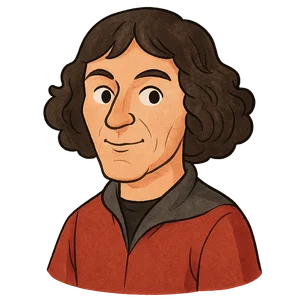
Nicolaus Copernicus
A Renaissance-era mathematician and astronomer who formulated a model of the universe that placed the Sun…
Reads at Grades 6–8 Listens at Grades 4–8
Print & create
Answer keys·No prep·Free with an account
28 worksheets · answer keys · full story · quiz · Ages 10-12 · CEFR B2
Plus adds 102,000+ more stories in 27 languages, audio for every one, and printables for all of them.
Just want Nicolaus Copernicus?
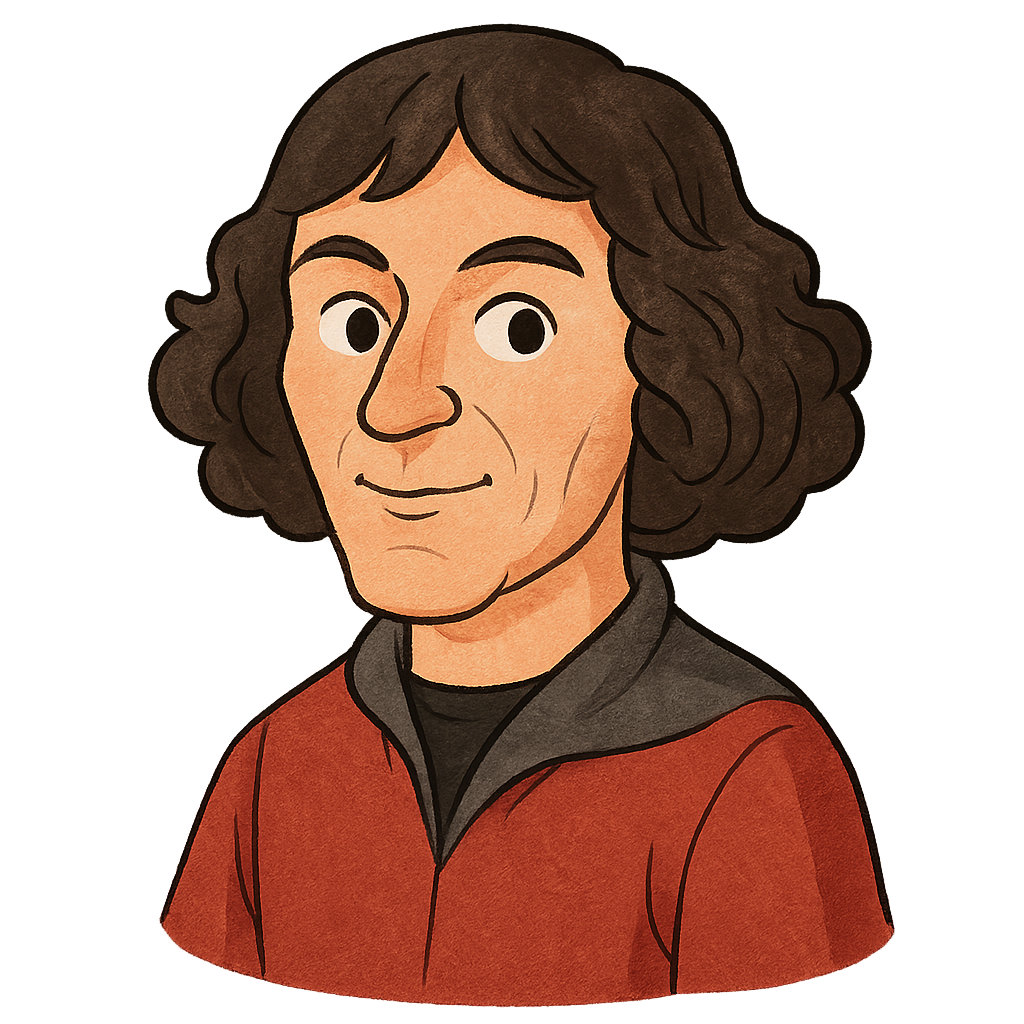
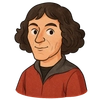
Hello, my name is Nicolaus Copernicus, and I am the astronomer who suggested that the Earth was not the center of the universe. My story begins on February 19th, 1473, in the city of Toruń, located in the Kingdom of Poland. I grew up in a family of successful merchants, and life was comfortable. However, everything changed when I was about ten years old and my father passed away. My future could have been uncertain, but my uncle, Lucas Watzenrode, stepped in to care for me and my siblings. He was a very powerful man—a bishop—and he believed deeply in the importance of education. He made sure that I had access to the best schools and teachers available. It was his guidance that set me on a path of learning and discovery, igniting a curiosity about the world around me and, most importantly, the vast, mysterious heavens that stretched out above my head every night.
My university years were a great journey across Europe in search of knowledge. In 1491, I enrolled at the University of Kraków, which had a wonderful reputation for mathematics and astronomy. It was there that my general curiosity about the stars sharpened into a true scientific passion. I learned how to use astronomical instruments and began to study the movements of the celestial bodies. After several years, my uncle decided I should continue my education in Italy, which was a center of learning during the Renaissance. Starting in 1496, I studied law at the University of Bologna and later medicine at the University of Padua. Though I applied myself to these subjects, my heart was always with the stars. In my free time, I would secretly conduct my own astronomical observations, carefully charting the positions of the Moon and planets. I also spent countless hours reading the works of ancient astronomers, trying to understand their theories about the universe.
Nicolaus Copernicus: The Man Who Moved the Earth
Hello, my name is Nicolaus Copernicus, and I am the astronomer who suggested that the Earth was not the center of the universe. My story begins on February 19th, 1473, in the city of Toruń, located in the Kingdom of Poland. I grew up in a family of successful merchants, and life was comfortable. However, everything changed when I was about ten years old and my father passed away. My future could have been uncertain, but my uncle, Lucas Watzenrode, stepped in to care for me and my siblings. He was a very powerful man—a bishop—and he believed deeply in the importance of education. He made sure that I had access to the best schools and teachers available. It was his guidance that set me on a path of learning and discovery, igniting a curiosity about the world around me and, most importantly, the vast, mysterious heavens that stretched out above my head every night.
My university years were a great journey across Europe in search of knowledge. In 1491, I enrolled at the University of Kraków, which had a wonderful reputation for mathematics and astronomy. It was there that my general curiosity about the stars sharpened into a true scientific passion. I learned how to use astronomical instruments and began to study the movements of the celestial bodies. After several years, my uncle decided I should continue my education in Italy, which was a center of learning during the Renaissance. Starting in 1496, I studied law at the University of Bologna and later medicine at the University of Padua. Though I applied myself to these subjects, my heart was always with the stars. In my free time, I would secretly conduct my own astronomical observations, carefully charting the positions of the Moon and planets. I also spent countless hours reading the works of ancient astronomers, trying to understand their theories about the universe.
After completing my studies, I returned to Poland around the year 1503. I accepted a position as a canon at the Frombork Cathedral, a role arranged by my uncle. This job provided me with a stable income and, crucially, the freedom and time to continue my private astronomical research. At that time, the entire world believed in a model of the universe designed by an ancient Greek astronomer named Ptolemy. His system, known as the geocentric model, placed a stationary Earth at the very center of everything, with the Sun, Moon, and all the planets revolving around it. For centuries, this idea was accepted as fact. While I had great respect for the ancient thinkers, my own observations and mathematical calculations revealed problems with Ptolemy's model. To make it work, it required many complex additions and adjustments, and even then, it didn't perfectly predict the paths of the planets. I began to suspect that this complicated system could not be the true design of the universe. I felt there had to be a more elegant and simpler explanation for what I was seeing in the night sky.
For nearly thirty years, I dedicated myself to solving this cosmic puzzle. From a tower in Frombork that served as my observatory, I meticulously watched the sky, night after night, recording my findings. I used mathematics as my guide, performing complex calculations to test my developing ideas. Over time, I arrived at a truly revolutionary concept: what if the Sun, and not the Earth, was the center of the universe? I imagined a system where the Earth was just one of several planets, all orbiting the much larger Sun. This heliocentric model, as it came to be known, made the movements of the planets far simpler and more logical to explain. It was a radical departure from centuries of belief, and I was nervous about how it would be received. Fearing ridicule from other scholars, I hesitated to share it widely. Around 1514, I wrote a short, handwritten summary of my ideas called the 'Commentariolus' and circulated it among a few trusted friends. It was not until a brilliant young mathematician named Georg Joachim Rheticus visited me many years later that I was finally persuaded. He urged me to publish my complete findings, and I eventually agreed to share my life's work with the world.
My great book, 'De revolutionibus orbium coelestium,' which means 'On the Revolutions of the Heavenly Spheres,' was finally published in 1543. That same year, my health failed, and I suffered a serious illness. I am told that a printed copy of my book, the result of a lifetime of work, was placed in my hands on my deathbed, just before my life came to an end. I lived to be 70 years old. My heliocentric theory was so different from what people had believed for over a thousand years that it was not accepted right away. In fact, it took many decades and the work of other courageous scientists to prove it was correct. However, my ideas marked the beginning of a great period of discovery known as the Scientific Revolution. Scientists who came after me, like the famous Galileo Galilei, built upon my foundation, forever changing humanity's understanding of our place in the cosmos. My work showed that we should always question, observe, and use reason to discover the true wonders of the universe.
Wow facts
About
A Renaissance-era mathematician and astronomer who formulated a model of the universe that placed the Sun, rather than the Earth, at its center.
Take a Quiz
Question 1 of 5
What was the main conflict or problem that Nicolaus Copernicus tried to solve in the story?
Explore next




Want to do even more?
Go beyond exploring. Unlock tools that turn every story into real learning.

Storypie Plus for families
Full stories, quizzes, and printables. Nights and car rides, sorted.
- Unlimited audio stories
- Create Mode: your child stars in the story
- Offline downloads
- Printable worksheets & coloring pages

Why Storypie for Schools
Students engaged. Prep in seconds. Evenings back to you.
- Worksheets & Quizzes
- Classroom Management
- Formative Assessment
- Custom Curriculum & Lesson Plans
- 27 Languages

Why Storypie for Homeschool
Curriculum done. They'll ask for more. Hours back in your day.
- Worksheet Generator
- First-Person Audio Stories
- Built-in Comprehension Quizzes
- Custom Curriculum & Lesson Plans
- Print & Go Activities