Niagara Falls for kids is loud, cool, and a little wild. Close your eyes and you can feel mist on your face. Little hands press the railing. Big mouths say wow. Parents and teachers will love how easily the place sparks questions. In 2024, Niagara Falls welcomed approximately 13 million visitors, generating about C$2.4 billion in economic impact, highlighting the significance of tourism in the region.
Niagara Falls for kids: Quick facts
Niagara Falls is three waterfalls on the Niagara River, which is 36 miles (58 kilometers) long, linking Lake Erie and Lake Ontario in the Great Lakes. The three falls are Horseshoe Falls, mostly in Canada, plus the American Falls and Bridal Veil Falls on the U.S. side. Horseshoe Falls is approximately 188 feet (57 meters) high with a crest length of about 2,200 feet (670 meters); the American Falls is roughly 190 feet (58 meters) high. Water pours over hard caprock and then undercuts softer rock. As the softer rock crumbles, the falls slowly move upstream. In short, the rocks break and the river changes shape over time. The average water flow over Horseshoe Falls is 681,000 cubic feet per second (20,000 cubic meters per second), showcasing their natural power and majesty.
How the falls were made
The falls began near the end of the last Ice Age. Retreating glaciers reshaped the land and released huge volumes of meltwater. Imagine a giant drain carving a river path. Over thousands of years, the Niagara River cut a deep gorge and a whirlpool below the falls. You can see rock layers like open pages in a book. For kids, the rocks feel like a tiny miracle of time.
Stories, people, and power
The Niagara corridor has long been home to Haudenosaunee and other Indigenous nations. Their place names and stories, including Maid of the Mist tales, help us understand the falls. Also, European visitors later wrote famous accounts, like Father Louis Hennepin’s. In the 1890s, Nikola Tesla and George Westinghouse helped turn river power into alternating-current electricity. Today, hydro plants still harness that energy for nearby cities.
Daredevils and rules
Long ago, people tried tightropes and barrels. Charles Blondin walked a rope across the gorge. Annie Edson Taylor went over the falls in a barrel and survived. However, modern stunts are illegal without permission and very dangerous. Teach kids that bravery does not mean risking safety.
Visit ideas for families
Bring raincoats and waterproof shoes. Let toddlers feel the mist from a safe viewpoint. Also, plan short stops and mix in hands-on moments to keep little ones engaged.
- Take a summer boat tour for a close, thunderous view.
- On the Canadian side, try Journey Behind the Falls and Table Rock for wide panoramas.
- On the U.S. side, Cave of the Winds and Prospect Point put you near the spray.
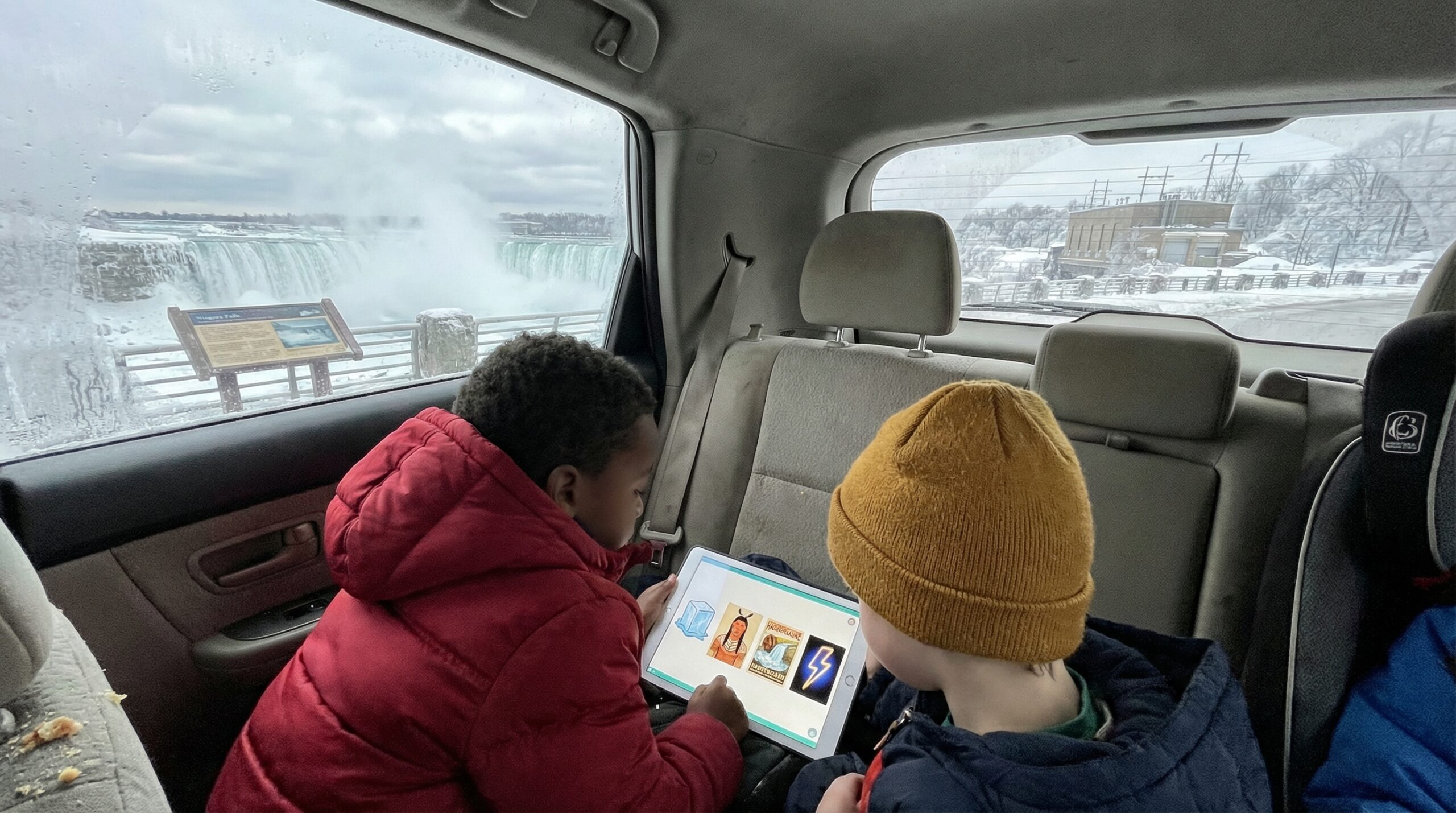
- In winter, the spray can freeze into glittering shapes.
Read or listen to a story about Niagara Falls now: Read or listen to a story about Niagara Falls now: For 3-5 year olds, For 6-8 year olds, For 8-10 year olds, and For 10-12 year olds.
We turned Niagara Falls into a kid-friendly audio story on Storypie, with glaciers, Haudenosaunee stories, daredevils, and Tesla’s spark for clean power. It feels cozy on a winter morning. It also makes a perfect short listen on the school run to spark one curious question. Get the app: Get the Storypie app.
Conservation and safety
People agreed long ago to balance power and nature. Treaties and flow controls help protect the falls and local wildlife. Stay behind barriers and follow park rules. Finally, talk with children about why we protect places we love. As of July 1, 2024, the estimated population of Niagara Falls, New York, was 47,512, a 2.4% decrease from April 1, 2020, which gives a sense of the community surrounding this natural wonder.
The test of a visit is simple. If a child walks to the railing and asks another question, the place is doing its job. Wonder-filled, brief, and ready to teach, Niagara is a story you can hear, touch, and remember.