
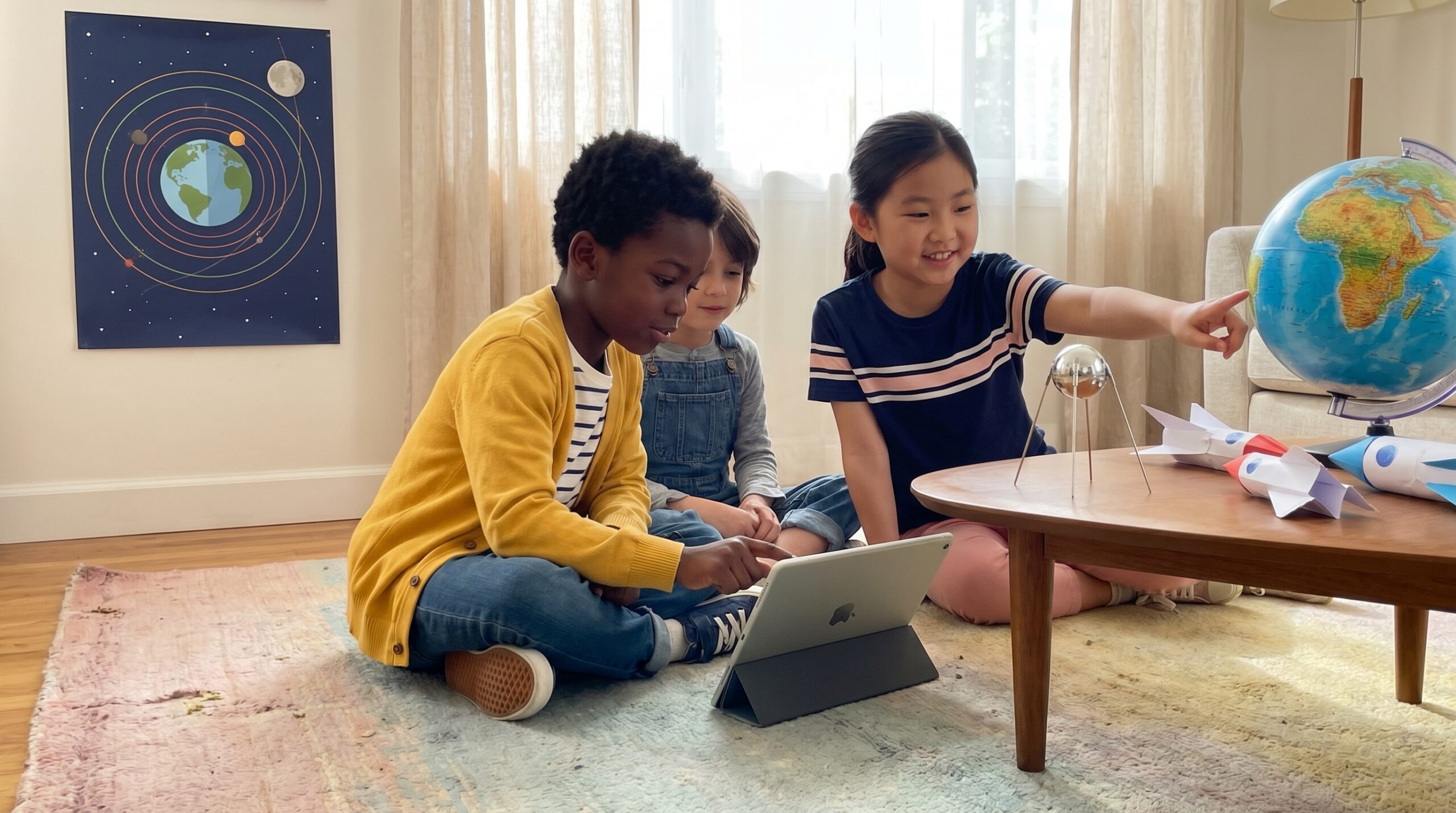
A satellite for kids often begins with a tiny beep. I remember that sound. It was simple and surprising. That steady radio beep from Sputnik made space feel close and magical.
Read or listen to a story about Satellite now: For 3-5 year olds, For 6-8 year olds, For 8-10 year olds, and For 10-12 year olds.
What is a satellite for kids
A satellite is an object that orbits a larger body. For example, the Moon orbits Earth, so it is a natural satellite.
Artificial satellites are human made machines that circle Earth. Some are big like a school bus. Others are tiny CubeSats that students can build. As of February 2024, NASA reported approximately 9,300 active satellites and roughly 31,000 trackable objects in Earth orbit, including about 5,410 active Starlink satellites.
Why Sputnik matters
Sputnik 1 launched on October 4, 1957. It sent a steady, simple beep people heard on radios around the world. That tiny beep made space real to many families.
Because of Sputnik, people paid attention to satellites. For many kids, the beep becomes a moment of wonder. It shows how something small can feel huge.
How satellites stay up
Think of swinging a ball on a string. If you throw the ball sideways fast enough, it will not fall straight down. Gravity pulls. Forward speed keeps the ball circling.
In short, balance equals orbit. This clear image helps explain why satellites keep moving around Earth.
Orbit types and uses
- Low Earth Orbit (LEO) sits close to Earth. It hosts the International Space Station and many observation satellites.
- Medium Earth Orbit (MEO) is home to navigation satellites such as GPS.
- Geostationary Orbit (GEO) stays high above the equator. It appears to hang in one place for TV and weather services.
- Highly Elliptical Orbit (HEO) swings in and out. It gives long views over certain regions.
Common satellite jobs
Satellites help us every day. They guide phones and cars with GPS. They bring weather forecasts. They beam television and internet signals. They also map floods and assist in emergencies.
Scientists use satellites to study planets and stars. Military and communications uses exist too. For kids, satellites show how science helps daily life. In 2023, the global space economy generated $400 billion in revenue, with the commercial satellite industry accounting for $285 billion, or 71% of the total.
Parts of a satellite
- Solar panels and batteries that provide power
- Payloads such as cameras or sensors
- Antennas for sending and receiving signals
- Onboard computers and thermal controls
- Sometimes small rockets for course adjustments
Simple demo for parents
Swing a ball on a string to show a child how orbit works. Then, pause and ask a single open question. For example, ask: Why was Sputnik’s beep so important?
Also, you can revisit the Sputnik story on Storypie if you want a short listening moment and a spark of curiosity.
Safety note
Space is busy now. Old satellites and fragments create debris. Engineers plan deorbiting and graveyard orbits to reduce risk. Teaching stewardship helps children care about the sky.
Final thought
Satellites mix science and story. They offer wow moments and real tools for life on Earth. Tiny beeps can lead to big ideas and lifelong curiosity.