
Simple Machine for Kids: What it Is
Simple machine for kids is a friendly way to name basic tools that make work easier. They have few or no moving parts. In short, they change force, direction, or distance so you push less hard. Research shows that the six classical simple machines are the lever, inclined plane, pulley, wedge, screw, and wheel and axle. Kids see these tiny helpers everywhere at home.
Six Simple Machines and Easy Home Examples
Below are the classic six simple machines and a fun household example for each. For example, a long spoon can act like a lever.
- Lever: a rigid bar that pivots on a fulcrum. Example: a seesaw or a long spoon used to lift a lid. A lever’s mechanical advantage is determined by the ratio of its two arms.
- Wheel and axle: a wheel fixed to a smaller axle. Example: a door knob or a rolling toy.
- Pulley: a grooved wheel for a rope. Example: a curtain ring or a clothesline pulley.
- Inclined plane: a flat surface tilted to lift things. Example: stairs or a ramp made from a book. An inclined plane reduces the effort needed to raise loads; the steeper the angle, the more effort is required.
- Wedge: two inclined planes back to back. Example: a knife or a chisel.
- Screw: an inclined plane wrapped around a cylinder. Example: a jar lid or a bolt. A screw is essentially a long inclined plane wrapped around a shaft.
How Simple Machines Help
Simple machines give mechanical advantage, which means you multiply your effort. For a lever, compare the effort arm length to the load arm length. For a ramp, compare the ramp length to the height. Also, for a pulley, count the rope segments holding the load. For a wheel and axle, compare the wheel radius to the axle radius.
Simple math shows why you push less hard but over a longer distance. Remember that simple machines do not create energy. Instead, they trade force for distance, and friction reduces some efficiency.
Compound Machines at Home
Many everyday tools mix simple machines. For example, scissors use two levers and two wedges. A wheelbarrow is a compound machine combining a lever and a wheel and axle. Noticing parts helps kids spot design in objects around the house.
A Short History Snapshot
The wheel appeared around 3500 BCE. Egyptians likely used long ramps and levers to move heavy stone blocks for pyramids. Archimedes studied levers in the third century BCE and invented the Archimedes screw to lift water. Later, Renaissance engineers like Leonardo da Vinci drew and combined simple machines to solve problems.
Quick, Safe At-Home Activities and a 10-Minute Scavenger Hunt
Try these short activities to explore simple machine for kids in a playful way. Keep everything light and supervised.
- Hunt: Find three simple machines around the house and name their types.
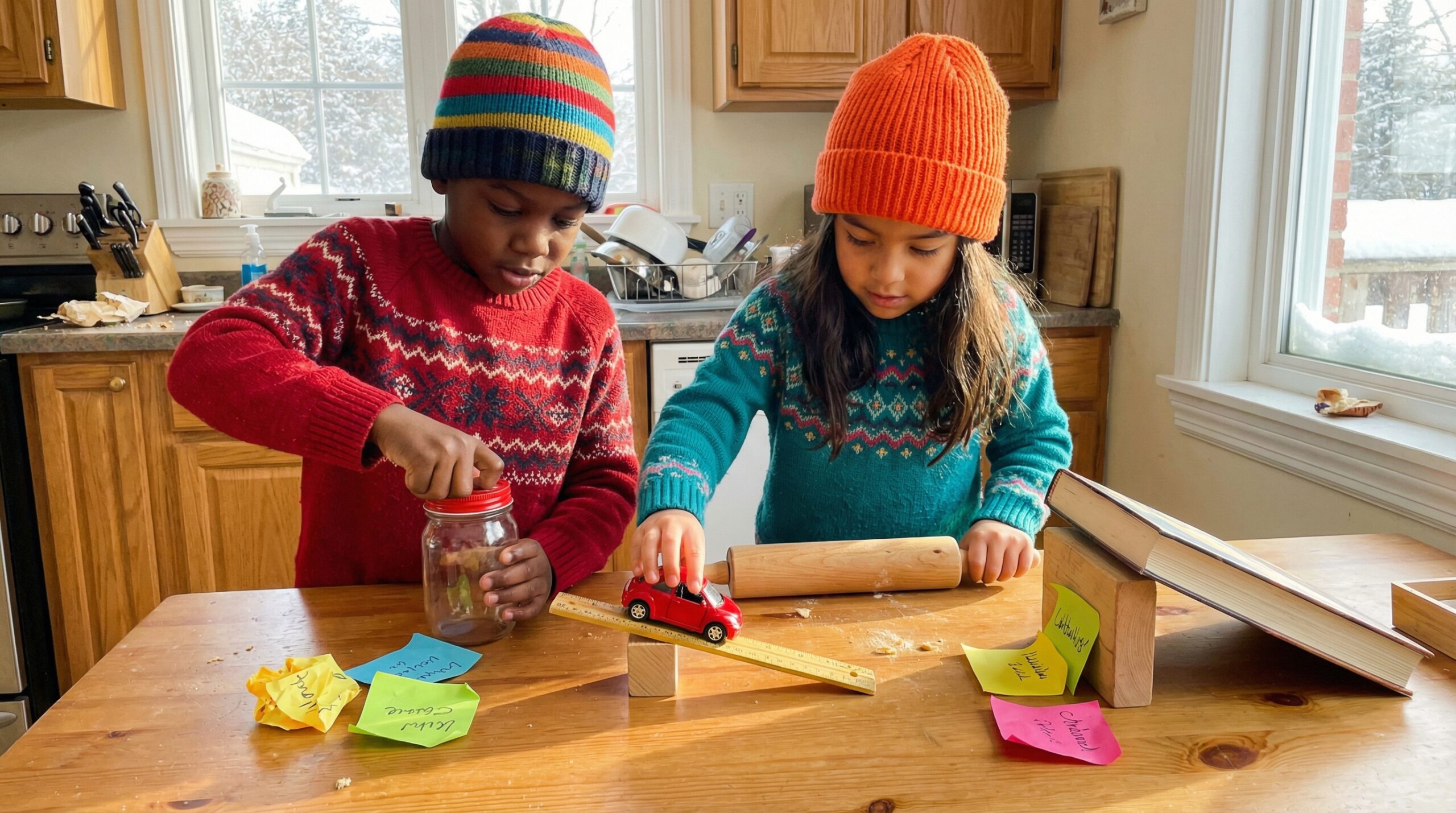
- Build: Make a lever with a ruler and a small block to lift a toy. First place the effort near the end. Next, move it closer to the fulcrum and feel the change.
- Ramp test: Roll a toy car on a flat table and then down a book ramp. Time how fast it goes and change the slope.
- Pulley demo: Use a spool and string to make a simple block and tackle and feel how the effort changes.
Safety tip: supervise sharp wedges and heavy loads. Also, keep experiments light and playful.
Read or listen to more
Read or listen to a story about Simple Machine now: For 3-5 year olds, For 6-8 year olds, For 8-10 year olds, and For 10-12 year olds.
Also, visit the main concept page for more Simple Machine resources: Simple Machine concept page.
Teaching Connections for Parents
Link simple machines to force and energy in science, to ratios and measurement in math, and to design thinking in engineering. Short experiments and quick observations make the ideas stick. Then watch a child say, I tried that, and it worked.
Finally, if you want short stories that match these ideas, explore Storypie for playful reads and audio stories. Visit Storypie for related concepts and collections.