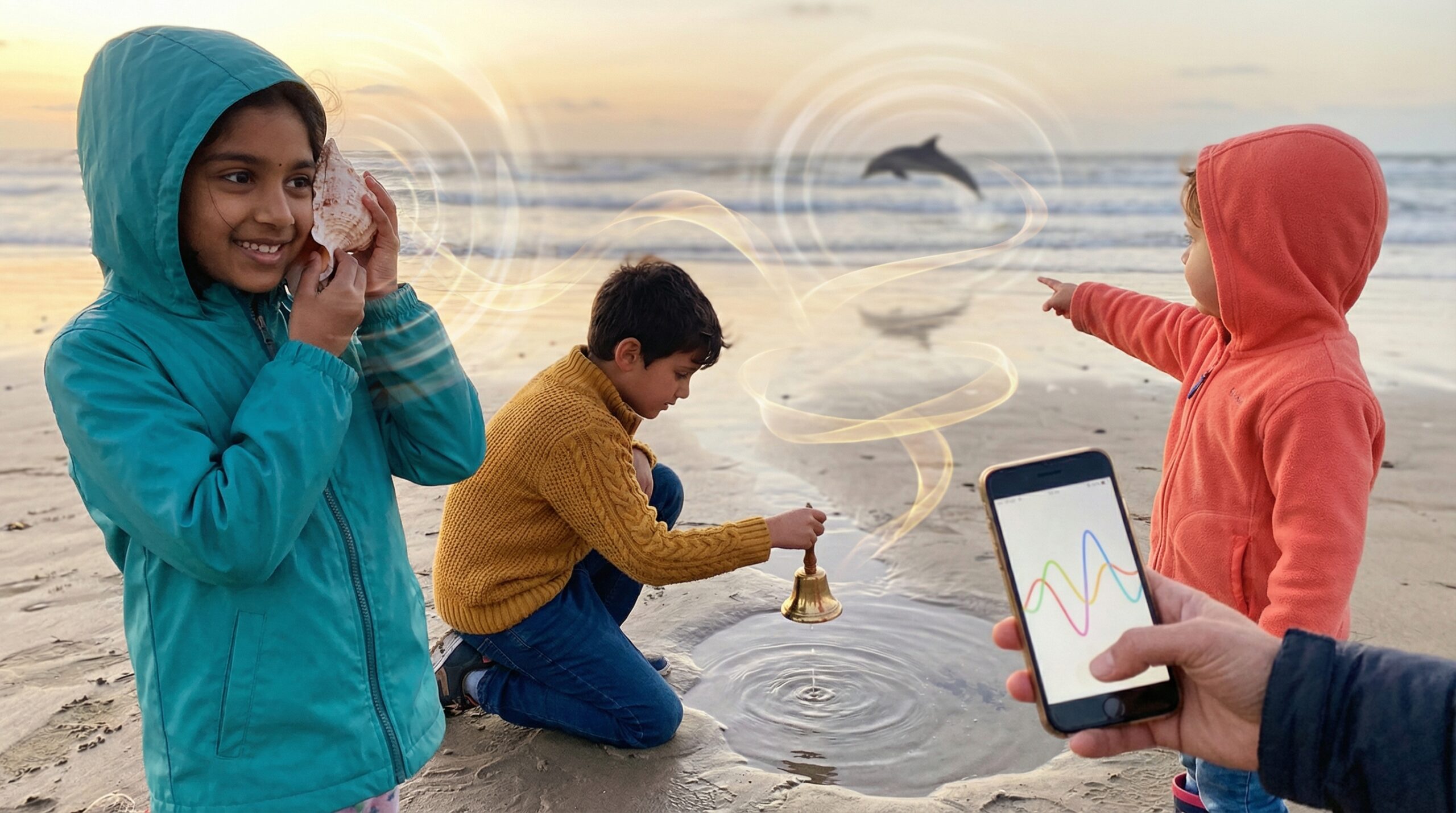
Sound waves for kids can open up a world of curious listening. Take a ten minute listening walk with a child. Stand still. Name three sounds. It is a simple, joyful science moment.
What are Sound Waves for Kids?
Sound is vibration. Something moves and it pushes air, water, or a solid. Those pushes travel as a wave made of compressions and rarefactions. In air, the wave moves as a longitudinal ripple, not like pond ripples.
Three things to notice
First, frequency is how fast vibrations happen. We hear frequency as pitch. Low frequency sounds feel deep. High frequency sounds sound squeaky. Humans can hear frequencies ranging from 20 Hz to 20,000 Hz (20 kHz), which is crucial for understanding how sound waves are perceived by kids.
Next, amplitude is how big the vibrations are. We hear amplitude as loudness. Bigger vibrations mean louder sound.
Finally, wavelength is the distance between compressions. Speed ties these ideas together. In fact, speed equals frequency times wavelength. For example, in dry air at 20 °C, sound moves about 343 meters per second (1,125 feet per second). In water, it moves much faster, about 1,482 meters per second (4,869 feet per second), highlighting the difference in sound propagation in different mediums.
How ears work
The outer ear gathers sound and funnels it in. Then the eardrum vibrates. Tiny bones pass the motion to the inner ear. There, hair cells change motion into signals the brain reads. People usually hear from about 20 Hz to 20,000 Hz. Children often hear higher tones than adults. If you worry about hearing, see a professional.
Echoes, reverberation, and resonance
An echo is a sound reflection that returns later. You need space for a clear echo. About a 17 meter round trip makes a 0.1 second delay you can notice. Reverberation is many reflections that blur together. Resonance happens when an object favors a frequency. That is why bells ring, glasses sing, and guitar strings make clear notes.
Beyond our ears
Some animals hear and use sounds we cannot. For example, dolphins and bats use echolocation. They hear ultrasonic clicks. Dolphin clicks can reach 100,000 to 150,000 Hz. Ultrasound matters in nature and science.
Quick experiments and safety
Try short, hands-on demos that fit a busy day. Always supervise closely.
- Bell test: ring a bell near a wall and then in an open yard.
- Whisper test: whisper at different distances and notice how sound fades.
- Paper cup telephone: make two cups linked by a taut string.
- Slinky demo: stretch a Slinky and nudge it to show compressions.
- Rice on a drum: watch vibrations make rice jump.
Also, protect little ears. Sounds above about 85 dB can harm young hearing after long exposure. An estimated 12.5% of U.S. children and adolescents aged 6–19 years (≈5.2 million) have permanent hearing damage from excessive noise exposure. Fireworks and loud concerts reach dangerous levels. Use ear protection and limit headphone time and volume.
Make it short and playful
Try the ten minute listening walk. Ask simple, playful prompts.
- Preschool: What do you hear now?
- Early elementary: Can you find the highest and lowest sounds?
- Older kids: How does tension change pitch?
Keep experiments brief. Follow up with a favorite story or a cozy chat.
Read or listen to a story about Sound Waves now: Read or listen to a story about Sound Waves now: For 3-5 year olds, For 6-8 year olds, For 8-10 year olds, and For 10-12 year olds.
Want more ideas? Visit Storypie for gentle, story-led science play.