Space rocket for kids is a great way to spark curiosity at home. A space rocket makes its own air. It carries both fuel and an oxidizer. In plain terms, it pushes mass out the back. As a result, the rocket moves forward. That idea follows Newton’s third law. Say the word thrust and eyes widen. Add a countdown and a dim bedroom, and curiosity blasts off.
Rockets and history
Rockets began as simple firework devices in China over a thousand years ago. Modern rocket theory grew with thinkers like Konstantin Tsiolkovsky. Builders such as Robert H. Goddard launched the first liquid fuel rocket in 1926. Key milestones include Sputnik 1 in 1957, Yuri Gagarin in 1961, and Apollo 11 in 1969. More recently, reusable boosters such as SpaceX Falcon 9 changed the game, with a payload capacity to low Earth orbit (LEO) of up to 22,800 kg (50,265 lb), showcasing the impressive capabilities of modern rockets. Families often love the dramatic stories behind each milestone.
How a space rocket for kids works
Think of a rocket in clear parts. The main parts are:
- payload and payload fairing
- stages and engines
- propellant tanks and guidance systems
Staging is clever. When the first stage runs out of fuel, it drops away. This makes the remaining rocket lighter and faster. To reach orbit you need sideways speed. For low Earth orbit you need roughly 7.8 km per second. Suborbital flights cross the Karman line at about 100 km. However, they do not reach orbital speed. In 2023, the world set a new record with 210 successful orbital launches, with the United States contributing 109 of these, illustrating the competitive landscape of global space exploration.
Thrust, orbit, and simple words
Use short glossary words when you talk with kids. For example: thrust, fuel, oxidizer, orbit, stage, payload, booster, astronaut. These words stick. They help curious minds link story to science.
Types, fuels, and safety
Rockets use solid, liquid, or hybrid propellants. Liquid engines such as RP-1 with liquid oxygen can throttle and sometimes restart. Solids provide strong and simple ignition. Modern launch safety includes launch ranges and flight termination systems. National authorities set strict rules. Also, environmental effects matter. High altitude exhaust and black carbon can change air chemistry. Space debris from spent stages remains a global concern. In 2025, SpaceX set a new record with 165 orbital launches, marking its sixth consecutive year of breaking its own launch record, up from 134 in 2024 and 25 in 2020, emphasizing the rapid advancements in space launch capabilities.
Family-friendly activities and ideas
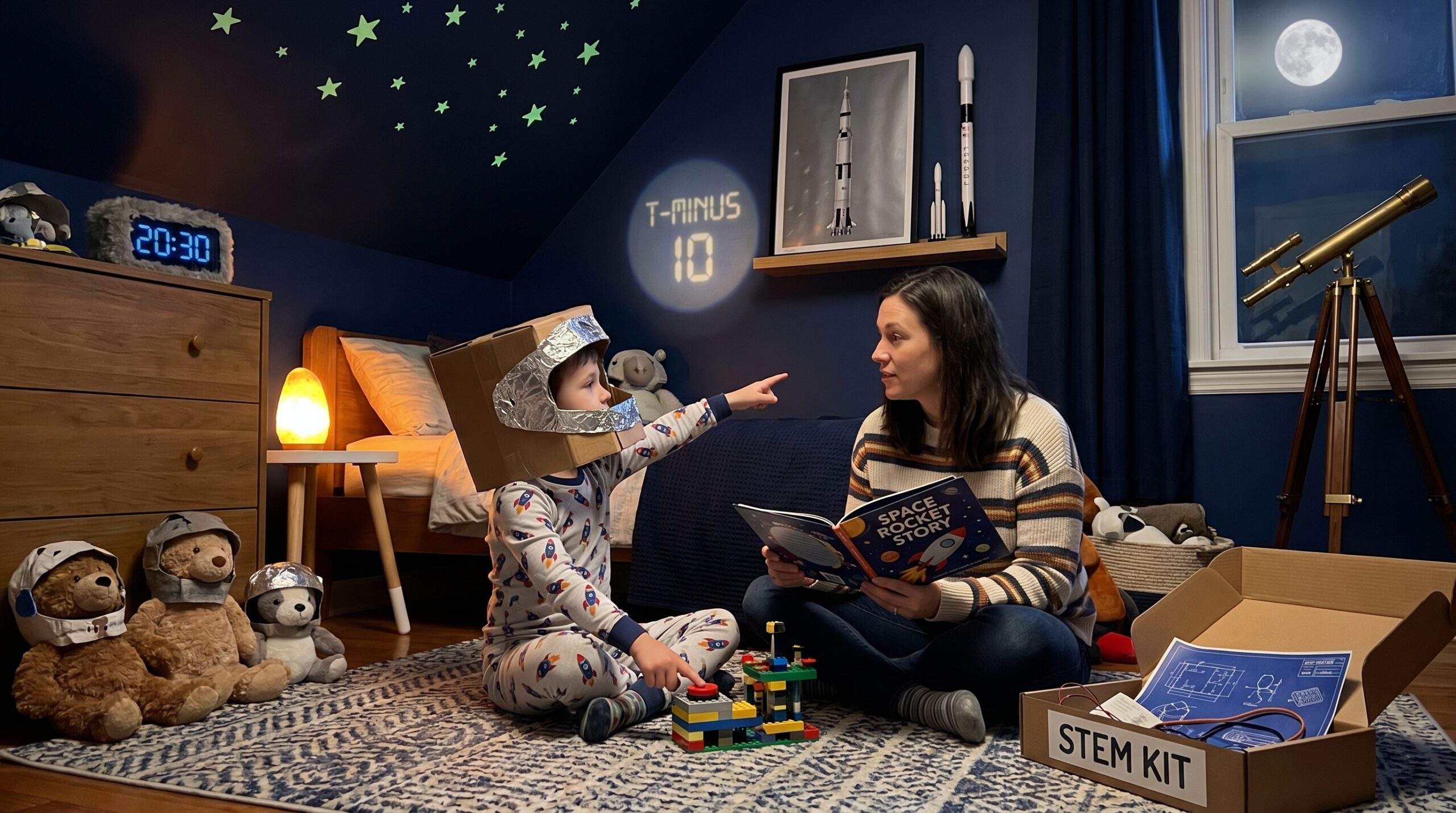
Try simple experiments that show thrust. For example, a balloon rocket makes the idea clear. A water rocket offers a safe backyard launch. Visit a space museum or watch a live launch webcast. For bedtime, dim the lights, count down, and ask one Moon question. These small rituals create big wonder.
Read or listen to a story about Space Rocket now: Read or listen to a story about Space Rocket now: For 3-5 year olds, For 6-8 year olds, For 8-10 year olds, and For 10-12 year olds.
Why a space rocket for kids matters
Rockets place satellites, enable science, and carry people beyond Earth. They offer families an exciting entry to STEM. Rockets are dramatic, historical, and hands on. Also, they invite lifelong questions. In 2023, SpaceX launched 98 rockets, comprising 91 Falcon 9s, five Falcon Heavies, and two Starships, showcasing the variety and volume of launches conducted by this innovative company.
Final thought
Rockets mix poetry and physics. With a clear analogy, a small experiment, and a good story, wonder can take off. Try a mini-launch tonight and watch imaginations orbit. For more gentle stories and playful prompts, visit Storypie or get the app.