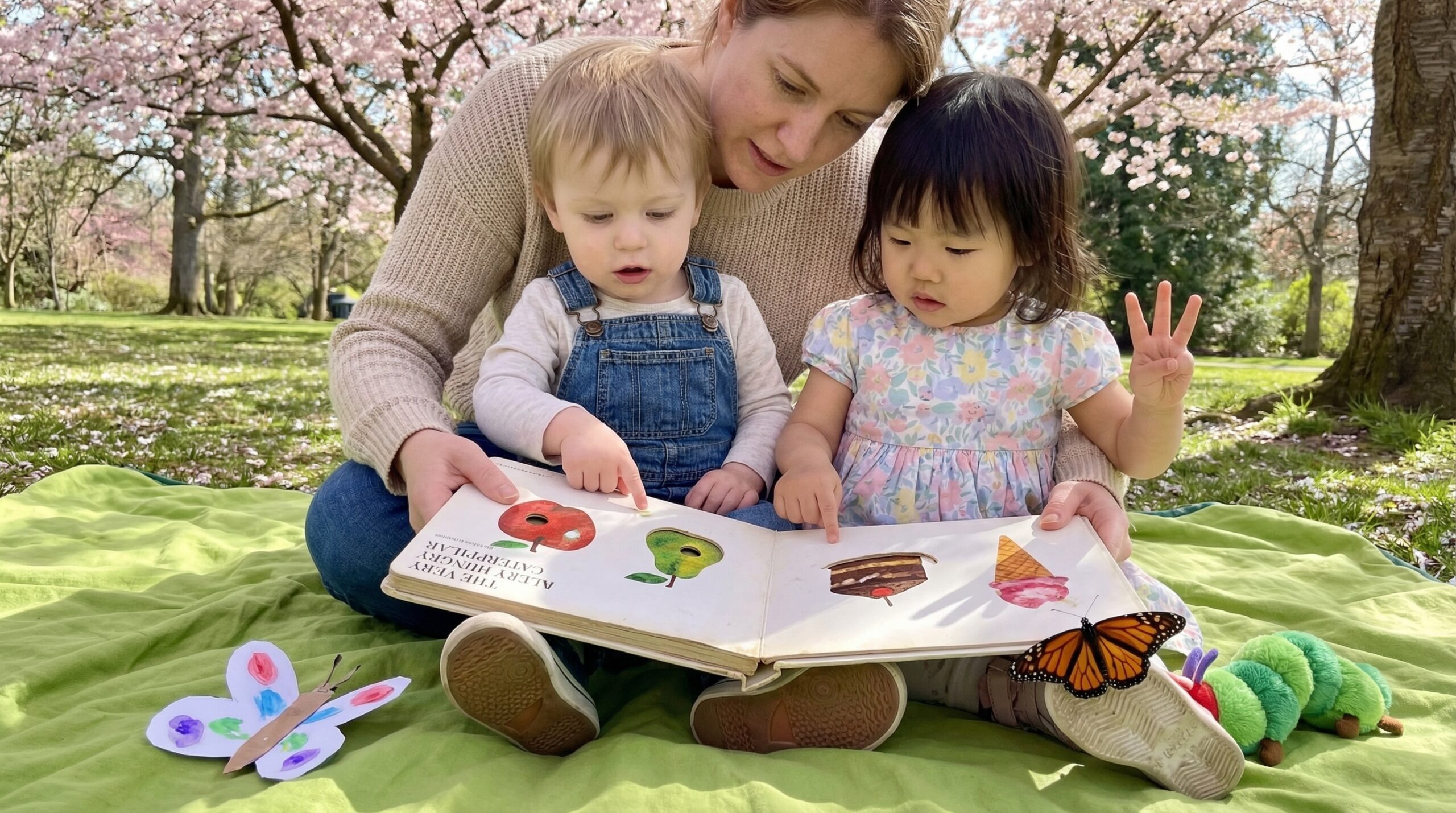
The Very Hungry Caterpillar book is tiny but mighty. At Storypie we love its bright collage art and playful holes.
Why The Very Hungry Caterpillar book remains beloved
Eric Carle wrote and illustrated this picture book in 1969. His hand painted papers, cut and layered in collage, give the pages vibrant texture. Also, the book’s die cut holes show what the caterpillar has eaten. Those holes make the book tactile, playful, and perfect for read alouds. As of 2021, *The Very Hungry Caterpillar* has sold over 55 million copies worldwide, solidifying its status as a beloved classic.
Simple structure, big learning
The story follows a caterpillar that hatches and eats through increasing amounts of food. Then the caterpillar rests and becomes a butterfly. The pattern names the days of the week. It also counts food: one apple, two pears, three plums, and more. That repetition supports early number sense, sequencing, and vocabulary. Research shows that repetitive structures in children’s literature aid in language acquisition and cognitive development.
Quick facts that matter
- Author and illustrator: Eric Carle (1929 2021).
- First published: 1969.
- Reach: reported sales over 55 million copies and translations in more than 75 languages.
- Formats: board books, picture book editions, large group formats, apps, toys, and licensed materials.
- In 2020, the book sold 610,032 print copies in the U.S.
A short science note for curious preschoolers
The book uses the word cocoon for the resting stage. Educators often point out that butterflies form a chrysalis. For accuracy, you can introduce metamorphosis and the life cycle: egg, caterpillar, chrysalis, butterfly.
Ways families can play and learn after reading
Here are simple, playful ideas that extend the story. Try one or try them all.
- Count the foods out loud and with fingers or toys.
- Ask which day comes next. Practice first, next, finally.
- Point through the holes and predict what the caterpillar ate.
- Make a paper chain caterpillar or paint collage papers and cut shapes.
- Sequence picture cards for the life cycle and retell the story.
Classroom and bilingual uses
Teachers value the book for circle time and emergent math. Board book editions are ideal for toddlers. Large format books work well for group reading. Translated editions and interactive apps make the story easy to use with bilingual families. The rhythmic text, bold images, and tactile pages invite participation and memory building. In fact, the board book edition saw a significant increase in sales, with 35,018 units sold in the UK from January to March 2025, marking a resurgence in popularity.
Read or listen to a story about The Very Hungry Caterpillar (book) now: Read or listen to a story about The Very Hungry Caterpillar (book) now: For 3-5 year olds, For 6-8 year olds, For 8-10 year olds, and For 10-12 year olds.
To make reading easy and joyful, try Storypie’s prompts and audio narration. Also, explore Storypie for flexible prompts and delightful characters. Finally, read, count, and imagine together. A small book with holes can open big worlds. This year, the story has also made its way to the stage, with The Eric Carle Story Show featuring *The Very Hungry Caterpillar* performing at Theatre 555 from August 13, 2023, through December 31, 2023.