
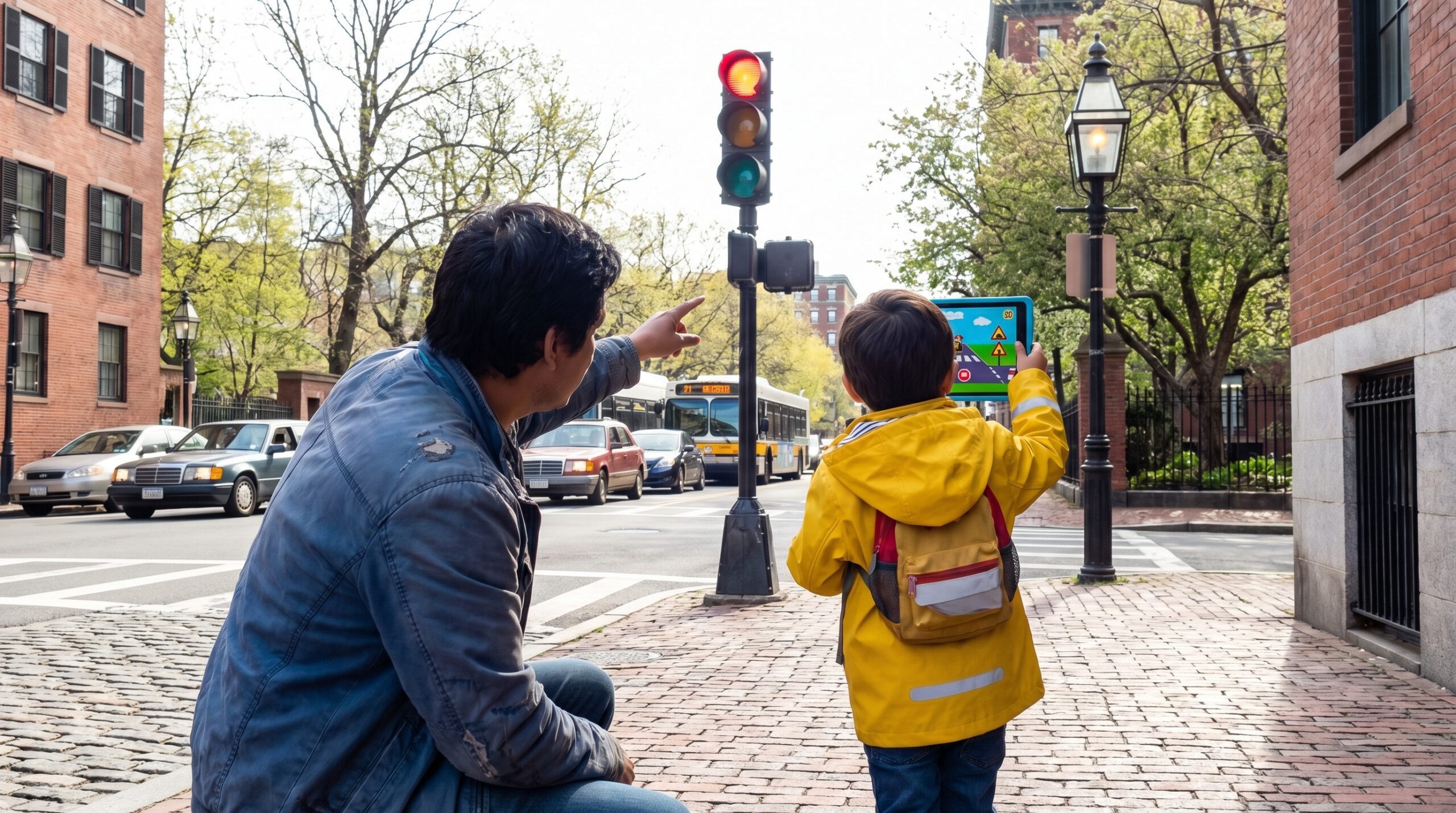
Traffic light safety for families starts with a tiny, bright idea that changed streets. First used in 1868, a gas-lit semaphore stood outside Parliament. That first lamp exploded and went away, yet the idea stayed.
A short history of the traffic light
By the 1910s electric signals began to appear as cars grew common. Then the three colours red, amber and green became standard in the 1920s. This addition gave drivers a safe transition between stop and go. However, despite these advancements, traffic safety remains a significant concern, as in 2023, 1,086 people were killed in crashes that involved red-light running, highlighting the ongoing need for effective traffic control measures.
How traffic lights work today
Today, the system is simple and clever. Red means stop. Amber tells drivers to prepare to stop or clear the junction. Green means go when safe. Controllers set timings and phases. Sensors like inductive loops, video and radar detect traffic and can change green times. In fact, a study by the Insurance Institute for Highway Safety (IIHS) found that red-light safety cameras reduced the fatal red-light-running crash rate in large cities by 21%, emphasizing the importance of technology in enhancing road safety.
Lights, bulbs and accessibility
Many signals now use LEDs. LEDs are bright and save energy. Pedestrian displays show icons or WALK and DON’T WALK words. You may see arrows, countdown timers, and audible beeps. Tactile pushbuttons help visitors with sight loss. Also, leading pedestrian intervals give walkers a head start before vehicles move. Recent data shows that in 2023, approximately 44% of signalized intersections along the National Highway System in the central Puget Sound region were equipped with Accessible Pedestrian Signals, up from 31.9% in 2019, indicating progress in making traffic signals more inclusive for pedestrians.
Traffic Light Safety for Families: Simple rules
Families can use a few clear rules to stay safe. First, hold hands near roads and stop at the curb. Next, wait for the green or walk signal before stepping out. Then, look left and right and look again, even on green. Use marked crossings and try to make eye contact with drivers. Finally, never run into the road.
- Hold hands at the curb.
- Wait for the green or walk signal.
- Look left, then right, then left again.
- Use marked crossings and make eye contact where possible.
- Do not run into the road.
Quick safety game for kids
For a playful practice, try a sidewalk game. Call out a colour and have children show the right action. For example, hands up for stop, ready stance for amber, and march on the spot for green. Make it cheery and give the child the title of traffic captain for a laugh.
Smart intersections and sensors
Modern developments make junctions smarter. Adaptive signal control reacts to real-time traffic. Some systems prioritise buses or emergency vehicles. Cameras, radar and inductive loops watch traffic and cyclists. Connected systems can speak to traffic centres. In big cities, signals may let buses pass faster or clear a path for an ambulance. For instance, a report by the U.S. DOT indicated that in Florida, the implementation of adaptive signal control technology resulted in a travel-time reduction of over 9% across eight corridors, demonstrating the benefits of modern traffic management technologies.
Why this matters to families
Traffic light safety for families helps children learn routine, caution, and attention. Kids love spotting lights on walks. Try a bingo card and collect matches to make outings more fun. Also, short talks after a walk reinforce meaning and safety without being heavy.
Read or listen to a story about Traffic Light now: For 3-5 year olds, For 6-8 year olds, For 8-10 year olds, and For 10-12 year olds.
For a cheery follow-up, listen on Storypie and ask your child to name the colours like a traffic captain. Visit Storypie for more bright, short inventions and histories.