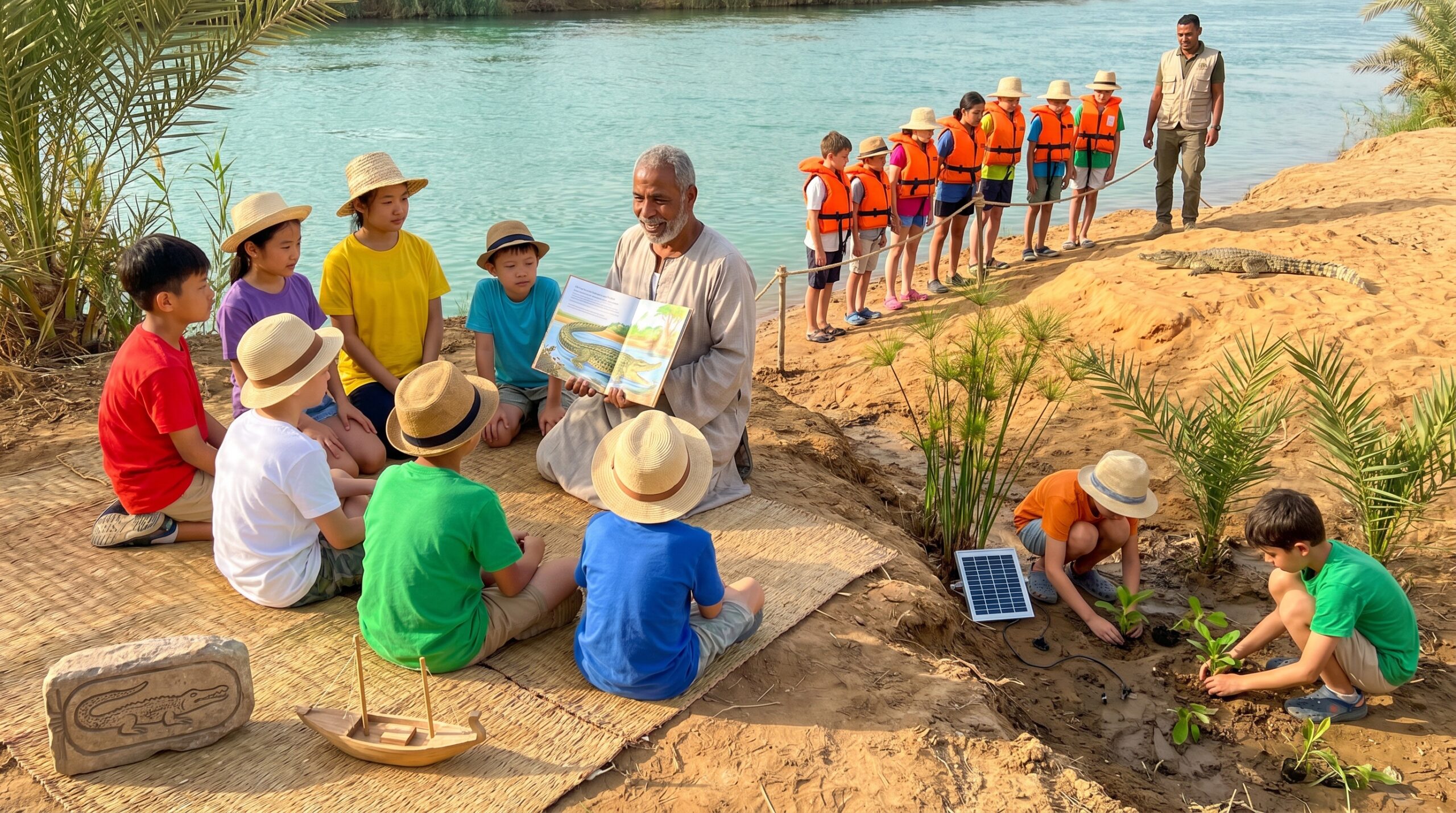
Nile crocodile facts for kids start with a simple picture. I see a Nile crocodile sunning on a muddy bend. It looks ancient and ordinary at once. Kids ask, Why does it matter? That question opens a big conversation.
Read or listen to a story about Nile Crocodile now: Read or listen to a story about Nile Crocodile now
Nile crocodile facts for kids: Size and habitat
The Nile crocodile lives across sub-Saharan Africa and the Nile basin. It prefers rivers, lakes, marshes and seasonal floodplains. Adults commonly reach three to five meters long, with adult male Nile crocodiles typically reaching lengths of 4 to 4.5 meters (13.1 to 14.8 feet) and weighing about 410 kg (900 pounds). Big males can be even longer. They carry hundreds of kilograms and a lot of presence. Also, they fit river life like armor fits a knight.
What makes the Nile crocodile a river superstar
They have thick scaly skin with bony plates called osteoderms. These plates protect and help regulate temperature. Eyes and nostrils sit on top of the head. As a result, a crocodile can watch while staying mostly hidden. Tiny pressure sensors on the jaws sense a fish flick a meter away. Night vision is excellent. Their bite is famously powerful. Then, when they need to break down a large meal, they may spin in a death roll. Yikes and wow.
Quick facts to share at bedtime
- Scientific name: Crocodylus niloticus.
- Typical length: 3 to 5 meters for most adults.
- Habitat: rivers, lakes, marshes, and floodplains.
Hunters and helpers
Nile crocodiles are ambush predators. They wait half-hidden at the water edge. Fish, birds, antelope and the occasional monkey are on the menu. Young crocodiles eat insects and small fish. Older crocodiles take larger prey. They also scavenge when times are tough. But they do an important job too. Crocodile holes hold water in dry seasons. Those holes help fish, frogs and thirsty animals. Thus, they act as ecosystem engineers for rivers and wetlands. The population of Nile crocodiles is estimated to be between 250,000 and 500,000 individuals, with between 50,000 and 70,000 being adults.
Family life: surprising and tender
Females dig nests on riverbanks and lay twenty to eighty eggs, with clutch sizes up to 80 eggs. Temperature helps decide whether eggs hatch male or female. Females usually reach sexual maturity at over 2.0 meters (often by age 10); males mature between ages 12 and 19. Mothers guard nests. When hatchlings call, the mother often digs them out. Then she carries them to water in her mouth. She may protect them for months. For many, that care feels both fierce and gentle.
Culture, safety, and conservation
In ancient Egypt people linked crocodiles to the god Sobek. Crocodiles symbolized the Nile’s power and fertility. Some were even mummified. That mix of awe and caution lives on today. If you visit crocodile country, supervise kids near water. Avoid swimming at dawn and dusk. Never feed or approach crocodiles. Nile crocodiles are responsible for several hundred confirmed human deaths per year; however, many attacks may go unreported, suggesting the true figure could be higher. The Nile crocodile is listed as Least Concern globally. However, it faces local threats from hunting, habitat loss and pollution. Protected areas and community programs have helped some populations recover. They can live between 40 and 60 years in the wild, making their conservation even more critical.
Try a gentle family activity
- Draw a crocodile hole and label who uses it.
- Compare a crocodile to a small car to show scale.
- Do a hat-and-cup experiment to explain temperature and egg sex.
I love how creatures this fierce also shape rivers and stories. Share a Storypie tale, then ask that one question again. How does the crocodile help the river? It opens a whole conversation about wildlife, history and stewardship.
Read or listen to a story about Nile Crocodile now: For 3-5 year olds, For 6-8 year olds, For 8-10 year olds, and For 10-12 year olds.
For more kid-friendly tales and learning, visit Storypie.