
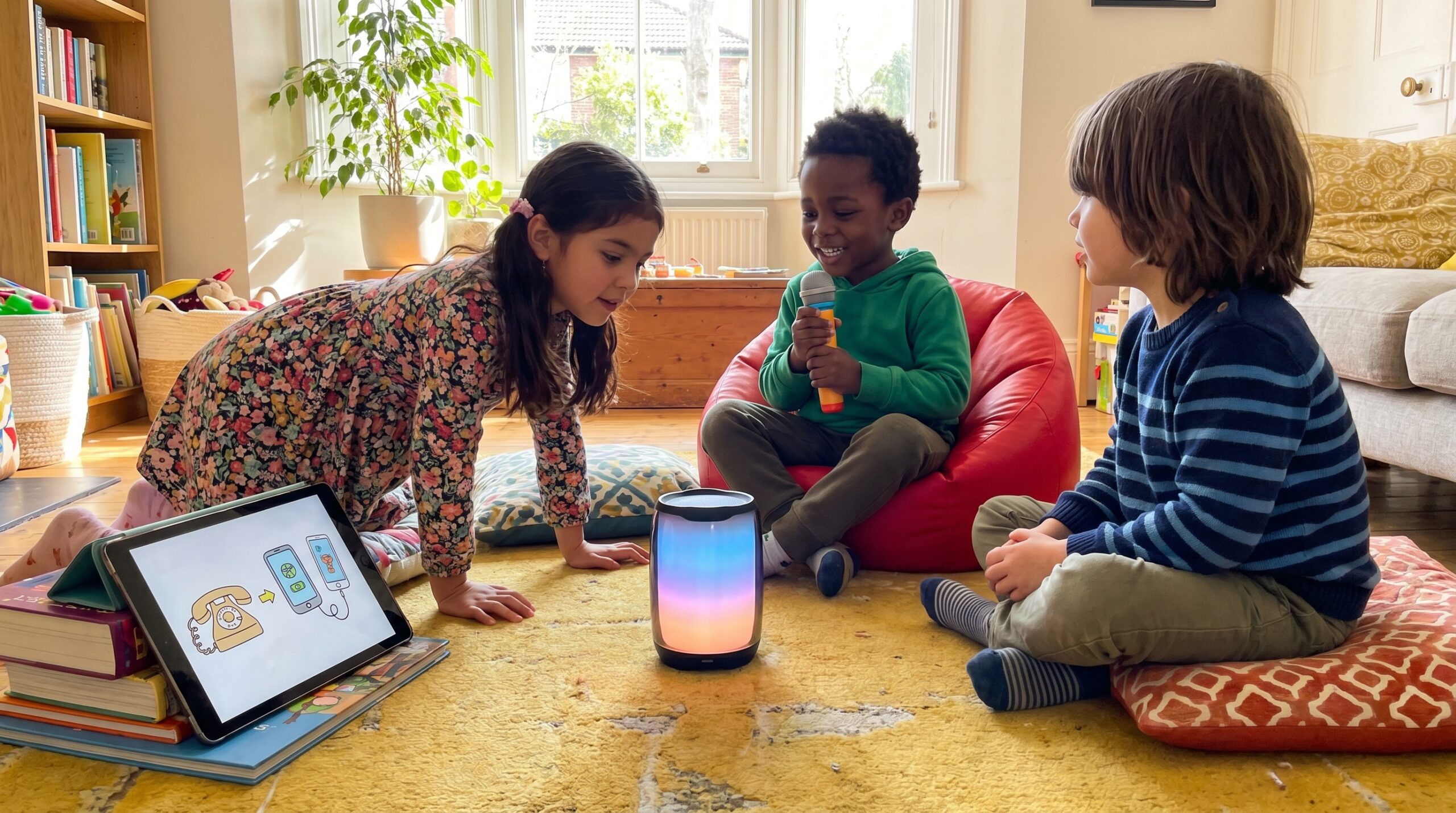
Voice assistant for families means a smart helper that listens, understands, and speaks back. Simply put, it answers questions, sets timers, plays music, and tells short stories. It often runs on a speaker or phone and feels like a tiny, friendly helper at home. As of 2025, there are approximately 8.4 billion voice assistants in use globally, surpassing the world’s population of 8.2 billion, highlighting their significance in modern technology.
What is a voice assistant?
A voice assistant is software that accepts spoken commands. Then it turns speech into text, detects intent, and replies by speaking or showing information. For example, you might ask for the weather or say, “Tell me a 5 minute story.” In fact, by 2025, 20.5% of internet users worldwide are expected to utilize voice search, indicating its increasing importance in how users interact with technology.
Quick history of voice assistants
Early voice tech began in the 1950s. Also, important steps followed in the 1960s and 1990s. Then companies launched household assistants in the 2010s. Notable milestones include Bell Labs Audrey, IBM Shoebox, Dragon’s dictation tools, Siri, Alexa, and Google Assistant. Tiny magic, indeed. The global voice assistant market was valued at $7.08 billion in 2024 and is projected to reach $59.9 billion by 2033, growing at a CAGR of 26.80% from 2025 to 2033, underscoring the rapid growth and economic potential of this technology.
How a voice assistant for families works
Under the hood are five core pieces. First, a wake word wakes the device. Next, automatic speech recognition converts sound to text. Then natural language understanding finds intent. After that, the system handles the action. Finally, it uses text to speech to reply. Also, some tasks run in the cloud, and more tasks run locally now for speed and privacy.
Core parts at a glance
- Wake word detection (for example, “Hey Siri” or “Alexa”)
- Automatic speech recognition (speech to text)
- Natural language understanding (figures out the request)
- Intent handling (decides what to do)
- Text to speech (friendly voice replies)
Friendly family uses
Families use voice assistants for short stories, timers, routines, and simple homework help. Also, kids practice language and listen to audiobooks. For example, a quick five minute story can calm a busy afternoon. Voice assistant use can spark curiosity and build language in small moments. In the United States, 153.5 million people are expected to use voice assistants in 2025, representing a 2.5% increase from 2024, showcasing their increasing integration into daily life.
Privacy, safety, and parental controls
Many devices send audio to cloud servers. Therefore parents should be mindful. Also, voice snippets may be stored for quality. Practical steps help keep things safer:
- Place devices in shared rooms.
- Create family or child profiles.
- Disable voice purchases or set a PIN.
- Turn on explicit content filters.
- Review and delete recorded voice history regularly.
- Use the visible mic indicator and the physical mute button when needed.
Accessibility and trends
Voice assistants help children with reading or visual challenges. Additionally, they support people with motor or speech differences. New trends include more natural voices, multilingual switching, local processing for privacy, and richer offline modes. Companies now offer diverse voice options to reflect more people. Interestingly, more than half of adults in the UK (54%) reported using a voice assistant in the past three months, with 66% of users favoring Amazon Alexa, demonstrating the popularity and usage patterns of voice assistants in a specific region.
Checklist: Setting up a Voice Assistant for Family Use
- Place the device in a shared space.
- Create family or child profiles.
- Disable purchases or set a PIN.
- Enable content filters.
- Teach simple rules for when kids can ask the assistant.
- Update firmware and review voice history periodically.
Read or listen to a story about Voice Assistant now: Read or listen to a story about Voice Assistant now: For 3-5 year olds, For 6-8 year olds, For 8-10 year olds, and For 10-12 year olds.
Explore Storypie for flexible prompts, delightful characters, and audio narration that make storytime super easy and fun. Also, try a Storypie story to see how a voice assistant can add tiny moments of delight.
Final thought
Voice assistant technology is not perfect, but it proves wonderfully useful. With a little setup and playful rules, it can spark curiosity and build language. Enjoy the tiny everyday delights.