
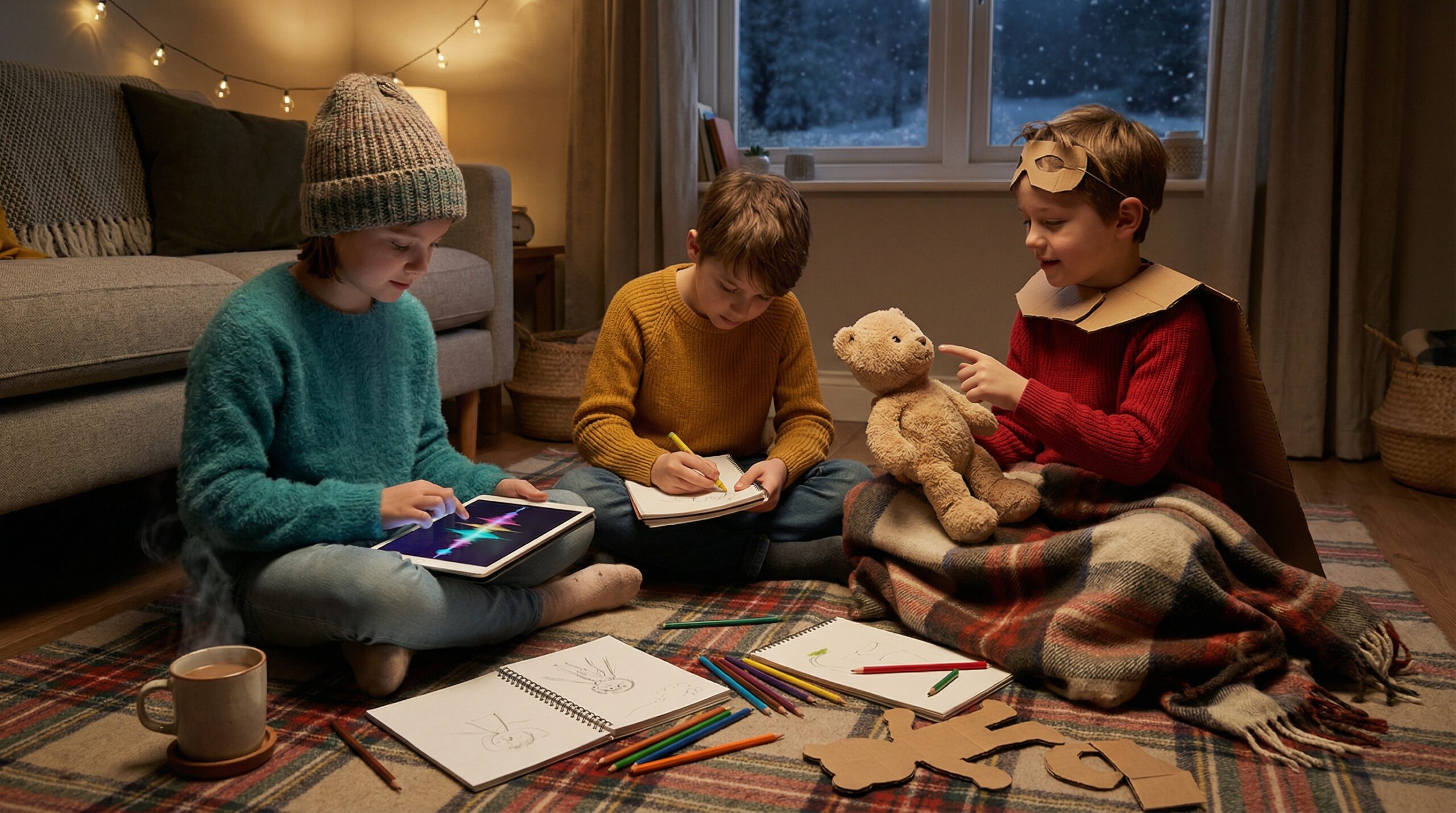
This weekend imagination challenge create your own hero began on a cozy Saturday. A wool hat became a helmet. My kid announced they were a rescue librarian. It took ten minutes. It felt like a tiny, mighty win.
Weekend imagination challenge create your own hero: Try it tonight
This challenge is simple and joyful. Parents and teachers love it because it fits busy evenings. Also, it invites playful surprise. You can start with a single object or a feeling. In fact, a 2024 report from the Institute of Imagination revealed that engaging children in structured creative activities can significantly boost their creative thinking by up to 100%.
Why this challenge matters
Pretend play teaches more than make believe. Inventing a hero builds vocabulary, perspective taking, emotion language, and confidence. For example, asking what a hero does when scared invites empathy practice. Additionally, a 2025 study involving 300 children found that creative activities like storytelling led to significant improvements in children’s imaginative skills, enhancing both their drawing innovativeness and storytelling richness. Also, short prompts give high impact in small doses.
A fast template that works
- Spark – Pick a simple object or feeling. I used a wool hat. You might pick a stick or blanket.
- Name – Ask your child to name the hero. Make it playful. “Captain Cuddle” is adorably brave.
- Backstory – One sentence: where are they from and what do they love? Keep it spoken.
- Fear – Ask “What would your hero do when they are scared?” This shifts toward coping and empathy.
- Strength – How do they help others? A power can be quirky, not supernatural.
- Share – Say it out loud or record it as a tiny souvenir.
How I run it: minute by minute
I set a timer. For toddlers I use ten minutes. For school-age kids I allow twenty minutes. Then I record one sentence as a short audio keepsake. Often I use the Storypie app to save and play back recordings. Hearing themselves makes the moment last. Engaging in such creative storytelling has been shown to produce a moderate improvement in narrative abilities in young children, as noted in a 2025 meta-analysis.
Age adaptations with examples
- Toddlers: Use textures and toys. Offer a cape with a bumpy patch. Ask what color makes the hero brave. Keep questions single-step.
- Preschool: Add a short feeling line. Try “My hero feels shy, but then they try.” Role-play with a toy.
- School-age: Introduce a small moral choice. For example: “Your hero finds a lost friend. Do they tell an adult or try to help alone?” Record the answer and ask why.
Formats and safety
You can use spoken play, drawing, role-play with props, or short audio prompts. Also, multimodal access helps different learners. Be inclusive. Offer options for varied bodies, cultures, and neurodiversity so every child sees themselves. When sharing on social media, use first names or pseudonyms, blur faces, and check privacy settings. Pretend play has been shown to enhance social skills and positive peer interactions, as demonstrated in a 2023 study involving preschool children.
How to use it tonight: quick checklist
- Timebox: Choose ten or twenty minutes.
- Choice: Offer two options, not a dozen.
- Speak: Narrate in first person for stickiness.
- Record: Save one short audio as a keepsake.
- Celebrate: Say one line of praise and clap for the hero.
Try this mini-experiment tonight. The weekend imagination challenge create your own hero turns a few minutes into memorable play. For more ideas, visit Storypie to store recordings and revisit the joy. Remember, a 2024 survey found that 75% of parents observed increased creativity in their children who regularly engage in reading activities.
Instagram-ready caption idea: Cozy Saturday spark a #Weekend #ImaginationChallenge. Ask “What would your hero do when they’re scared?” and tag Storypie.