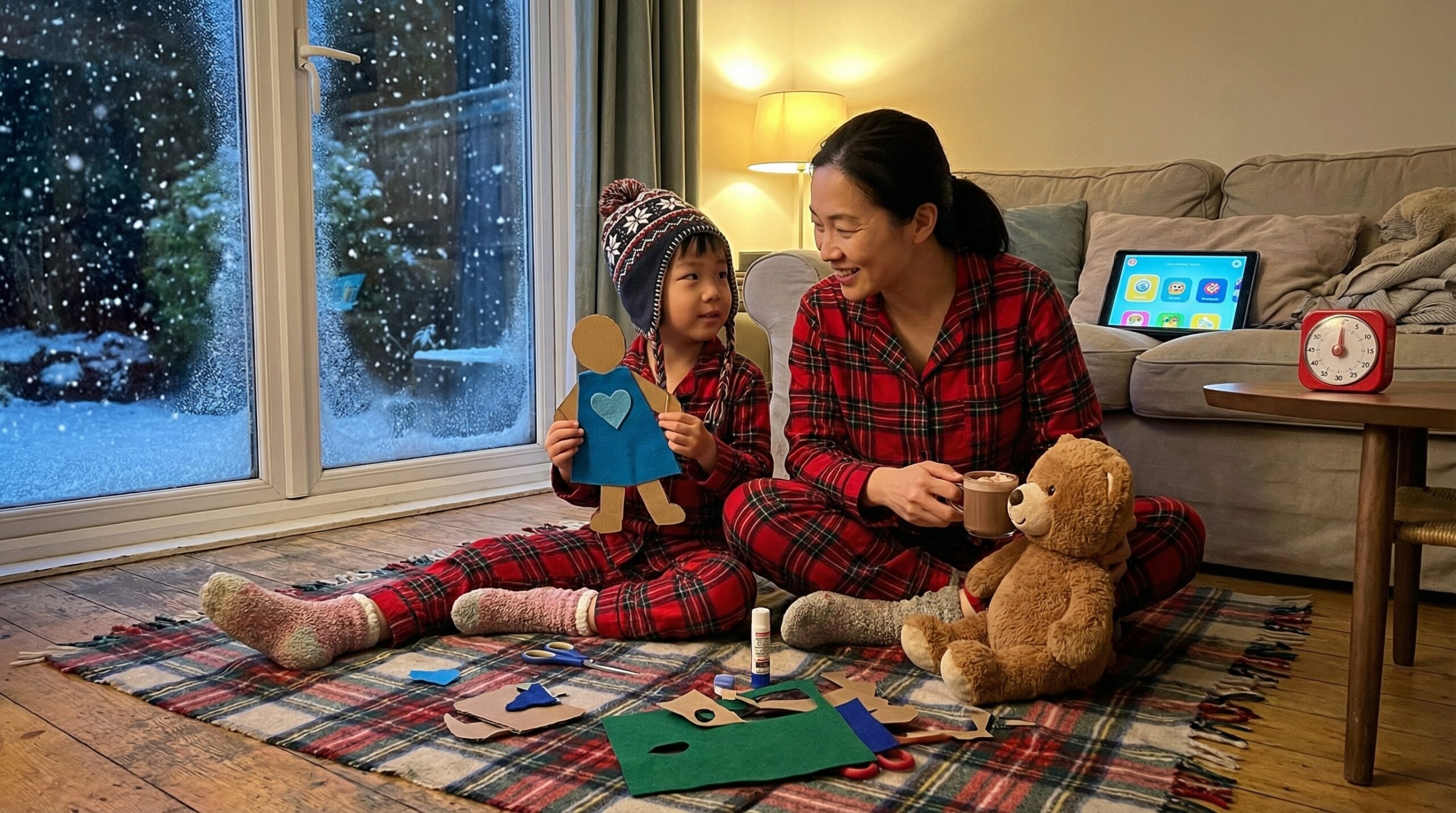
This weekend imagination challenge: create your own hero turns screen time into fresh play. It is low pressure and delightfully small. You can finish it in a cozy afternoon. Parents and teachers call it calming and brave. In fact, a 2023 survey by the American Psychiatric Association found that 46% of American adults reported using creative activities to relieve stress or anxiety.
Weekend imagination challenge: create your own hero
We tried this on a rainy Saturday. My child chose a sock puppet and named it Nova. We gave Nova one small kindness to do. Then we told a five minute story. The room softened and new words appeared. My child made a caring choice. That tiny loop of play felt brilliant and very human. This aligns with findings from a 2023 study by the Adobe Foundation and the National Alliance on Mental Illness, which revealed that 61% of participants who engaged in creative activities experienced reduced feelings of stress or anxiety.
Why it works for a cozy afternoon
It keeps steps short and the pressure low. Also, it invites curiosity and gentle risk. The project focuses on one small kindness. Therefore kids practice prosocial thinking, new words, and empathy. Research shows that engaging in imaginative play can enhance social skills in children. A 2024 meta-analysis of 34 empirical studies found a small but statistically significant positive relation between pretend play and social competence in children aged 3–8. Best of all, you get a new story and a warm memory.
How to do the challenge in 20 minutes
Timebox the activity to 20 minutes. Next, pick a spark: a toy, a place, or a child idea. Then offer two choices only: two names, two powers, two costumes. Co-create the beats: problem, try, oops, learn, kindness. Finally, wrap with a five minute retelling or a quick drawing.
- 1) Set a 20 minute timer.
- 2) Choose a spark item or idea.
- 3) Offer two simple choices each time.
- 4) Co-create the story beats together.
- 5) End with a quick retell or sketch.
Five-sentence bedtime story template
Use this fill-in-the-blank template to finish tonight:
- I am [hero name].
- I wear [costume or feature].
- I can [skill or power].
- One day I found [problem].
- I solved it by [small kindness], and everyone felt safer.
Example: I am Nova the Sock Finder. I wear a bright mitten cape. I can sniff out lost things. One day I found a lonely slipper. I gave it back and made the child smile.
Materials, formats, and inclusion
Low tech works best. Try paper, crayons, scarves, stickers, or puppets. High tech can help too. For instance, use voice recordings or Storypie prompts to spark ideas. Offer gender neutral options. Include everyday heroes like a neighbor, teacher, or pet. Provide tactile props for kids with sensory needs. Notably, a 2023 study showed that pretending to be a superhero did not increase acute risk-taking among preschoolers, suggesting that imaginative play is safe and beneficial.
Safety, sharing, and simple success measures
If you share online, avoid names, locations, and school details. Use parent-managed accounts and privacy settings. Measure success by engagement time, new words used, and moments of prosocial thinking. Most of all, celebrate attempts not polish. Engaging in open-ended creative activities, such as this challenge, can lead to play with greater detail and originality, as highlighted by a 2025 study of 203 children.
Try this weekend. It is a tiny project with big returns: a confident kid, a new story, and a warm memory. For more prompts, open the Storypie app or check Storypie prompts for ready ideas.