English

Cetaceans
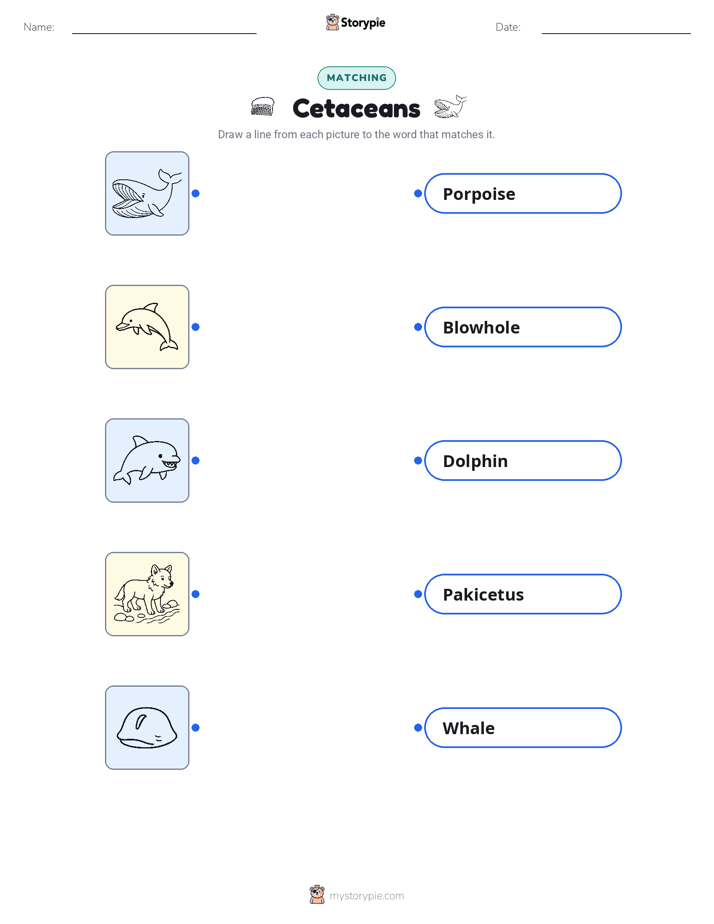
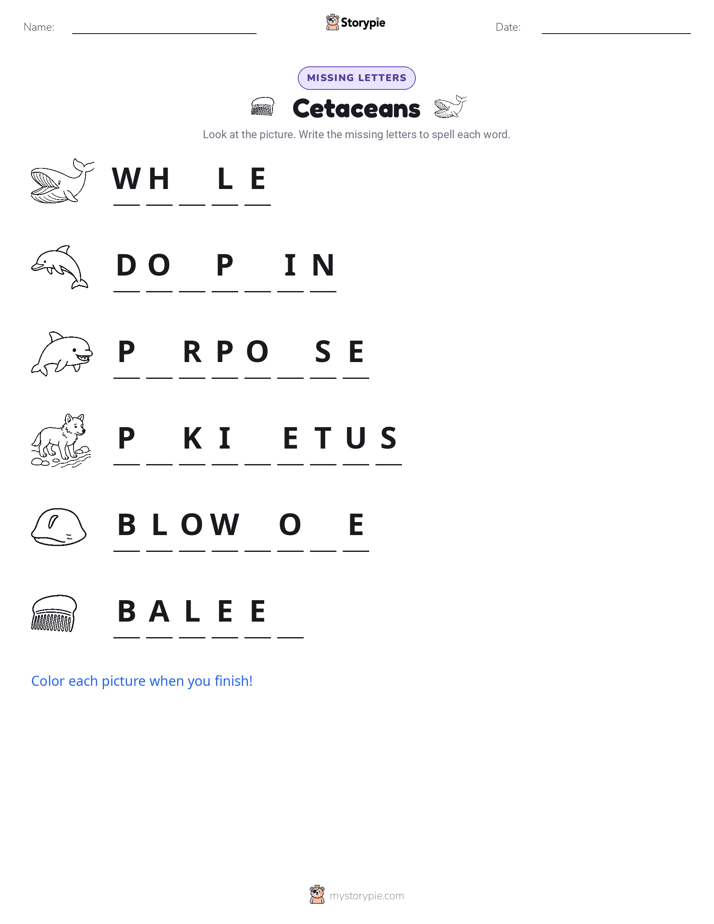
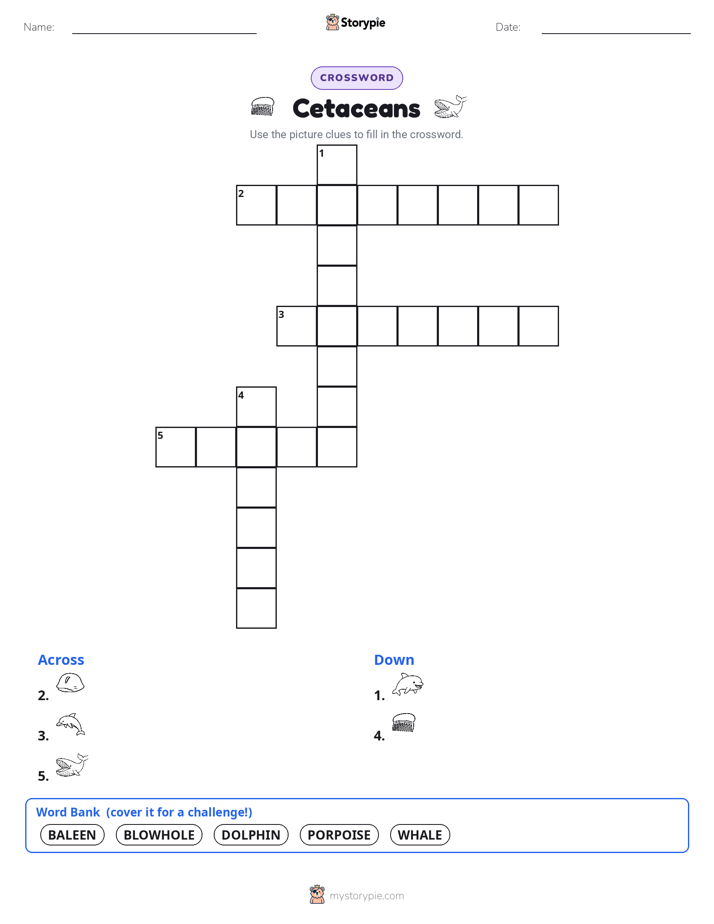
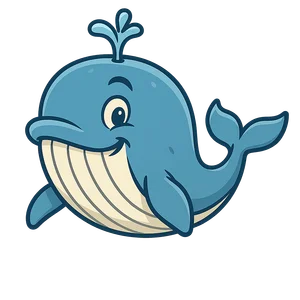
Cetaceans are a group of fully aquatic marine mammals that includes whales, dolphins, and porpoises.
Reads at Grades 6–8 Listens at Grades 4–8
Print & create
Answer keys·No prep·Free with an account
28 worksheets · answer keys · full story · quiz · Ages 10-12 · CEFR B2
Plus adds 164,000+ more stories in 27 languages, audio for every one, and printables for all of them.
Just want Cetaceans?
Hello! We are the cetaceans—the whales, dolphins, and porpoises of the world’s oceans. Our story, however, didn’t begin in the water. It started on land, about 50 million years ago, during a time scientists call the Eocene epoch. Our earliest ancestors were small, four-legged mammals known as Pakicetus, which looked something like a wolf with hooves. They lived near streams and rivers in a world very different from our own. Over millions of years, we discovered that the water offered us safety from land predators and a rich source of food. This discovery marked the beginning of our transformation, as we slowly changed our bodies, trading legs for flippers and a powerful tail. This was the start of our great journey into the blue, an evolutionary adventure that would reshape our very existence.
Living in the ocean required us to change completely, and our bodies adapted in remarkable ways. One of the most significant changes was the movement of our nostrils from the front of our faces to the very top of our heads, where they became blowholes. This allowed us to breathe at the surface without lifting our entire bodies from the water, a crucial adaptation for a marine life. Around 34 million years ago, our family tree branched into two major groups. Some of us became the Mysticeti, or baleen whales. We developed huge, bristly plates of baleen in our mouths, which act like giant filters to strain tiny krill and fish from the water. The other group became the Odontoceti, or toothed whales, which includes dolphins, orcas, and sperm whales. We developed a superpower: echolocation. By sending out high-pitched clicks and listening for the returning echoes, we create a perfect sound-map of our world, allowing us to navigate and hunt with precision in the darkest depths of the sea.
The Ocean's Song: A Cetacean's Story
Hello! We are the cetaceans—the whales, dolphins, and porpoises of the world’s oceans. Our story, however, didn’t begin in the water. It started on land, about 50 million years ago, during a time scientists call the Eocene epoch. Our earliest ancestors were small, four-legged mammals known as Pakicetus, which looked something like a wolf with hooves. They lived near streams and rivers in a world very different from our own. Over millions of years, we discovered that the water offered us safety from land predators and a rich source of food. This discovery marked the beginning of our transformation, as we slowly changed our bodies, trading legs for flippers and a powerful tail. This was the start of our great journey into the blue, an evolutionary adventure that would reshape our very existence.
Living in the ocean required us to change completely, and our bodies adapted in remarkable ways. One of the most significant changes was the movement of our nostrils from the front of our faces to the very top of our heads, where they became blowholes. This allowed us to breathe at the surface without lifting our entire bodies from the water, a crucial adaptation for a marine life. Around 34 million years ago, our family tree branched into two major groups. Some of us became the Mysticeti, or baleen whales. We developed huge, bristly plates of baleen in our mouths, which act like giant filters to strain tiny krill and fish from the water. The other group became the Odontoceti, or toothed whales, which includes dolphins, orcas, and sperm whales. We developed a superpower: echolocation. By sending out high-pitched clicks and listening for the returning echoes, we create a perfect sound-map of our world, allowing us to navigate and hunt with precision in the darkest depths of the sea.
Our lives are built around complex social structures and constant communication. We travel in groups called pods, which are like our families. Within these pods, we hunt together, play, and protect each other from danger. In the vast, dark world of the ocean, sound is everything to us. Light doesn’t travel very far underwater, so we use a rich language of whistles, clicks, and groans to talk to one another across immense distances. Some of us, like the humpback whales, are famous for our complex and haunting songs that can travel for hundreds of miles through the water. These songs are not just beautiful melodies; they are how we share stories, find mates, and maintain the bonds that keep our communities together in the boundless ocean.
For millions of years, we thrived in the world's oceans, adapting and diversifying. But in the 1800s and 1900s, we faced a new and formidable challenge: large-scale commercial whaling by humans. Their ships were fast and their hunting tools were powerful, and many of our populations shrank to dangerously low numbers. It was a frightening and uncertain time for many of our species. However, as the 20th century progressed, many humans began to understand the severe damage that was being done to the oceans. A major step toward protecting us was taken on December 2nd, 1946, when the International Whaling Commission was formed to help manage our populations. A huge turning point finally came in 1986, when this commission agreed to a moratorium, or pause, on most commercial whaling. This monumental decision gave many of our kind a chance to slowly begin the long journey of recovery.
Today, we are still here, swimming in every ocean from the icy poles to the warm tropics. Our journey from land to sea is a powerful story of the incredible power of adaptation over millions of years. We are more than just large animals navigating the deep; we are essential gardeners of the ocean. When we dive to the depths to feed and then return to the surface to breathe, we bring vital nutrients up from the abyss. This process, called the 'whale pump,' fertilizes the tiny floating plants called phytoplankton near the surface. These phytoplankton are crucial, as they form the base of the marine food web and create much of the oxygen that you and all other life on Earth breathe. Our story is written in the waves, and our legacy is woven into the health of the blue planet we all share.
Wow facts
About
Cetaceans are a group of fully aquatic marine mammals that includes whales, dolphins, and porpoises. They evolved from land-dwelling mammals and are known for their intelligence, complex social behaviors, and adaptations to life in the water.
Take a Quiz
Question 1 of 5
What was the major problem cetaceans faced in the 1800s and 1900s, and what was the resolution mentioned in the story?
Explore next






Want to do even more?
Go beyond exploring. Unlock tools that turn every story into real learning.

Storypie Plus for families
Full stories, quizzes, and printables. Nights and car rides, sorted.
- Unlimited audio stories
- Create Mode: your child stars in the story
- Offline downloads
- Printable worksheets & coloring pages

Why Storypie for Schools
Students engaged. Prep in seconds. Evenings back to you.
- Worksheets & Quizzes
- Classroom Management
- Formative Assessment
- Custom Curriculum & Lesson Plans
- 27 Languages

Why Storypie for Homeschool
Curriculum done. They'll ask for more. Hours back in your day.
- Worksheet Generator
- First-Person Audio Stories
- Built-in Comprehension Quizzes
- Custom Curriculum & Lesson Plans
- Print & Go Activities