English

Alessandro Volta
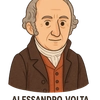
Alessandro Volta was an Italian physicist and chemist who was a pioneer of electricity and power.
Reads at Grades 6–8 Listens at Grades 4–8
Print & create
Answer keys·No prep·Free with an account
28 worksheets · answer keys · full story · quiz · Ages 10-12 · CEFR B2
Plus adds 116,000+ more stories in 27 languages, audio for every one, and printables for all of them.
Just want Alessandro Volta?
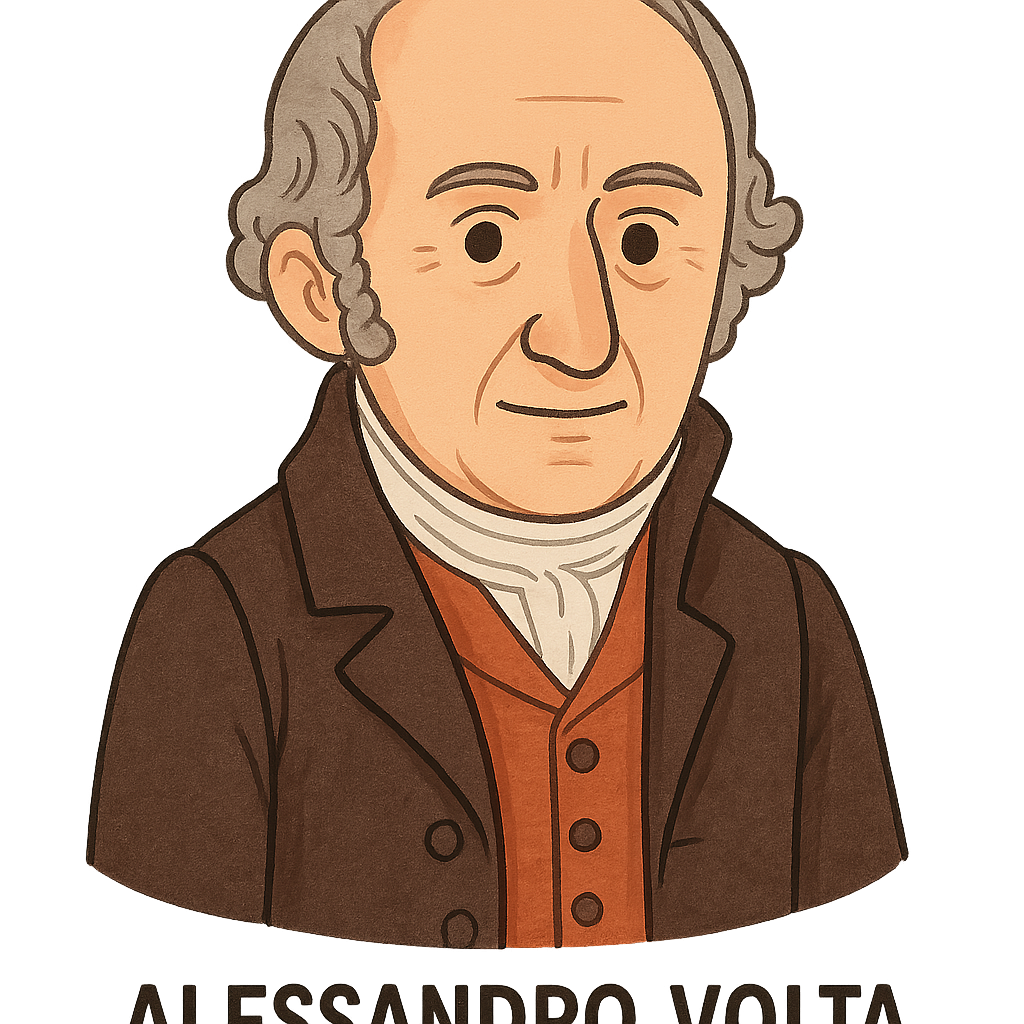
Hello! My name is Alessandro Volta, and I would like to tell you my story. I was born on February 18th, 1745, in a beautiful town called Como, which is now part of Italy. My family had planned for me to study law, but my mind was constantly filled with questions about the natural world. I was especially fascinated by electricity. During thunderstorms, I would watch the powerful bolts of lightning and wonder if humans could ever understand, let alone use, such an incredible force. This deep curiosity guided me down a path of scientific exploration that would ultimately change the world.
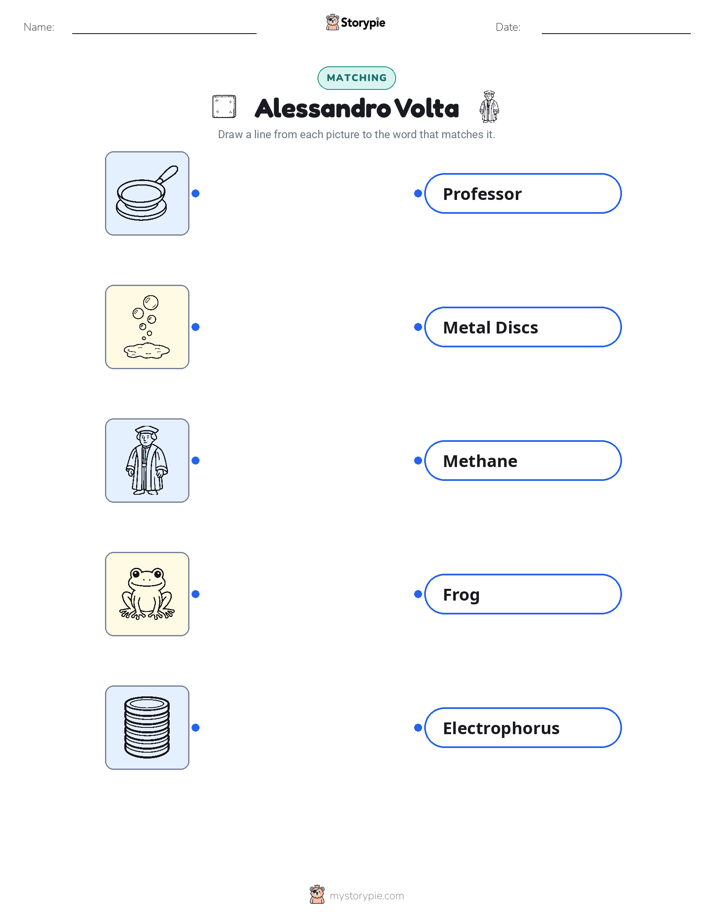
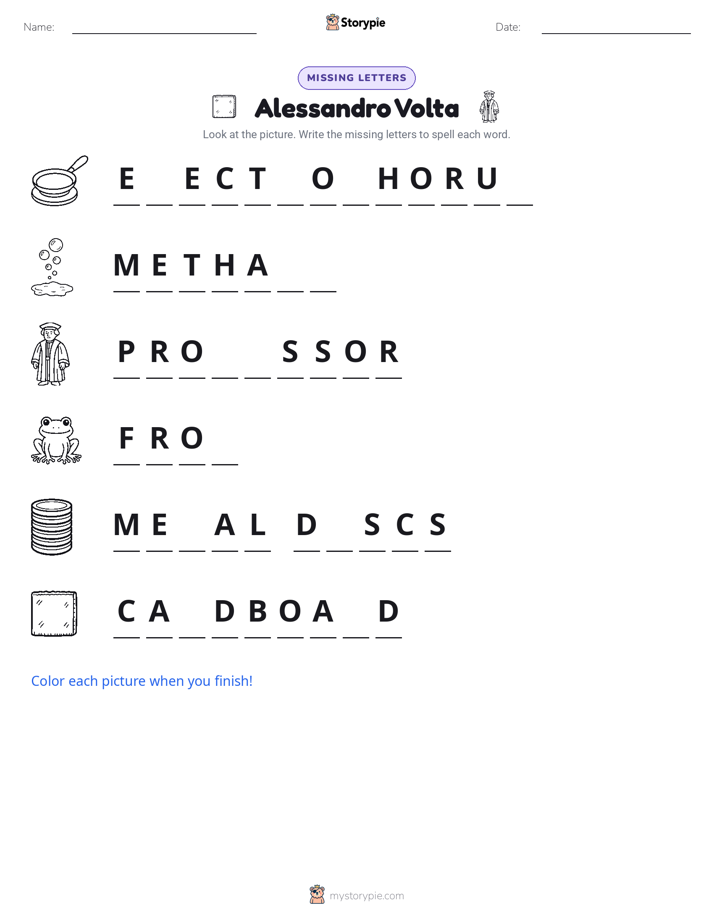
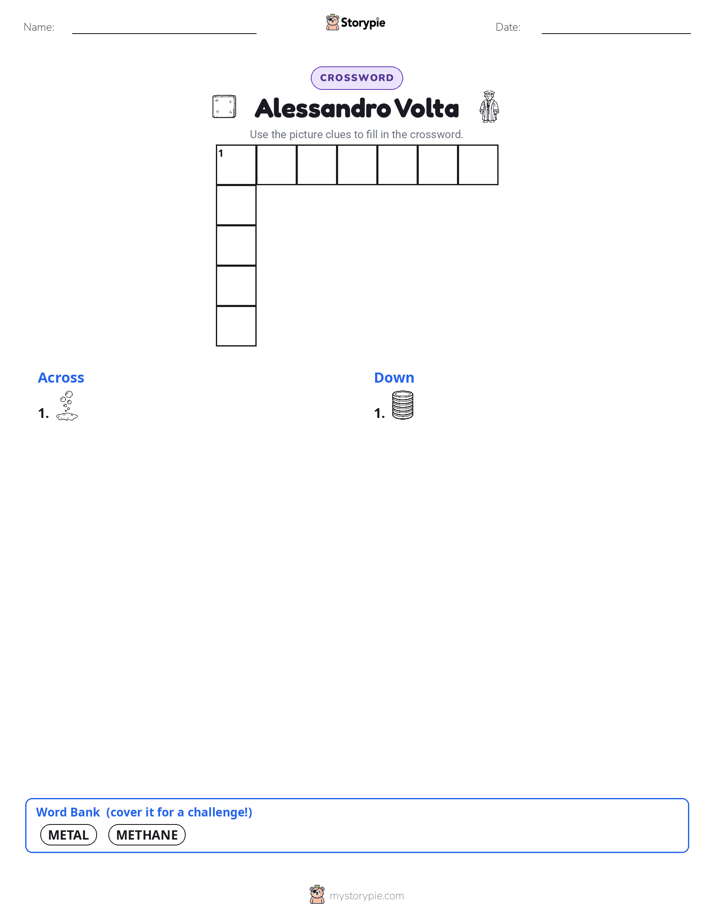
I began conducting my own experiments as soon as I could. In 1775, I developed one of my first inventions, which I called the electrophorus. It was a clever device capable of generating a static electric charge repeatedly. Just a year later, in 1776, my scientific curiosity led me to investigate the marshes near my home. I observed bubbles rising from the muddy water and decided to collect some of the gas to study it. I discovered it was highly flammable, a new kind of air that we now know as methane. My work began to gain recognition, and in 1779, I was given the great honor of becoming a professor of physics at the University of Pavia. This position allowed me to continue my research while teaching the next generation of scientists.
Around this time, another Italian scientist named Luigi Galvani made a fascinating observation. He discovered that a frog's legs would twitch as if alive when touched by two different types of metal. Galvani believed this was evidence of a special kind of electricity that came from the animal itself, which he called 'animal electricity.' I was intrigued by his findings, but I had a different hypothesis. After beginning my own series of experiments around 1791, I started to suspect that the electricity was not generated by the frog, but by the two different metals making contact through the moisture on the frog's leg. This disagreement was not a conflict, but rather a scientific puzzle that I was determined to solve.
Alessandro Volta: The Spark of Invention
Hello! My name is Alessandro Volta, and I would like to tell you my story. I was born on February 18th, 1745, in a beautiful town called Como, which is now part of Italy. My family had planned for me to study law, but my mind was constantly filled with questions about the natural world. I was especially fascinated by electricity. During thunderstorms, I would watch the powerful bolts of lightning and wonder if humans could ever understand, let alone use, such an incredible force. This deep curiosity guided me down a path of scientific exploration that would ultimately change the world.
I began conducting my own experiments as soon as I could. In 1775, I developed one of my first inventions, which I called the electrophorus. It was a clever device capable of generating a static electric charge repeatedly. Just a year later, in 1776, my scientific curiosity led me to investigate the marshes near my home. I observed bubbles rising from the muddy water and decided to collect some of the gas to study it. I discovered it was highly flammable, a new kind of air that we now know as methane. My work began to gain recognition, and in 1779, I was given the great honor of becoming a professor of physics at the University of Pavia. This position allowed me to continue my research while teaching the next generation of scientists.
Around this time, another Italian scientist named Luigi Galvani made a fascinating observation. He discovered that a frog's legs would twitch as if alive when touched by two different types of metal. Galvani believed this was evidence of a special kind of electricity that came from the animal itself, which he called 'animal electricity.' I was intrigued by his findings, but I had a different hypothesis. After beginning my own series of experiments around 1791, I started to suspect that the electricity was not generated by the frog, but by the two different metals making contact through the moisture on the frog's leg. This disagreement was not a conflict, but rather a scientific puzzle that I was determined to solve.
To prove my theory, I needed to create a source of electricity that did not involve any animal parts. I spent years testing various combinations of metals and liquids. Finally, in the year 1800, I achieved a major breakthrough. I created a stack of small discs, alternating between copper and zinc. Between each pair of metal discs, I placed a piece of cardboard or cloth that had been soaked in salt water. When I connected a wire to the top and bottom of this stack, it produced a steady, continuous flow of electricity. I named my invention the 'voltaic pile.' Unlike the momentary spark of static electricity, this was a constant current, like a river of electrical energy. It was the world's first electric battery.
I was eager to share my discovery with the scientific community. On March 20th, 1800, I sent a letter to the prestigious Royal Society in London to announce my invention. The news astonished scientists across Europe. My voltaic pile provided them with a reliable and continuous source of power, which opened the door for countless new experiments. The following year, in 1801, I received an invitation to Paris to demonstrate my battery to the leader of France, Napoleon Bonaparte. He was so impressed by my work that he awarded me a medal and granted me the title of count. My simple stack of metal discs had truly unlocked a new era in the study of electricity.
I spent the remainder of my career teaching and conducting experiments, always driven by the same curiosity that had inspired me as a boy. I lived to be 82 years old, passing away in my beloved hometown of Como in 1827. Although my life came to an end, my work powered a new beginning for science and technology. My invention of the battery paved the way for incredible discoveries and innovations. Today, when you hear the term 'volt' used to measure electric potential, you are hearing my name. I hope my story shows you that a simple question, combined with perseverance, can spark an invention that changes the world forever.
Wow facts
About
Alessandro Volta was an Italian physicist and chemist who was a pioneer of electricity and power. He is credited as the inventor of the first electric battery, the voltaic pile, in 1800.
Take a Quiz
Question 1 of 5
What was the core of the scientific disagreement between Alessandro Volta and Luigi Galvani?
Explore next



Want to do even more?
Go beyond exploring. Unlock tools that turn every story into real learning.

Storypie Plus for families
Full stories, quizzes, and printables. Nights and car rides, sorted.
- Unlimited audio stories
- Create Mode: your child stars in the story
- Offline downloads
- Printable worksheets & coloring pages

Why Storypie for Schools
Students engaged. Prep in seconds. Evenings back to you.
- Worksheets & Quizzes
- Classroom Management
- Formative Assessment
- Custom Curriculum & Lesson Plans
- 27 Languages

Why Storypie for Homeschool
Curriculum done. They'll ask for more. Hours back in your day.
- Worksheet Generator
- First-Person Audio Stories
- Built-in Comprehension Quizzes
- Custom Curriculum & Lesson Plans
- Print & Go Activities