English

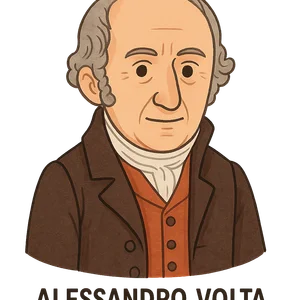
Alessandro Volta
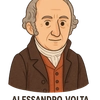
Alessandro Volta was an Italian physicist and chemist who was a pioneer of electricity and power.
Reads at Grades 3–5 Listens at Grades 1–5
Print & create
Answer keys·No prep·Free with an account
28 worksheets · answer keys · full story · quiz · Ages 8-10 · CEFR B1
Plus adds 116,000+ more stories in 27 languages, audio for every one, and printables for all of them.
Just want Alessandro Volta?
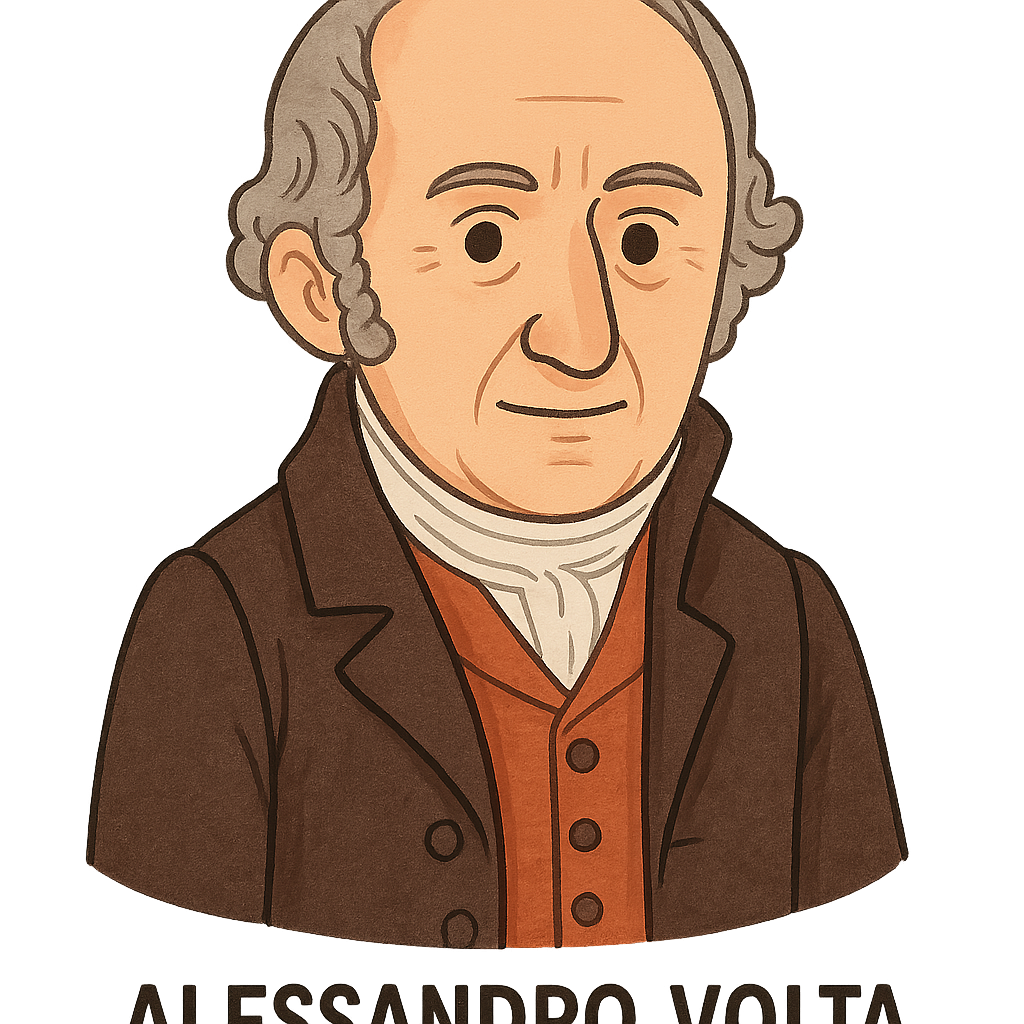
Hello, my name is Alessandro Volta, and I discovered a way to create a steady flow of electricity. My story begins on February 18th, 1745, when I was born in the beautiful city of Como, Italy. As a little boy, I didn't start speaking as early as other children, which worried my family. But even though I was quiet, my mind was never still. I was filled with endless questions about the world, especially about the mysterious and invisible force called electricity. My family hoped I would grow up to study law, a very respected job at the time. However, I couldn't ignore my fascination with science. The puzzles of the natural world were far more interesting to me than courtrooms, so I decided to follow my passion and dedicate my life to scientific study.
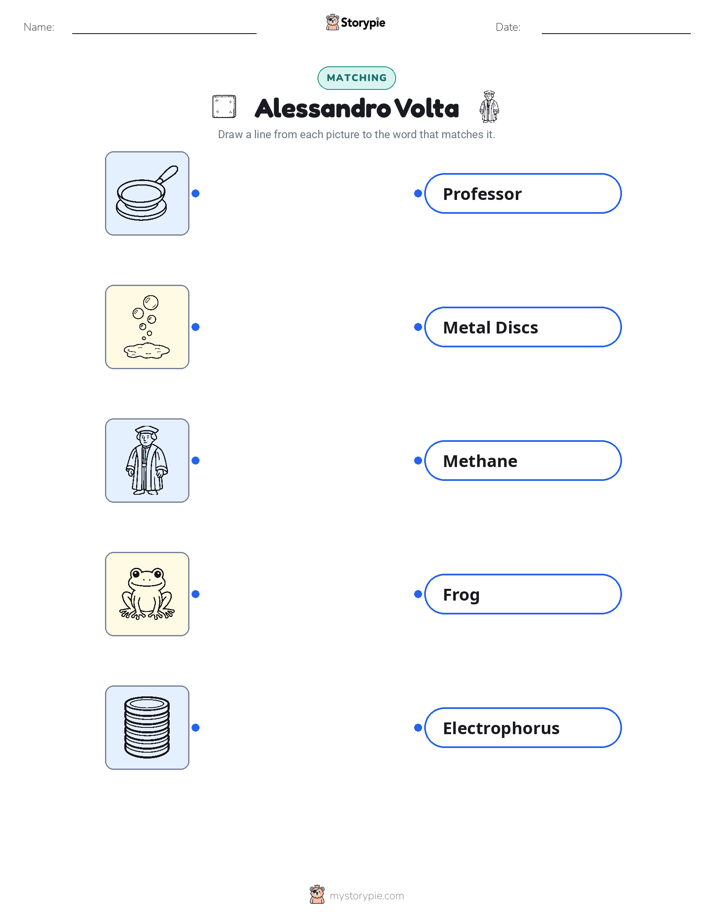
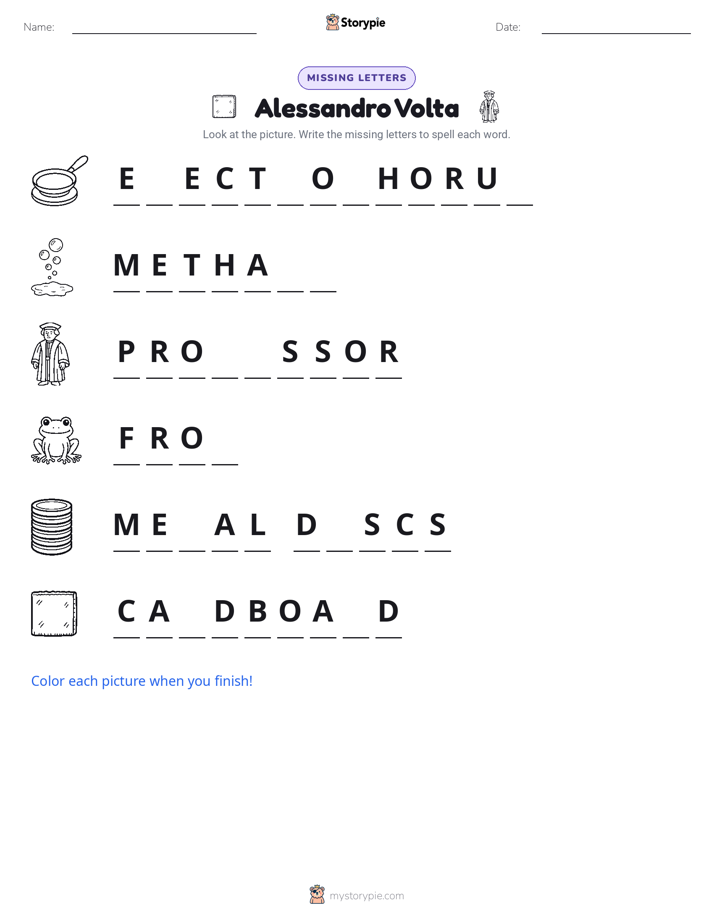
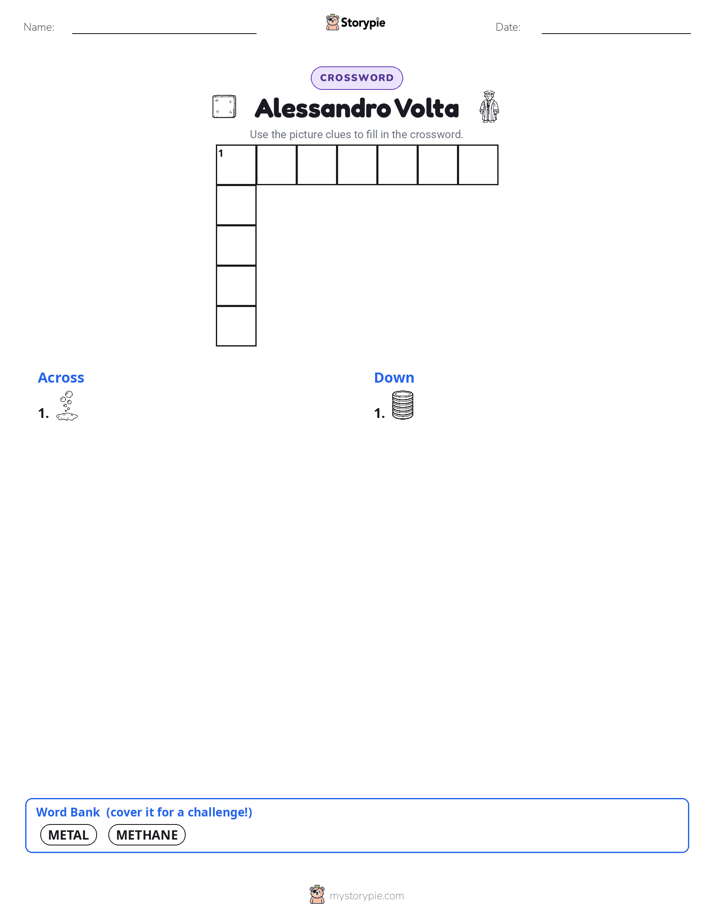
My hard work paid off, and in 1774, I was filled with excitement when I became a physics professor right in my hometown of Como. This job allowed me to spend my days doing what I loved most: conducting experiments. I traveled and learned, always observing the world closely. Around 1776, during a walk near a marsh, I noticed bubbles rising from the muddy water. When I collected this gas, I discovered it was a new kind of 'flammable air' that would catch fire with a spark. This gas is what we now call methane. My discoveries were getting noticed, and in 1779, I was offered an even more important position as a professor at the famous University of Pavia. This new role gave me access to better laboratories, where I could dive deeper into my experiments with electricity.
Alessandro Volta
Hello, my name is Alessandro Volta, and I discovered a way to create a steady flow of electricity. My story begins on February 18th, 1745, when I was born in the beautiful city of Como, Italy. As a little boy, I didn't start speaking as early as other children, which worried my family. But even though I was quiet, my mind was never still. I was filled with endless questions about the world, especially about the mysterious and invisible force called electricity. My family hoped I would grow up to study law, a very respected job at the time. However, I couldn't ignore my fascination with science. The puzzles of the natural world were far more interesting to me than courtrooms, so I decided to follow my passion and dedicate my life to scientific study.
My hard work paid off, and in 1774, I was filled with excitement when I became a physics professor right in my hometown of Como. This job allowed me to spend my days doing what I loved most: conducting experiments. I traveled and learned, always observing the world closely. Around 1776, during a walk near a marsh, I noticed bubbles rising from the muddy water. When I collected this gas, I discovered it was a new kind of 'flammable air' that would catch fire with a spark. This gas is what we now call methane. My discoveries were getting noticed, and in 1779, I was offered an even more important position as a professor at the famous University of Pavia. This new role gave me access to better laboratories, where I could dive deeper into my experiments with electricity.
Around the year 1791, I entered into a friendly but serious scientific debate with another talented scientist named Luigi Galvani. He had performed an experiment where he touched a frog's leg with two different types of metal, and the leg twitched as if it were alive. From this, he concluded that animals produced a special kind of 'animal electricity' inside their bodies. I admired his work, but I had a different idea. I didn't believe the electricity was coming from the frog at all. I suspected that the two different metals were the true source of the electrical spark, and the frog’s moist body was simply acting as a conductor, allowing the electricity to flow through it.
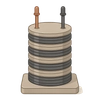
To prove my theory, I knew I had to create an electrical current without using any animal parts. I spent years experimenting with different metals and materials. Finally, in the year 1800, I had a breakthrough. I created the world's very first battery by making a stack, or a pile, of pairs of copper and zinc discs. Between each pair of metal discs, I placed a piece of cardboard that had been soaked in saltwater. When I connected a wire to the top and bottom of this stack, it produced a steady, continuous flow of electricity. I called my invention the 'voltaic pile.' This was a monumental achievement because, for the first time in history, we had a reliable source of electricity. In 1801, I traveled to Paris to demonstrate my amazing invention to France's leader, Napoleon Bonaparte, who was very impressed by its power.
I lived a long life full of curiosity and discovery. I lived to be 82 years old, and I was able to see the world begin to change because of my work. My invention of the battery, the voltaic pile, was not just an experiment; it was the key that unlocked a new age of science and technology. It powered countless new inventions and experiments that came after me. As a great honor, the scientific world decided to name the unit for measuring electric potential the 'volt.' It makes me proud to know that my name is still spoken in science classrooms and laboratories all over the world today.
Wow facts
About
Alessandro Volta was an Italian physicist and chemist who was a pioneer of electricity and power. He is credited as the inventor of the first electric battery, the voltaic pile, in 1800.
Take a Quiz
Question 1 of 5
What problem was Alessandro Volta trying to solve when he invented the voltaic pile?
Explore next



Want to do even more?
Go beyond exploring. Unlock tools that turn every story into real learning.

Storypie Plus for families
Full stories, quizzes, and printables. Nights and car rides, sorted.
- Unlimited audio stories
- Create Mode: your child stars in the story
- Offline downloads
- Printable worksheets & coloring pages

Why Storypie for Schools
Students engaged. Prep in seconds. Evenings back to you.
- Worksheets & Quizzes
- Classroom Management
- Formative Assessment
- Custom Curriculum & Lesson Plans
- 27 Languages

Why Storypie for Homeschool
Curriculum done. They'll ask for more. Hours back in your day.
- Worksheet Generator
- First-Person Audio Stories
- Built-in Comprehension Quizzes
- Custom Curriculum & Lesson Plans
- Print & Go Activities