English

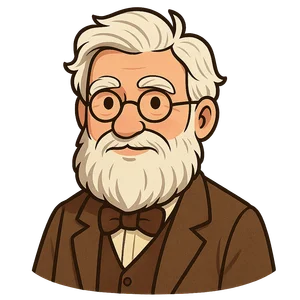
Alfred Russel Wallace
Alfred Russel Wallace was a British naturalist, explorer…
Reads at Grades 3–5 Listens at Grades 1–5
Alfred Russel Wallace: The Man Who Discovered Evolution with Darwin
Hello there. My name is Alfred Russel Wallace, and I was a naturalist, which is a scientist who studies the natural world. My story begins on January 8th, 1823, when I was born in a small village in the beautiful country of Wales. As a boy, I wasn't very interested in sitting inside. I much preferred being outdoors, exploring the green fields and forests near my home. I loved to collect things I found on my walks, from flowers to rocks. But my favorite things to collect were beetles. I was amazed by their different shapes, sizes, and especially their brilliant, shining colors. I would spend hours searching for new ones to add to my collection. This early hobby sparked a curiosity in me that would last my entire life and take me on adventures to the other side of the world.
My first great adventure began in 1848. I was a young man then, and I decided to travel to a place I had only dreamed of: the Amazon rainforest in South America. I sailed there with my good friend, another naturalist named Henry Walter Bates. For four years, we explored the dense jungle, a world buzzing with life. The sounds of monkeys and colorful birds filled the air, and giant butterflies with wings like blue glass fluttered past. My job was to collect specimens—thousands of them! I carefully gathered insects, birds, and other animals that were completely new to scientists back in England. I preserved them so they could be studied. But this incredible trip ended in sadness. In 1852, I boarded a ship to sail home, my precious collection packed away. But during the voyage, the ship caught fire. I escaped, but nearly everything I had worked so hard to collect for four years was lost to the flames and the sea. It was a terrible loss, but it did not stop my desire to explore.
Just two years later, in 1854, I set off on another journey, this time to a group of islands called the Malay Archipelago, which is now part of Indonesia and Malaysia. I spent eight long years there, traveling over 14,000 miles between the islands, often in small, rickety boats. The wildlife there was even more astonishing than in the Amazon. I discovered creatures that seemed to be from a fantasy story, like frogs that could glide through the air and birds-of-paradise with feathers like rainbows. As I traveled from one island to the next, I started to notice something very strange. The animals on the islands in the western part of the archipelago were similar to those in Asia, while the animals on the eastern islands were more like those in Australia. It was as if an invisible line ran through the islands, separating these two different worlds of animals. This discovery was so important that scientists later named this invisible boundary the 'Wallace Line' in my honor.
In 1858, while living on a small island called Ternate, I became very sick with a fever. As I lay in my hut, shaking with chills, a powerful idea suddenly flashed into my mind. I thought about how animals struggle to survive. I realized that individual animals in a species are all slightly different. If one of them had a small difference—like a longer beak or better camouflage—that helped it find food or avoid being eaten, it would have a better chance of living long enough to have babies. Its babies would then inherit that same helpful feature. Over thousands and thousands of years, these small changes could add up, and a species could slowly change into something new. This was the key to understanding how life evolves! I was so excited that I immediately wrote down my ideas in a short essay. I decided to send it to a famous scientist I greatly admired back in England, a man named Charles Darwin.
What I didn't know was that Charles Darwin had been working on the very same idea for almost twenty years but had never published it. When he received my letter, he was stunned. Our ideas were so similar that our work was presented together at a scientific meeting in London later in 1858. This was the moment the theory of evolution by natural selection was introduced to the world. I finally returned to England in 1862 and spent the rest of my life writing books about my travels, including my most famous one, 'The Malay Archipelago.' I lived to be 90 years old and passed away in 1913. Today, people remember me not just as a great explorer, but as the co-discoverer of one of the most important ideas in science, an idea that forever changed how we see our planet and all the wonderful living things that call it home.
Wow facts
About
Alfred Russel Wallace was a British naturalist, explorer, and biologist who independently conceived the theory of evolution through natural selection. His work alongside Charles Darwin changed the course of biology.
Take a Quiz
Question 1 of 5
Why do you think Alfred Russel Wallace went on another big trip after the fire on his ship?
Explore next





Want to do even more?
Go beyond exploring. Unlock tools that turn every story into real learning.

Storypie Plus for families
Full stories, quizzes, and printables. Nights and car rides, sorted.
- Unlimited audio stories
- Create Mode: your child stars in the story
- Offline downloads
- Printable worksheets & coloring pages

Why Storypie for Schools
Students engaged. Prep in seconds. Evenings back to you.
- Worksheets & Quizzes
- Classroom Management
- Formative Assessment
- Custom Curriculum & Lesson Plans
- 27 Languages

Why Storypie for Homeschool
Curriculum done. They'll ask for more. Hours back in your day.
- Worksheet Generator
- First-Person Audio Stories
- Built-in Comprehension Quizzes
- Custom Curriculum & Lesson Plans
- Print & Go Activities