English

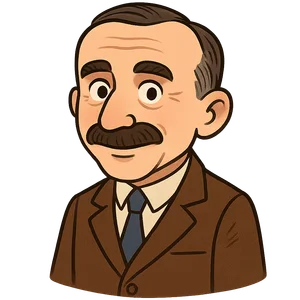
Alfred Wegener
Alfred Wegener was a German climatologist, geologist…
Reads at Grades 6–8 Listens at Grades 4–8
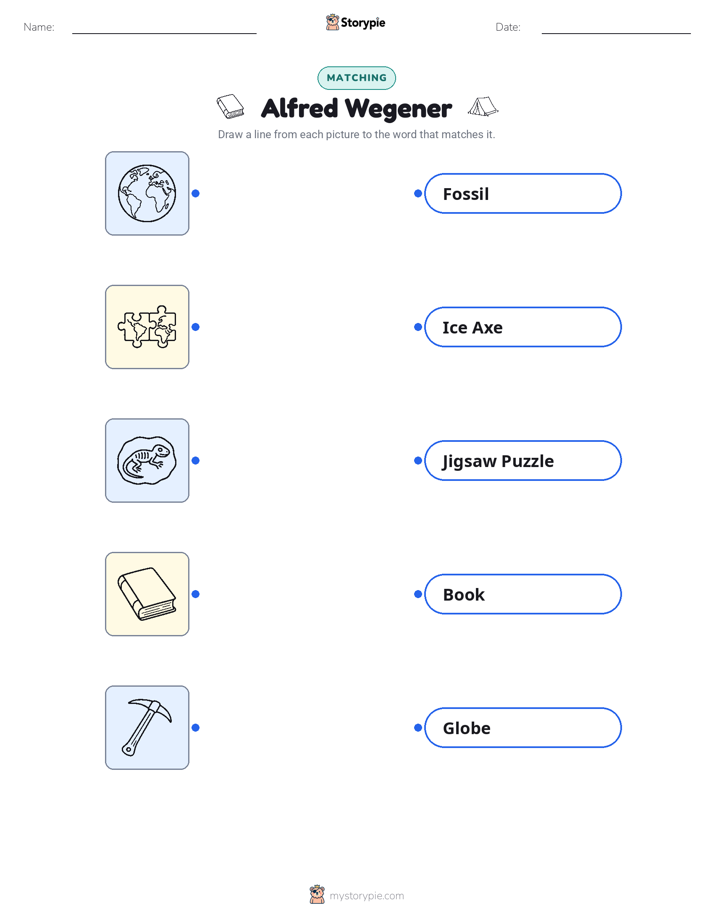
Print & create
Answer keys·No prep·Free with an account
28 worksheets · answer keys · full story · quiz · Ages 10-12 · CEFR B2
Plus adds 244,000+ more stories in 27 languages, audio for every one, and printables for all of them.
Just want Alfred Wegener?
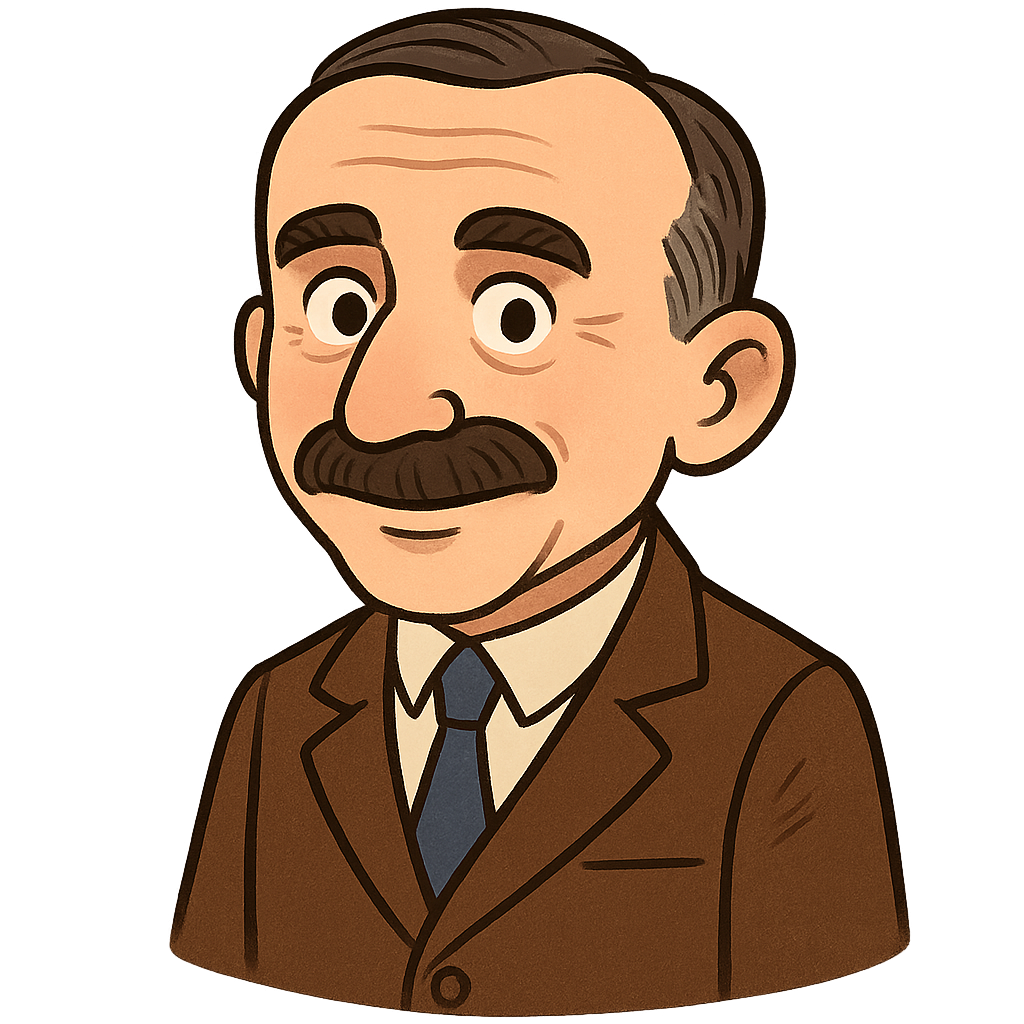
Hello! My name is Alfred Wegener, and I've always seen the world as a giant, fascinating puzzle. I was born in Berlin, Germany, on November 1st, 1880. As a boy, my bedroom walls were covered with maps. I would trace the coastlines with my fingers and dream of exploring the most remote, icy corners of the Earth, especially a vast, mysterious island called Greenland. I loved science, but I was also an adventurer at heart. I knew from a young age that I wouldn't be happy just sitting behind a desk; I wanted to go out and discover the secrets our planet was holding.
I followed my passion for science all the way to university, earning my doctorate in astronomy in 1905. But looking at the stars made me more curious about our own world. I became a meteorologist, a scientist who studies weather and the atmosphere. To do that, you have to go up. In 1906, my brother Kurt and I set a world record by flying in a hot air balloon for over 52 hours straight. Floating high above the ground, I realized just how much there was to learn about the forces shaping our planet, from the wind in the sky to the ground beneath my feet.
One day, while looking at a world map, something clicked. I noticed that the coastline of South America looked like it could fit perfectly against the coastline of Africa, like two pieces of a jigsaw puzzle. It wasn't a new observation—others had noticed it before—but for me, it was the spark of a giant idea. What if it wasn't a coincidence? What if the continents had once been connected and had somehow drifted apart? The thought was so incredible that I couldn't let it go. I had to find out if it was true.
Alfred Wegener: The Man Who Moved Continents
Hello! My name is Alfred Wegener, and I've always seen the world as a giant, fascinating puzzle. I was born in Berlin, Germany, on November 1st, 1880. As a boy, my bedroom walls were covered with maps. I would trace the coastlines with my fingers and dream of exploring the most remote, icy corners of the Earth, especially a vast, mysterious island called Greenland. I loved science, but I was also an adventurer at heart. I knew from a young age that I wouldn't be happy just sitting behind a desk; I wanted to go out and discover the secrets our planet was holding.
I followed my passion for science all the way to university, earning my doctorate in astronomy in 1905. But looking at the stars made me more curious about our own world. I became a meteorologist, a scientist who studies weather and the atmosphere. To do that, you have to go up. In 1906, my brother Kurt and I set a world record by flying in a hot air balloon for over 52 hours straight. Floating high above the ground, I realized just how much there was to learn about the forces shaping our planet, from the wind in the sky to the ground beneath my feet.
One day, while looking at a world map, something clicked. I noticed that the coastline of South America looked like it could fit perfectly against the coastline of Africa, like two pieces of a jigsaw puzzle. It wasn't a new observation—others had noticed it before—but for me, it was the spark of a giant idea. What if it wasn't a coincidence? What if the continents had once been connected and had somehow drifted apart? The thought was so incredible that I couldn't let it go. I had to find out if it was true.
I became a detective, searching for clues to support my idea. I read research from all over the world. I discovered that fossils of the same ancient plants and animals, like the small reptile Mesosaurus, were found in both South America and Africa. How could a small freshwater reptile swim across the massive Atlantic Ocean? It couldn't. It made more sense if the continents were once joined. I also found that mountain ranges that stopped at the edge of one continent seemed to continue on another one across the ocean. Even clues in rocks showed that tropical places once had glaciers, and cold places once had tropical swamps. The evidence was piling up.
With all my evidence, I was ready to share my theory. In 1912, I began giving talks, and in 1915, I published my book, The Origin of Continents and Oceans. I proposed that millions of years ago, all the continents were joined together in one giant supercontinent. I gave it a name: Pangaea, which means 'all-Earth' in Greek. I explained that this massive landmass broke apart, and the continents have been slowly drifting across the Earth's surface ever since. To me, it was the only explanation that made sense of all the clues I had found.
Most other scientists did not like my idea at all. They thought it was ridiculous. 'What force could possibly be strong enough to move entire continents?' they would ask. This was a fair question, and I didn't have the complete answer for the 'how.' I proposed some ideas, but none were convincing enough for them. For years, my theory of continental drift was rejected and even made fun of. It was discouraging, but I trusted my evidence. I believed that one day, the truth would be accepted.
Throughout all this, I never lost my love for exploration. I made several dangerous expeditions to Greenland to study its massive ice sheet and weather patterns. My final journey was in 1930. It was a very difficult expedition, and a group of my colleagues was stranded at a camp in the middle of the ice cap without enough food. I led a team to bring them supplies. On my 50th birthday, I started the journey back, but I never made it. The Arctic is a beautiful but unforgiving place.
I lived to be 50 years old. Although I didn't get to see it myself, my big idea was finally proven right decades after my time. In the 1960s, scientists discovered evidence of seafloor spreading, which provided the engine I had been looking for to explain how the continents moved. My theory of continental drift paved the way for the modern theory of plate tectonics, which is the foundation of geology today. It just goes to show that sometimes, even if an idea seems impossible, you should always follow the evidence, no matter where it leads you.
Wow facts
About
Alfred Wegener was a German climatologist, geologist, and meteorologist who developed the theory of continental drift, proposing that the continents were once joined in a single supercontinent called Pangaea.
Take a Quiz
Question 1 of 5
What was the main conflict Alfred Wegener faced after publishing his theory of continental drift in 1915?
Explore next





Want to do even more?
Go beyond exploring. Unlock tools that turn every story into real learning.

Storypie Plus for families
Full stories, quizzes, and printables. Nights and car rides, sorted.
- Unlimited audio stories
- Create Mode: your child stars in the story
- Offline downloads
- Printable worksheets & coloring pages

Why Storypie for Schools
Students engaged. Prep in seconds. Evenings back to you.
- Worksheets & Quizzes
- Classroom Management
- Formative Assessment
- Custom Curriculum & Lesson Plans
- 27 Languages

Why Storypie for Homeschool
Curriculum done. They'll ask for more. Hours back in your day.
- Worksheet Generator
- First-Person Audio Stories
- Built-in Comprehension Quizzes
- Custom Curriculum & Lesson Plans
- Print & Go Activities