English

Andrew Carnegie
Andrew Carnegie was a Scottish-American industrialist and philanthropist who led the expansion of the…
Reads at Grades 6–8 Listens at Grades 4–8
Print & create
Answer keys·No prep·Free with an account
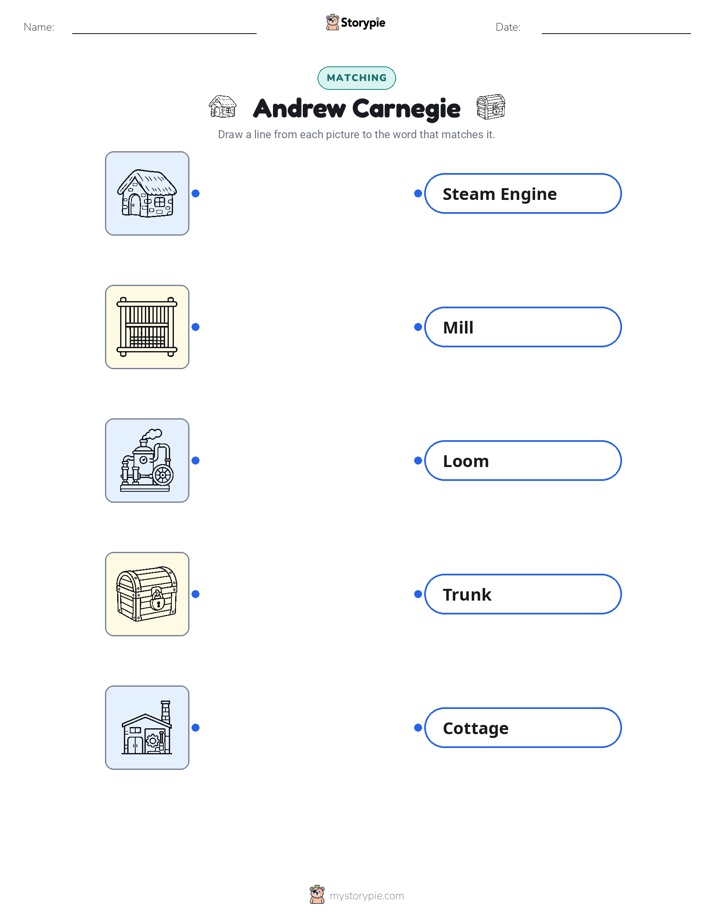
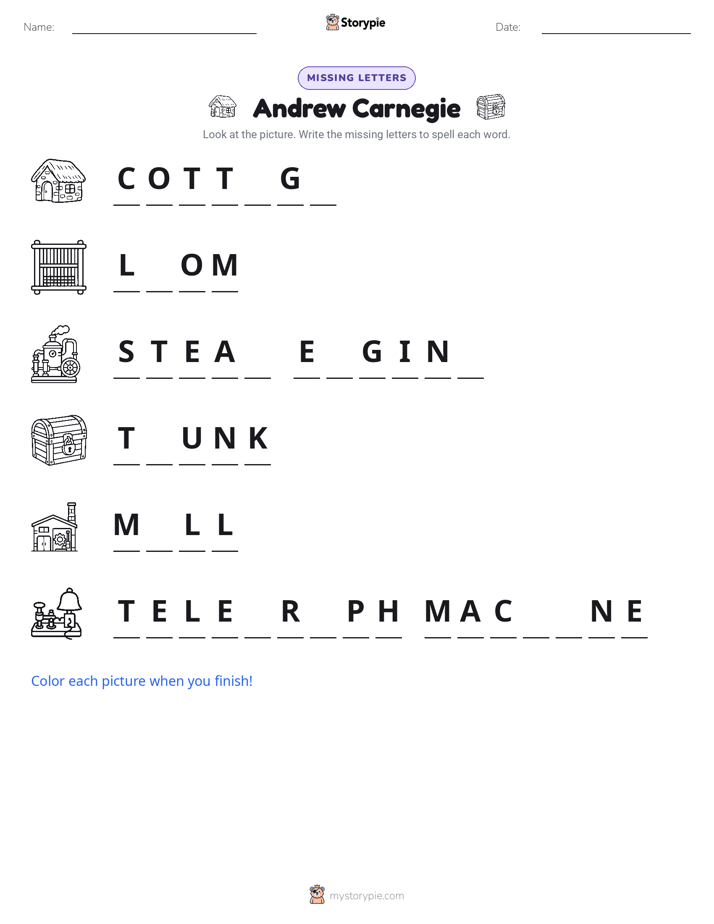
28 worksheets · answer keys · full story · quiz · Ages 10-12 · CEFR B2
Plus adds 244,000+ more stories in 27 languages, audio for every one, and printables for all of them.
Just want Andrew Carnegie?
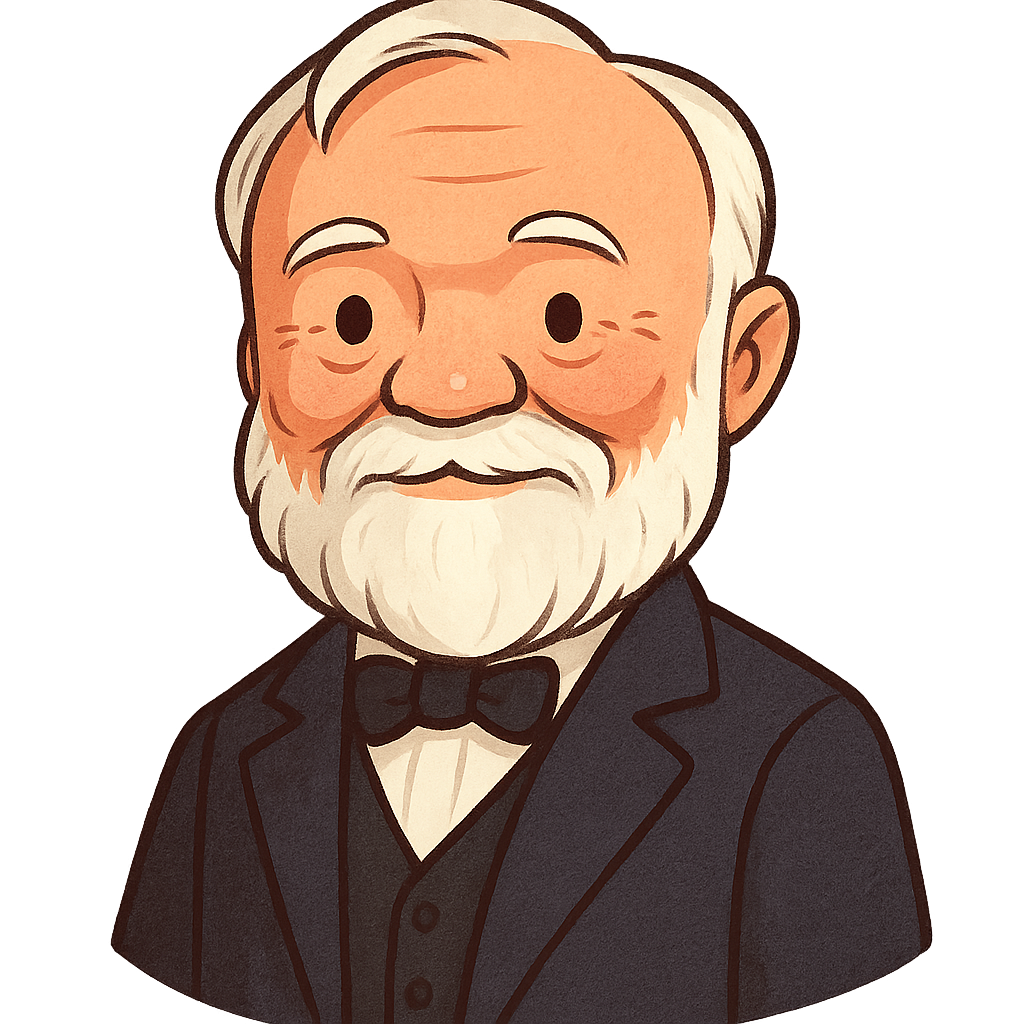
I'd like to tell you my story. My name is Andrew Carnegie, and I was born on November 25th, 1835, in a small weaver's cottage in Dunfermline, Scotland. My father was a handloom weaver, and I was so proud of the beautiful cloth he made. But in the 1840s, new steam-powered looms in big factories began to do the work much faster. It became very difficult for my father to find work, and our family fell into poverty. My mother was determined to find a better life for us. In 1848, when I was 12 years old, we sold our belongings and sailed across the Atlantic Ocean to start a new life in America.
We settled in Allegheny, Pennsylvania, a busy, smoky city full of factories. To help my family, I got a job as a 'bobbin boy' in a cotton mill, working 12 hours a day for very little pay. It was difficult work, but I was determined to succeed. In 1849, I found a better job as a telegraph messenger. I loved dashing through the streets of Pittsburgh, and I quickly memorized the locations of all the important businesses. I studied hard and taught myself how to operate the telegraph machine. This skill led to a job in 1853 with the Pennsylvania Railroad. My boss there, Thomas A. Scott, took notice of my hard work and taught me about the world of business and investing.
After the American Civil War, I saw that the country was growing at an incredible speed. It needed new railroads, giant bridges, and skyscrapers. To build all of that, it needed a material that was much stronger than iron. The future, I realized, was in steel. On a trip to Britain in 1872, I saw the amazing Bessemer process, a new way to make huge quantities of steel quickly and cheaply. I brought that technology back to America and, in 1875, opened my first big steel mill. My business, the Carnegie Steel Company, grew to become the largest in the world. But this success came with challenges. The work in the mills was often dangerous, and in 1892, a terrible and violent disagreement between my company and its workers, known as the Homestead Strike, happened while I was away in Scotland. It was a very sad time that showed how difficult the relationship between industry and workers could be.
Andrew Carnegie: The Steel King Who Gave It All Away
I'd like to tell you my story. My name is Andrew Carnegie, and I was born on November 25th, 1835, in a small weaver's cottage in Dunfermline, Scotland. My father was a handloom weaver, and I was so proud of the beautiful cloth he made. But in the 1840s, new steam-powered looms in big factories began to do the work much faster. It became very difficult for my father to find work, and our family fell into poverty. My mother was determined to find a better life for us. In 1848, when I was 12 years old, we sold our belongings and sailed across the Atlantic Ocean to start a new life in America.
We settled in Allegheny, Pennsylvania, a busy, smoky city full of factories. To help my family, I got a job as a 'bobbin boy' in a cotton mill, working 12 hours a day for very little pay. It was difficult work, but I was determined to succeed. In 1849, I found a better job as a telegraph messenger. I loved dashing through the streets of Pittsburgh, and I quickly memorized the locations of all the important businesses. I studied hard and taught myself how to operate the telegraph machine. This skill led to a job in 1853 with the Pennsylvania Railroad. My boss there, Thomas A. Scott, took notice of my hard work and taught me about the world of business and investing.
After the American Civil War, I saw that the country was growing at an incredible speed. It needed new railroads, giant bridges, and skyscrapers. To build all of that, it needed a material that was much stronger than iron. The future, I realized, was in steel. On a trip to Britain in 1872, I saw the amazing Bessemer process, a new way to make huge quantities of steel quickly and cheaply. I brought that technology back to America and, in 1875, opened my first big steel mill. My business, the Carnegie Steel Company, grew to become the largest in the world. But this success came with challenges. The work in the mills was often dangerous, and in 1892, a terrible and violent disagreement between my company and its workers, known as the Homestead Strike, happened while I was away in Scotland. It was a very sad time that showed how difficult the relationship between industry and workers could be.
By 1901, I had worked for many decades and decided it was time for a change. I sold the Carnegie Steel Company to the banker J.P. Morgan for $480 million, which made me one of the wealthiest men in the world. But I never believed that money was just for me. Years earlier, in 1889, I wrote an article called 'The Gospel of Wealth.' In it, I explained my belief that a person with great wealth has a responsibility to use it to improve society. I argued that it was a disgrace to die rich. So, I retired from business and started my second career: giving my fortune away in a thoughtful and useful way.
As a boy, I had benefited from borrowing books from a man's private library. That experience opened up the world to me, and I wanted every person to have the same chance. My greatest passion became funding public libraries. I helped pay for the construction of over 2,500 libraries across America and the world. I also gave money to build schools and universities, like Carnegie Mellon University in Pittsburgh. I built Carnegie Hall in New York City, a beautiful place for people to enjoy music, and founded organizations dedicated to scientific research and world peace.
My life was an incredible journey, from a poor boy in Scotland to a leader of American industry. I lived to be 83 years old. When people remember me today, they often talk about the steel that helped build modern America. But I hope my true legacy is found in the libraries, schools, and halls that are still used today. My goal was never just to be rich, but to give everyone the tools of knowledge and the opportunity to build a better life for themselves.
Wow facts
About
Andrew Carnegie was a Scottish-American industrialist and philanthropist who led the expansion of the American steel industry in the late 19th century and became one of the richest Americans in history. He is renowned for his extensive philanthropy, especially his funding of public libraries, schools, and cultural institutions.
Take a Quiz
Question 1 of 5
What was the main idea of Andrew Carnegie's 1889 article, 'The Gospel of Wealth'?
Explore next






Want to do even more?
Go beyond exploring. Unlock tools that turn every story into real learning.

Storypie Plus for families
Full stories, quizzes, and printables. Nights and car rides, sorted.
- Unlimited audio stories
- Create Mode: your child stars in the story
- Offline downloads
- Printable worksheets & coloring pages

Why Storypie for Schools
Students engaged. Prep in seconds. Evenings back to you.
- Worksheets & Quizzes
- Classroom Management
- Formative Assessment
- Custom Curriculum & Lesson Plans
- 27 Languages

Why Storypie for Homeschool
Curriculum done. They'll ask for more. Hours back in your day.
- Worksheet Generator
- First-Person Audio Stories
- Built-in Comprehension Quizzes
- Custom Curriculum & Lesson Plans
- Print & Go Activities