English

Andrew Johnson
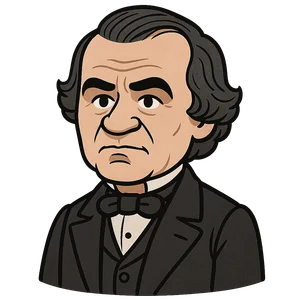
Andrew Johnson was the 17th President of the United States, serving from 1865 to 1869.
Reads at Grades 6–8 Listens at Grades 4–8
Print & create
Answer keys·No prep·Free with an account
28 worksheets · answer keys · full story · quiz · Ages 10-12 · CEFR B2
Plus adds 244,000+ more stories in 27 languages, audio for every one, and printables for all of them.
Just want Andrew Johnson?
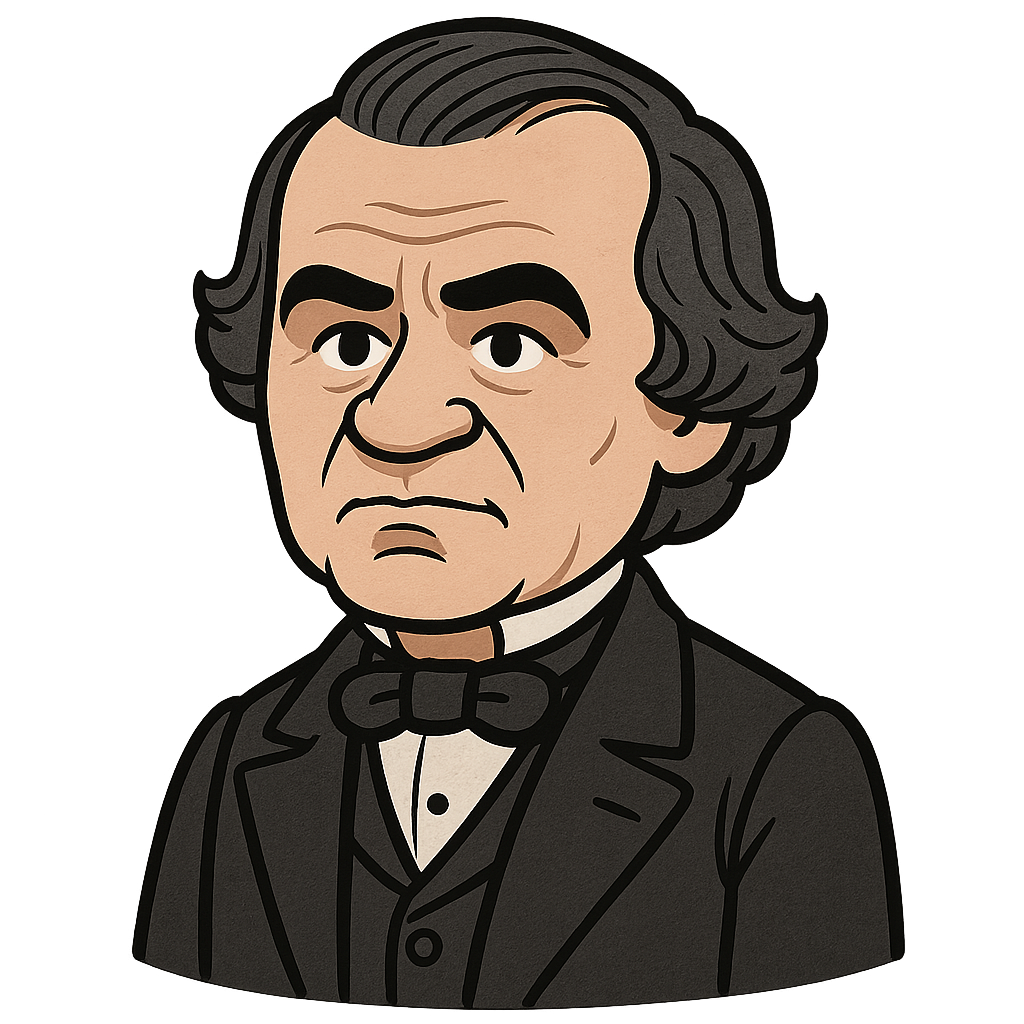
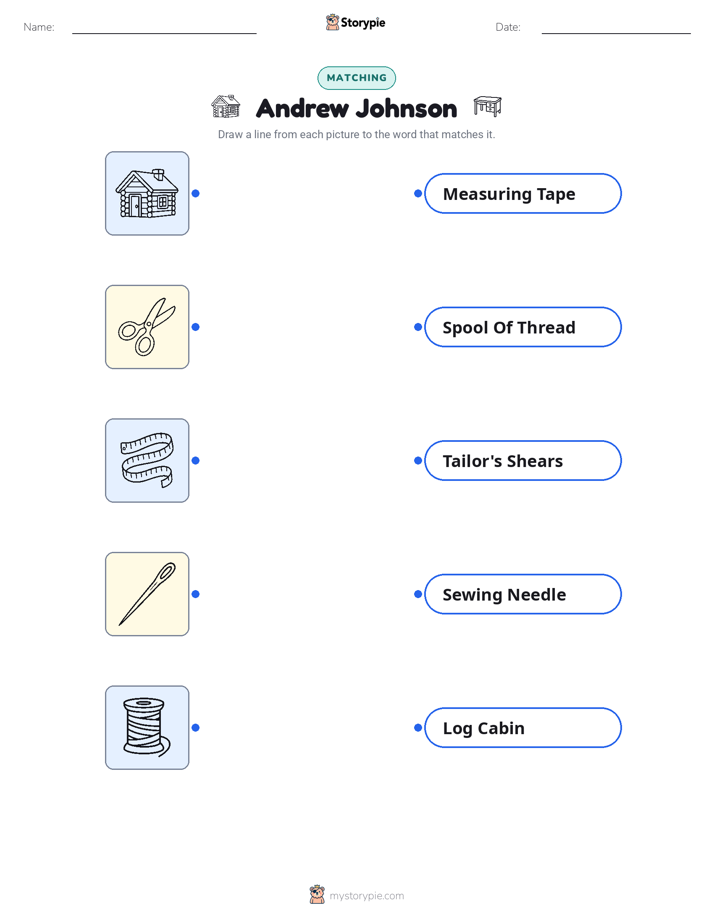
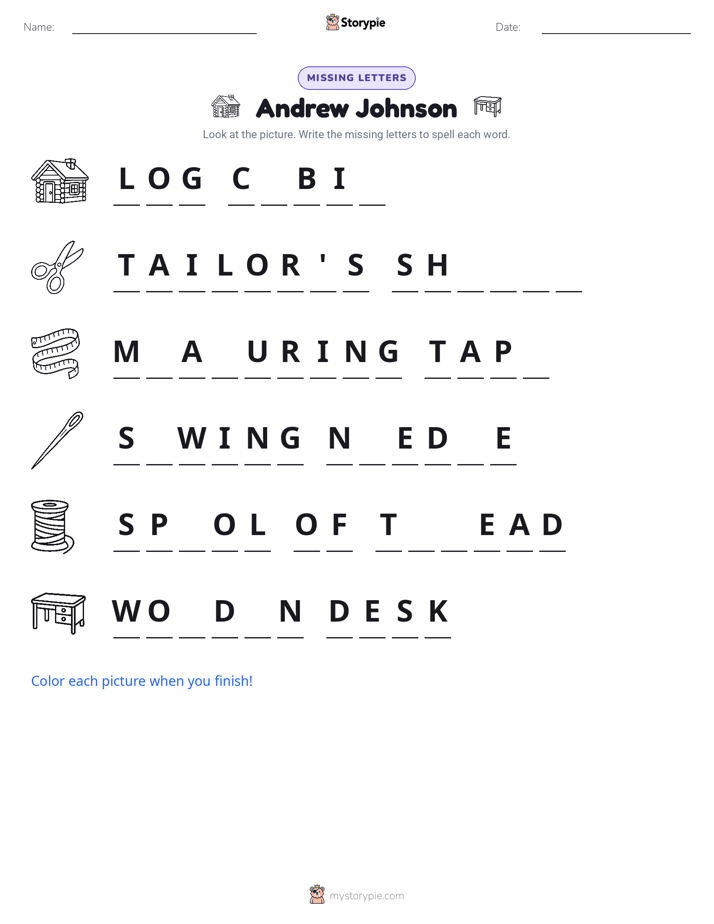
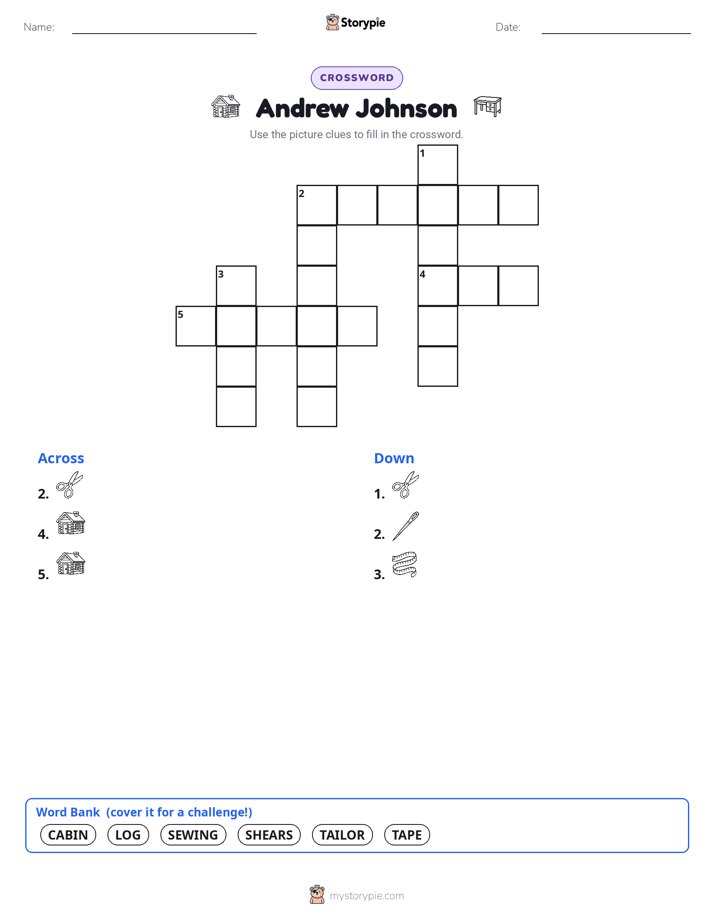
My name is Andrew Johnson, and I became the 17th President of the United States. My story starts not in a grand house, but in a small log cabin in Raleigh, North Carolina, where I was born on December 29th, 1808. My family didn't have much money, and I never spent a single day in a schoolhouse as a boy. To learn a trade that would help me make a living, I became a tailor's apprentice. Around 1826, I decided to move west to Greeneville, Tennessee, where I opened my very own tailor shop. It was there that I met my wonderful wife, Eliza McCardle. We were married on May 17th, 1827. While I worked hard sewing clothes, she would read to me from books and newspapers, helping me improve my reading, writing, and arithmetic skills, which were so important for my future.
My tailor shop quickly became more than just a place for sewing; it turned into a gathering spot where people from town came to discuss the news and politics of the day. I loved participating in these debates and found that I had strong opinions about how to help our community. This interest led me into politics. I started with local positions and eventually, in 1843, the people of Tennessee elected me to serve in the U.S. House of Representatives. After serving there for ten years, I was elected Governor of Tennessee in 1853. In all my roles, I tried to be a voice for the common, working people, like the farmers and mechanics I had grown up with. My political journey continued to climb, and in 1857, I was elected to represent Tennessee in the U.S. Senate in Washington, D.C.
Andrew Johnson: From Tailor to President
My name is Andrew Johnson, and I became the 17th President of the United States. My story starts not in a grand house, but in a small log cabin in Raleigh, North Carolina, where I was born on December 29th, 1808. My family didn't have much money, and I never spent a single day in a schoolhouse as a boy. To learn a trade that would help me make a living, I became a tailor's apprentice. Around 1826, I decided to move west to Greeneville, Tennessee, where I opened my very own tailor shop. It was there that I met my wonderful wife, Eliza McCardle. We were married on May 17th, 1827. While I worked hard sewing clothes, she would read to me from books and newspapers, helping me improve my reading, writing, and arithmetic skills, which were so important for my future.
My tailor shop quickly became more than just a place for sewing; it turned into a gathering spot where people from town came to discuss the news and politics of the day. I loved participating in these debates and found that I had strong opinions about how to help our community. This interest led me into politics. I started with local positions and eventually, in 1843, the people of Tennessee elected me to serve in the U.S. House of Representatives. After serving there for ten years, I was elected Governor of Tennessee in 1853. In all my roles, I tried to be a voice for the common, working people, like the farmers and mechanics I had grown up with. My political journey continued to climb, and in 1857, I was elected to represent Tennessee in the U.S. Senate in Washington, D.C.
My time as a senator unfolded during one of the most challenging periods in our country's history. The nation was fiercely divided over the issue of slavery, and this disagreement led several Southern states to secede, or leave, the Union. In 1861, my own state of Tennessee voted to join the Confederacy. This presented me with a difficult and profound choice: should I stay loyal to my state or to my country? I firmly believed that the United States must remain one united nation. Because of this belief, I became the only senator from a seceding Southern state who refused to give up my seat in the U.S. Senate. My loyalty to the Union did not go unnoticed. In 1862, President Abraham Lincoln appointed me to serve as the military governor of Tennessee. Two years later, during the presidential election of 1864, he asked me to run alongside him as his Vice President.
We won the election, and I was sworn in as Vice President on March 4th, 1865. The long and devastating Civil War was finally coming to an end, and a sense of hope for peace and unity was spreading across the nation. However, just over a month later, a terrible tragedy struck our country. On April 15th, 1865, President Lincoln was assassinated. The nation was plunged into deep mourning, and in the midst of this sorrow, the responsibilities of the presidency fell to me. I took the oath of office and became the 17th President of the United States. The greatest and most urgent task before me was a challenge known as 'Reconstruction'—the enormous process of healing our broken country and figuring out how to bring the Southern states back into the Union.
Reconstruction proved to be an incredibly difficult process, and my ideas on how to approach it were very different from those of many leaders in Congress. I favored a lenient plan that would allow the Southern states to rejoin the Union quickly and with few conditions. However, a powerful group in Congress, known as the 'Radical Republicans,' wanted a much stricter approach. They were determined to protect the civil rights of the four million newly freed African Americans and to ensure that the old Southern leaders did not regain power and influence. Our disagreements were so strong that I often vetoed, or rejected, major bills they passed. This included the important Civil Rights Act of 1866. But for the first time in American history, Congress gathered enough votes to override my vetoes, making the bills into law despite my objections. During this contentious period, my government did achieve something that would become very important later: in 1867, we purchased the vast territory of Alaska from Russia.
My constant clashes with Congress eventually reached a boiling point. Congress had passed a law called the Tenure of Office Act, which stated that I could not fire certain high-ranking government officials without getting the Senate's permission first. I believed this law was unconstitutional and that it interfered with my powers as president. To challenge it, I fired my Secretary of War, Edwin Stanton. In response, the House of Representatives voted to impeach me in February 1868. Impeachment doesn't mean removal from office; it means I was formally accused of committing a crime. I was then put on trial in the Senate. After a long and dramatic trial, the senators cast their votes. In the end, they were just one single vote short of the two-thirds majority needed to remove me from office. I was acquitted and remained president until my term officially ended in 1869.
After leaving the White House, I returned to my home in Tennessee, thinking my time in Washington was over. However, my political career wasn't quite finished. In a unique comeback, I was elected to the U.S. Senate once again in 1875, becoming the only former president ever to serve in the Senate. I lived to be 66 years old. I am remembered as a complex and controversial president who led the nation during the turbulent and uncertain start of Reconstruction. My story serves as a reminder that even someone from the humblest of beginnings can rise to the highest office in the land, and it highlights the fierce debates that have shaped our nation's history.
Wow facts
About
Andrew Johnson was the 17th President of the United States, serving from 1865 to 1869. He assumed the presidency after the assassination of Abraham Lincoln and presided over the Reconstruction era, during which he became the first U.S. president to be impeached.
Take a Quiz
Question 1 of 5
What was the main reason the House of Representatives voted to impeach President Johnson in 1868?
Explore next






Want to do even more?
Go beyond exploring. Unlock tools that turn every story into real learning.

Storypie Plus for families
Full stories, quizzes, and printables. Nights and car rides, sorted.
- Unlimited audio stories
- Create Mode: your child stars in the story
- Offline downloads
- Printable worksheets & coloring pages

Why Storypie for Schools
Students engaged. Prep in seconds. Evenings back to you.
- Worksheets & Quizzes
- Classroom Management
- Formative Assessment
- Custom Curriculum & Lesson Plans
- 27 Languages

Why Storypie for Homeschool
Curriculum done. They'll ask for more. Hours back in your day.
- Worksheet Generator
- First-Person Audio Stories
- Built-in Comprehension Quizzes
- Custom Curriculum & Lesson Plans
- Print & Go Activities