English


Barbara McClintock
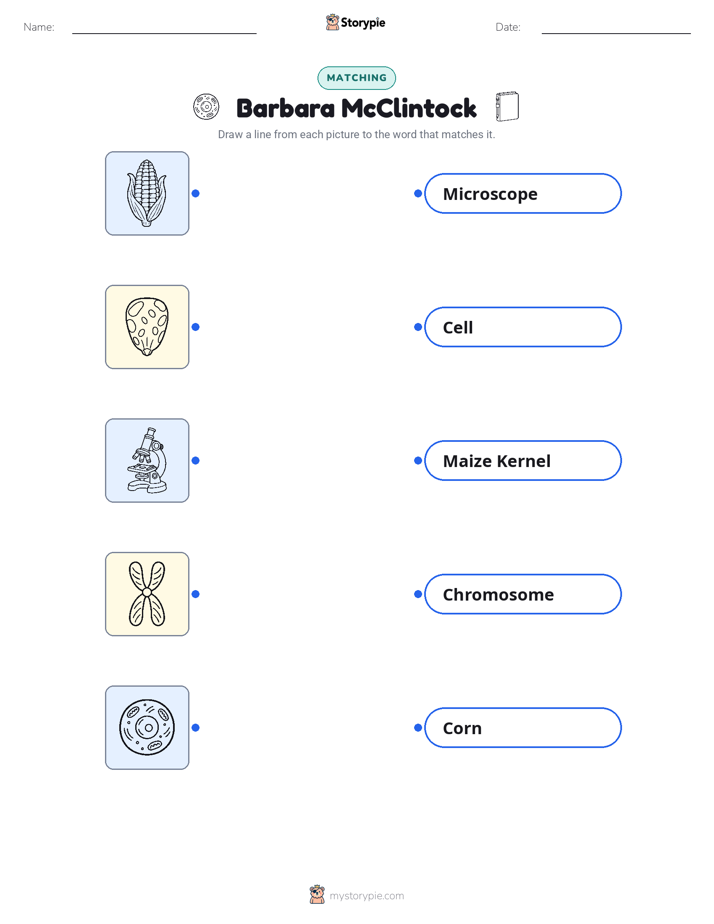
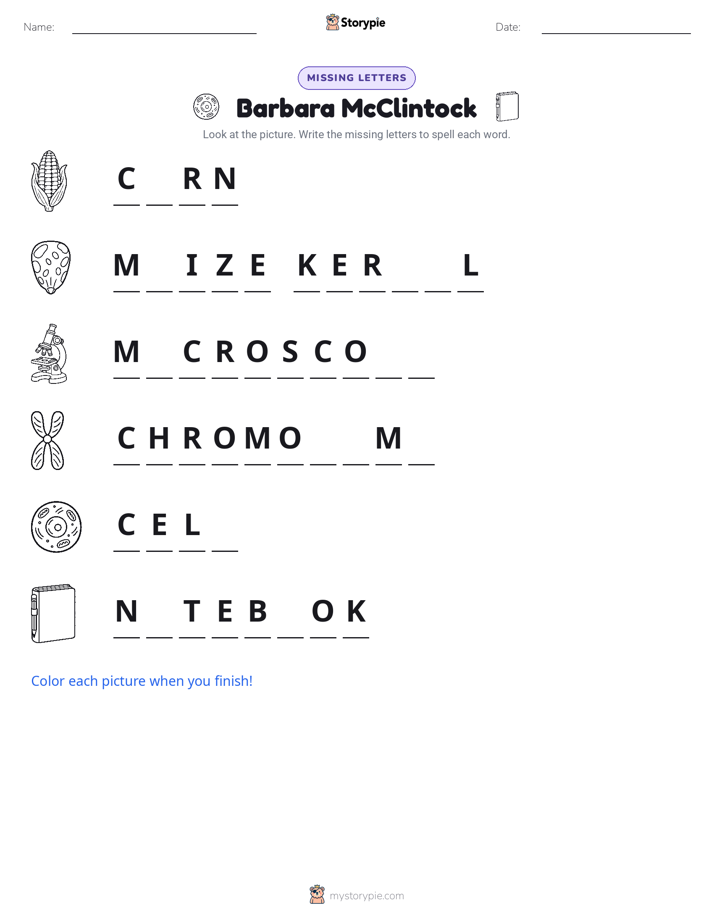
Barbara McClintock was a pioneering American scientist and cytogeneticist who discovered mobile genetic…
Reads at Grades K-2 Listens at K–3
Print & create
Answer keys·No prep·Free with an account
28 worksheets · answer keys · full story · quiz · Ages 6-8 · CEFR A2
Plus adds 290,000+ more stories in 27 languages, audio for every one, and printables for all of them.
Just want Barbara McClintock?

Hello! My name is Barbara McClintock. I was born on June 16th, 1902. When I was a little girl, I loved exploring the world around me. I was very curious and enjoyed figuring things out all on my own. I was always asking my parents, "Why does this work?" or "Why is the sky blue?" Learning new things was my favorite hobby, and I was so excited when I was old enough to go to school. I couldn't wait to learn about everything, from how plants grow to how stars shine. My curiosity was like a little engine inside me that never stopped running.
When I grew up, I went to a big school called Cornell University in 1919. I decided to study plants because I found them so interesting. Of all the plants in the world, my very favorite was maize, which you probably know by its other name: corn! I was fascinated by the corn cobs and their colorful kernels. Some were yellow, some were red, and some were even spotted. I wanted to understand the secret instructions inside each plant that made it special. I knew that if I looked closely enough, the corn could tell me its secrets.
To understand those secrets, I had to learn about something called genes. You can think of genes as being like a recipe book for every living thing. They tell a plant if it should be tall or short, or what color its corn kernels should be. Starting in the 1940s, I spent many, many years in my laboratory looking at corn cells through a powerful microscope. Day after day, I watched them very carefully. One day, I noticed something amazing that no one had ever seen before. I saw that some of the genes weren't stuck in one place in the recipe book. They could move around! It was as if they could hop from one page to another, like a frog jumping on a lily pad. I called them "jumping genes." This was a brand new idea, and at first, some other scientists didn't believe me. But I had seen it with my own eyes, and I knew my discovery was important.
Barbara McClintock: The Scientist and the Jumping Genes
Hello! My name is Barbara McClintock. I was born on June 16th, 1902. When I was a little girl, I loved exploring the world around me. I was very curious and enjoyed figuring things out all on my own. I was always asking my parents, "Why does this work?" or "Why is the sky blue?" Learning new things was my favorite hobby, and I was so excited when I was old enough to go to school. I couldn't wait to learn about everything, from how plants grow to how stars shine. My curiosity was like a little engine inside me that never stopped running.
When I grew up, I went to a big school called Cornell University in 1919. I decided to study plants because I found them so interesting. Of all the plants in the world, my very favorite was maize, which you probably know by its other name: corn! I was fascinated by the corn cobs and their colorful kernels. Some were yellow, some were red, and some were even spotted. I wanted to understand the secret instructions inside each plant that made it special. I knew that if I looked closely enough, the corn could tell me its secrets.
To understand those secrets, I had to learn about something called genes. You can think of genes as being like a recipe book for every living thing. They tell a plant if it should be tall or short, or what color its corn kernels should be. Starting in the 1940s, I spent many, many years in my laboratory looking at corn cells through a powerful microscope. Day after day, I watched them very carefully. One day, I noticed something amazing that no one had ever seen before. I saw that some of the genes weren't stuck in one place in the recipe book. They could move around! It was as if they could hop from one page to another, like a frog jumping on a lily pad. I called them "jumping genes." This was a brand new idea, and at first, some other scientists didn't believe me. But I had seen it with my own eyes, and I knew my discovery was important.
Many years later, other scientists built better and stronger tools. When they looked at cells, they saw that I was right all along! Genes really could jump. In 1983, I received a very special award for my work called the Nobel Prize. It made me so happy to know that my discovery was finally understood by everyone. I lived to be 90 years old, and my work with 'jumping genes' helps scientists today understand so much about plants, animals, and people. I hope you always stay curious and trust your own amazing discoveries!
Wow facts
About
Barbara McClintock was a pioneering American scientist and cytogeneticist who discovered mobile genetic elements, or "jumping genes," for which she was awarded the Nobel Prize in Physiology or Medicine in 1983.
Take a Quiz
Question 1 of 4
Why did Barbara McClintock love to study corn so much?
Explore next






Want to do even more?
Go beyond exploring. Unlock tools that turn every story into real learning.

Storypie Plus for families
Full stories, quizzes, and printables. Nights and car rides, sorted.
- Unlimited audio stories
- Create Mode: your child stars in the story
- Offline downloads
- Printable worksheets & coloring pages

Why Storypie for Schools
Students engaged. Prep in seconds. Evenings back to you.
- Worksheets & Quizzes
- Classroom Management
- Formative Assessment
- Custom Curriculum & Lesson Plans
- 27 Languages

Why Storypie for Homeschool
Curriculum done. They'll ask for more. Hours back in your day.
- Worksheet Generator
- First-Person Audio Stories
- Built-in Comprehension Quizzes
- Custom Curriculum & Lesson Plans
- Print & Go Activities