English


Barbara McClintock
Barbara McClintock was a pioneering American scientist and cytogeneticist who discovered mobile genetic…
Reads at Grades 3–5 Listens at Grades 1–5
Print & create
Answer keys·No prep·Free with an account
28 worksheets · answer keys · full story · quiz · Ages 8-10 · CEFR B1
Plus adds 290,000+ more stories in 27 languages, audio for every one, and printables for all of them.
Just want Barbara McClintock?

Hello! My name is Barbara McClintock. I was born a long time ago, on June 16th, 1902, in Hartford, Connecticut. Even as a little girl, I loved being on my own and figuring things out. I would spend hours outside, exploring the world around me. I was very independent and loved to learn, but my mother worried that being too smart might make it hard for me to find a husband someday. Luckily, my father believed in me and always encouraged my curiosity. He knew how much I wanted to go to college and supported my dream.
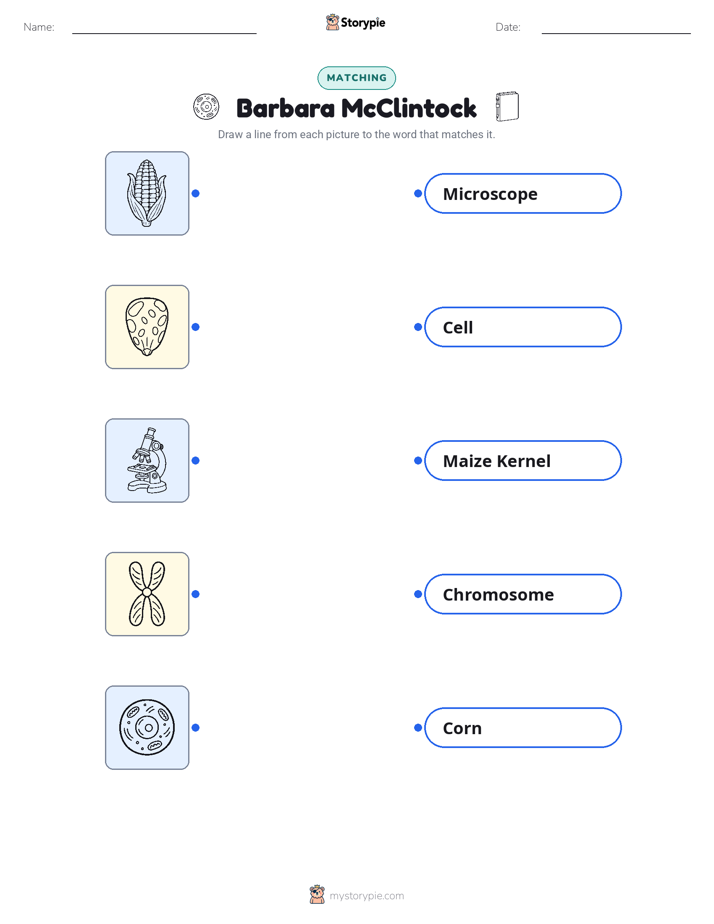
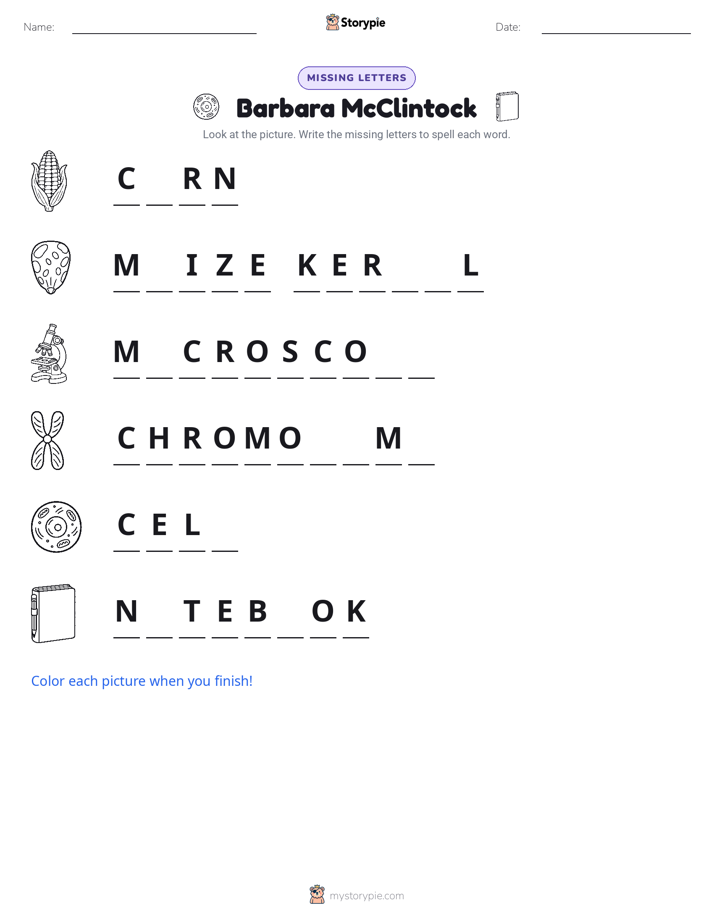
When I was old enough, in 1919, I went to Cornell University to study agriculture. It was there I fell in love with a special field of science called genetics, which is the study of how traits are passed down in living things. I was especially fascinated by maize, which you probably know as corn! I spent hours and hours in the lab, looking at corn cells under a microscope. I earned my first degree in 1923 and kept on studying, earning my Ph.D. in botany in 1927. I wanted to understand all the secrets hidden inside each tiny kernel of corn.
After college, I continued my research. I noticed something very strange while studying the colorful patterns on kernels of corn. The colors—purple, yellow, white—were appearing in patterns that didn't follow the rules of genetics that everyone knew. It was a real puzzle! After years of careful observation in the 1940s, I realized what was happening. Some pieces of genetic material, called genes, weren't staying in one place. They were actually 'jumping' from one spot to another on the chromosomes! This jumping around changed the instructions for the corn's color. In 1951, I shared my idea about these 'jumping genes,' which scientists now call transposable elements.
Barbara McClintock
Hello! My name is Barbara McClintock. I was born a long time ago, on June 16th, 1902, in Hartford, Connecticut. Even as a little girl, I loved being on my own and figuring things out. I would spend hours outside, exploring the world around me. I was very independent and loved to learn, but my mother worried that being too smart might make it hard for me to find a husband someday. Luckily, my father believed in me and always encouraged my curiosity. He knew how much I wanted to go to college and supported my dream.
When I was old enough, in 1919, I went to Cornell University to study agriculture. It was there I fell in love with a special field of science called genetics, which is the study of how traits are passed down in living things. I was especially fascinated by maize, which you probably know as corn! I spent hours and hours in the lab, looking at corn cells under a microscope. I earned my first degree in 1923 and kept on studying, earning my Ph.D. in botany in 1927. I wanted to understand all the secrets hidden inside each tiny kernel of corn.
After college, I continued my research. I noticed something very strange while studying the colorful patterns on kernels of corn. The colors—purple, yellow, white—were appearing in patterns that didn't follow the rules of genetics that everyone knew. It was a real puzzle! After years of careful observation in the 1940s, I realized what was happening. Some pieces of genetic material, called genes, weren't staying in one place. They were actually 'jumping' from one spot to another on the chromosomes! This jumping around changed the instructions for the corn's color. In 1951, I shared my idea about these 'jumping genes,' which scientists now call transposable elements.
When I first told other scientists about my discovery, many of them didn't believe me. It was a completely new idea, and the tools they had back then couldn't prove I was right. It was difficult, but I knew what I had seen under my microscope. I didn't get discouraged. I just kept working quietly on my research, trusting my own observations. I knew that one day, science would catch up to what I had found in my cornfields.
And you know what? It did! Many years later, other scientists with new technology saw the same 'jumping genes' in other plants and animals. My work was finally understood! In 1983, I was awarded the Nobel Prize in Physiology or Medicine for my discovery. I was the very first woman to win that prize all by herself. I lived to be 90 years old, and I am so happy that my discovery helped change how we understand genetics. I hope my story reminds you to always stay curious, to look closely at the world, and to trust your own ideas, even if no one else understands them yet.
Wow facts
About
Barbara McClintock was a pioneering American scientist and cytogeneticist who discovered mobile genetic elements, or "jumping genes," for which she was awarded the Nobel Prize in Physiology or Medicine in 1983.
Take a Quiz
Question 1 of 5
What subject did I study when I first went to college in 1919?
Explore next






Want to do even more?
Go beyond exploring. Unlock tools that turn every story into real learning.

Storypie Plus for families
Full stories, quizzes, and printables. Nights and car rides, sorted.
- Unlimited audio stories
- Create Mode: your child stars in the story
- Offline downloads
- Printable worksheets & coloring pages

Why Storypie for Schools
Students engaged. Prep in seconds. Evenings back to you.
- Worksheets & Quizzes
- Classroom Management
- Formative Assessment
- Custom Curriculum & Lesson Plans
- 27 Languages

Why Storypie for Homeschool
Curriculum done. They'll ask for more. Hours back in your day.
- Worksheet Generator
- First-Person Audio Stories
- Built-in Comprehension Quizzes
- Custom Curriculum & Lesson Plans
- Print & Go Activities