English


Carlos Chagas
Carlos Chagas was a Brazilian sanitary physician, scientist, and bacteriologist who, in 1909…
Reads at Grades 6–8 Listens at Grades 4–8
Print & create
Answer keys·No prep·Free with an account
28 worksheets · answer keys · full story · quiz · Ages 10-12 · CEFR B2
Plus adds 164,000+ more stories in 27 languages, audio for every one, and printables for all of them.
Just want Carlos Chagas?

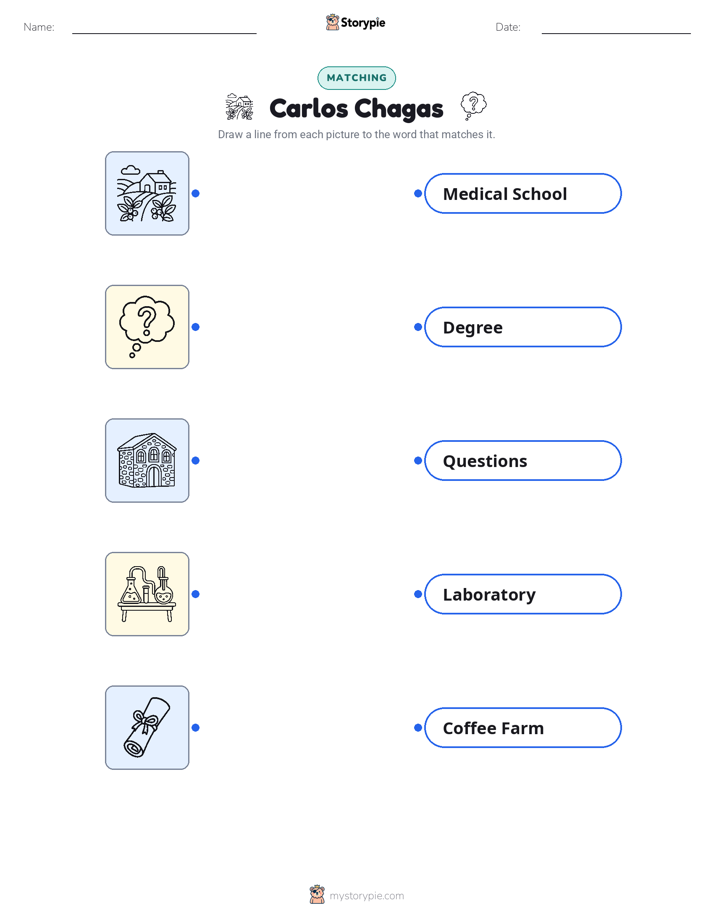
Hello! My name is Carlos Chagas. I want to tell you the story of how my curiosity led me to a discovery that helped people all over the world. I was born on July 9th, 1879, on a coffee farm in a town called Oliveira, Brazil. Growing up surrounded by the wonders of nature, I was always filled with questions about the world around me. This constant curiosity guided me to the bustling city of Rio de Janeiro in 1897, where I began my studies in medicine. I was driven by a deep desire to understand the complexities of the human body and learn how to heal people when they fell ill.
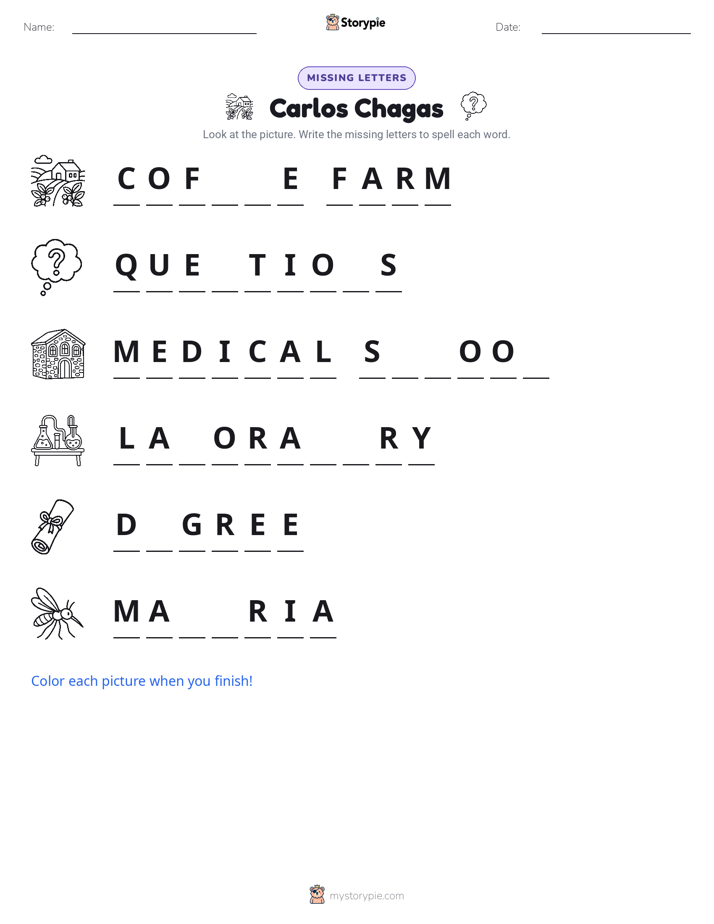
In medical school, my path crossed with a brilliant scientist named Oswaldo Cruz, who would become my greatest teacher and hero. He was the director of a special laboratory, the Oswaldo Cruz Institute, which was dedicated to fighting the devastating diseases that plagued Brazil at the time. After I earned my degree in 1903, I was honored to join him at the institute. My first major assignment involved studying malaria, a serious illness spread by mosquitoes. It was during this time that Dr. Cruz taught me the most valuable lesson of my career: to be a scientific detective. He showed me how to observe the world with immense care, to constantly ask questions, and to follow the clues with persistence, no matter where they might lead.
In 1907, Dr. Cruz entrusted me with a critical mission. I was sent to a small, remote town named Lassance, where a new railroad was under construction. A mysterious illness was spreading among the workers, and the common belief was that it was another outbreak of malaria. To investigate, I set up a small laboratory for myself inside a converted railroad car and began my work. However, I soon observed something that didn't fit the malaria theory. The workers lived in simple houses with walls made of mud, and I noticed that at night, a large, blood-sucking insect would emerge. The local people called it a 'barbeiro,' which translates to 'kissing bug.' I felt a strong hunch that this insect might be a crucial piece of the puzzle I was trying to solve.
Carlos Chagas: A Scientific Detective's Story
Hello! My name is Carlos Chagas. I want to tell you the story of how my curiosity led me to a discovery that helped people all over the world. I was born on July 9th, 1879, on a coffee farm in a town called Oliveira, Brazil. Growing up surrounded by the wonders of nature, I was always filled with questions about the world around me. This constant curiosity guided me to the bustling city of Rio de Janeiro in 1897, where I began my studies in medicine. I was driven by a deep desire to understand the complexities of the human body and learn how to heal people when they fell ill.
In medical school, my path crossed with a brilliant scientist named Oswaldo Cruz, who would become my greatest teacher and hero. He was the director of a special laboratory, the Oswaldo Cruz Institute, which was dedicated to fighting the devastating diseases that plagued Brazil at the time. After I earned my degree in 1903, I was honored to join him at the institute. My first major assignment involved studying malaria, a serious illness spread by mosquitoes. It was during this time that Dr. Cruz taught me the most valuable lesson of my career: to be a scientific detective. He showed me how to observe the world with immense care, to constantly ask questions, and to follow the clues with persistence, no matter where they might lead.
In 1907, Dr. Cruz entrusted me with a critical mission. I was sent to a small, remote town named Lassance, where a new railroad was under construction. A mysterious illness was spreading among the workers, and the common belief was that it was another outbreak of malaria. To investigate, I set up a small laboratory for myself inside a converted railroad car and began my work. However, I soon observed something that didn't fit the malaria theory. The workers lived in simple houses with walls made of mud, and I noticed that at night, a large, blood-sucking insect would emerge. The local people called it a 'barbeiro,' which translates to 'kissing bug.' I felt a strong hunch that this insect might be a crucial piece of the puzzle I was trying to solve.
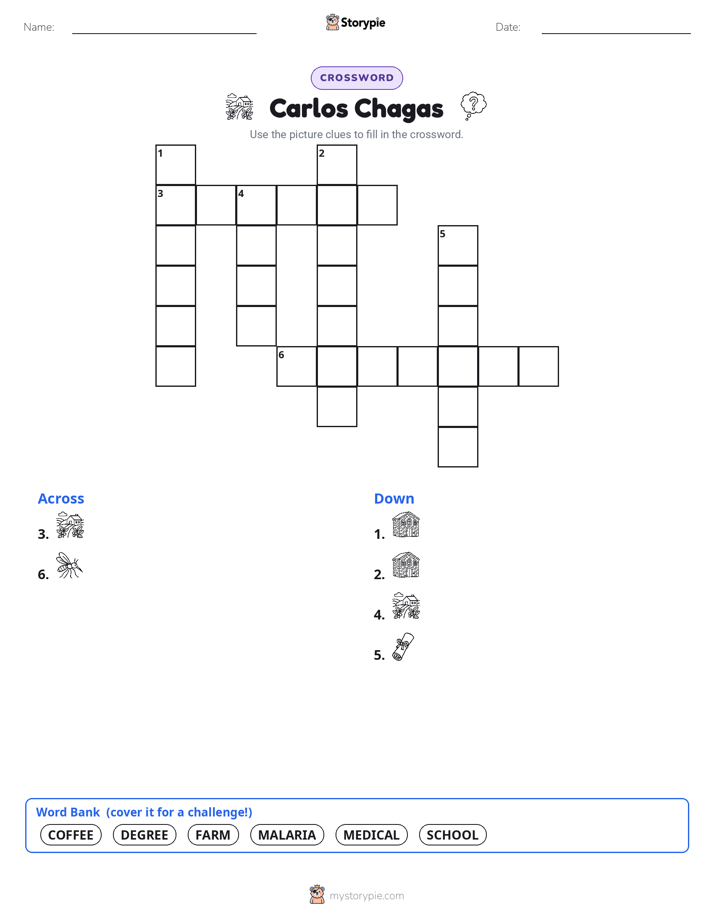
Following my scientific intuition, I began a detailed study of the kissing bugs. While examining them under my microscope, I discovered a tiny, wriggling parasite inside their bodies—a life form that had never been documented by science before. In 1909, I officially named this new organism Trypanosoma cruzi, a tribute to my esteemed teacher. Yet, the most important question was still unanswered: could this newly discovered parasite be the cause of the illness affecting the workers? The final clue fell into place on April 14th, 1909. I was called to see a two-year-old girl named Berenice Soares de Moura, who was suffering from a high fever and other puzzling symptoms. I took a small sample of her blood and rushed to my microscope. Looking through the lens, I saw it—the very same Trypanosoma cruzi parasite I had found in the kissing bugs. In that moment, I had discovered a brand-new disease, its cause, and the insect that transmitted it, all at the same time. This was a unique achievement in the history of medicine.
My discovery soon became known to the world as Chagas disease. After completing my groundbreaking work in Lassance, I returned to Rio de Janeiro to continue my research. When my dear friend and mentor, Oswaldo Cruz, passed away in 1917, I was appointed the new director of his institute, a responsibility I took very seriously. For the rest of my career, I dedicated myself to the field of public health, working to combat other serious illnesses, including the Spanish flu epidemic that swept across the globe. For my discovery of Chagas disease, I was nominated for the Nobel Prize on two separate occasions. However, my greatest satisfaction always came from knowing that my work provided doctors with the knowledge to understand and treat people suffering from this illness.
I lived to be 55 years old. Today, the disease I discovered still affects millions of people, particularly in Latin America. But because of my work, doctors and scientists understand what causes it, how it spreads, and how to diagnose it. They continue the research to find better medicines and to stop the kissing bugs from spreading the parasite to more people. I hope my story shows you that if you remain curious, carefully observe the world around you, and are never afraid to ask big questions, you might just make a discovery that can change the world for the better.
Wow facts
About
Carlos Chagas was a Brazilian sanitary physician, scientist, and bacteriologist who, in 1909, discovered Chagas disease. He was the first to completely describe Chagas disease: its germ, how it spreads, who can get it, and the signs that someone is sick.
Take a Quiz
Question 1 of 5
In your own words, describe the key steps Carlos Chagas took in Lassance that led to his famous discovery.
Explore next


Want to do even more?
Go beyond exploring. Unlock tools that turn every story into real learning.

Storypie Plus for families
Full stories, quizzes, and printables. Nights and car rides, sorted.
- Unlimited audio stories
- Create Mode: your child stars in the story
- Offline downloads
- Printable worksheets & coloring pages

Why Storypie for Schools
Students engaged. Prep in seconds. Evenings back to you.
- Worksheets & Quizzes
- Classroom Management
- Formative Assessment
- Custom Curriculum & Lesson Plans
- 27 Languages

Why Storypie for Homeschool
Curriculum done. They'll ask for more. Hours back in your day.
- Worksheet Generator
- First-Person Audio Stories
- Built-in Comprehension Quizzes
- Custom Curriculum & Lesson Plans
- Print & Go Activities