English

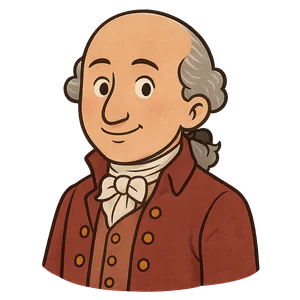
Charles-Augustin de Coulomb
A French military engineer and physicist best known for formulating Coulomb's law…
Reads at Grades 3–5 Listens at Grades 1–5
Print & create
Answer keys·No prep·Free with an account
28 worksheets · answer keys · full story · quiz · Ages 8-10 · CEFR B1
Plus adds 244,000+ more stories in 27 languages, audio for every one, and printables for all of them.
Just want Charles-Augustin de Coulomb?
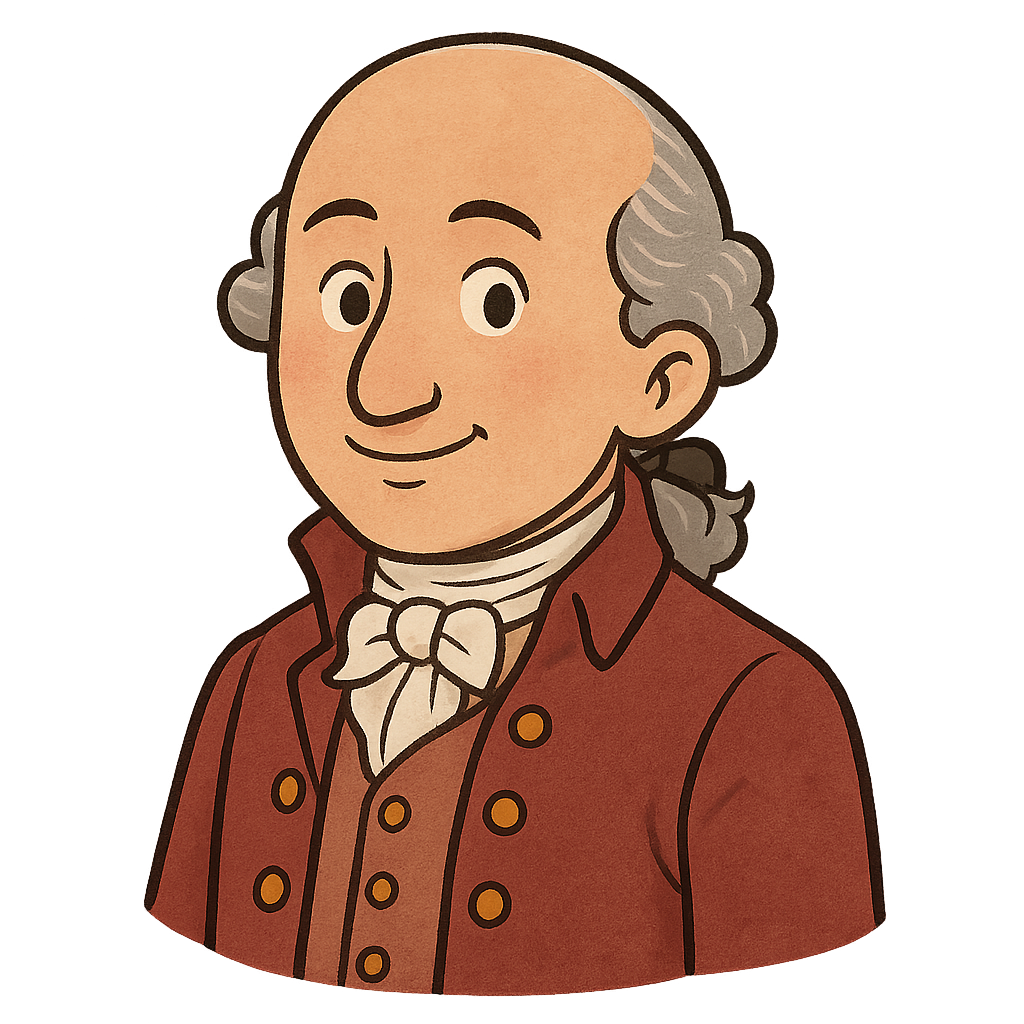
Hello, my name is Charles-Augustin de Coulomb, and I am a scientist who loved to measure the world around me, even the things I couldn't see. I was born on June 14th, 1736, in a town called Angoulême in France. When I was a boy, my family moved to the big, bustling city of Paris. It was an exciting place filled with new ideas. From a young age, I was fascinated by numbers and how things worked. While other children might have preferred playing games, I found my greatest joy in studying mathematics and science. I could spend hours solving difficult problems, and I knew that this love for learning would guide my life. My parents encouraged my curiosity, which set me on a path to becoming an engineer and a physicist, ready to solve some of science’s biggest puzzles.
As I grew older, I decided to use my skills to serve my country. I chose to become a military engineer, a job that combines math, science, and building to create strong defenses. I studied hard at a special school called the Royal Engineering School of Mézières and graduated in 1761, ready for a challenge. In 1764, I was sent on a great adventure far across the ocean to an island called Martinique in the West Indies. My job was very important: I was in charge of building a massive new fort to protect the island. We named it Fort Bourbon. The work was incredibly difficult. For nine years, I worked under the hot sun, managing hundreds of workers and solving complex construction problems. The climate was tough, and the hard work affected my health, but those years taught me so much about the strength of different materials and the practical side of engineering. It was a lesson I would never forget.
Charles-Augustin de Coulomb: Measuring the Invisible
Hello, my name is Charles-Augustin de Coulomb, and I am a scientist who loved to measure the world around me, even the things I couldn't see. I was born on June 14th, 1736, in a town called Angoulême in France. When I was a boy, my family moved to the big, bustling city of Paris. It was an exciting place filled with new ideas. From a young age, I was fascinated by numbers and how things worked. While other children might have preferred playing games, I found my greatest joy in studying mathematics and science. I could spend hours solving difficult problems, and I knew that this love for learning would guide my life. My parents encouraged my curiosity, which set me on a path to becoming an engineer and a physicist, ready to solve some of science’s biggest puzzles.
As I grew older, I decided to use my skills to serve my country. I chose to become a military engineer, a job that combines math, science, and building to create strong defenses. I studied hard at a special school called the Royal Engineering School of Mézières and graduated in 1761, ready for a challenge. In 1764, I was sent on a great adventure far across the ocean to an island called Martinique in the West Indies. My job was very important: I was in charge of building a massive new fort to protect the island. We named it Fort Bourbon. The work was incredibly difficult. For nine years, I worked under the hot sun, managing hundreds of workers and solving complex construction problems. The climate was tough, and the hard work affected my health, but those years taught me so much about the strength of different materials and the practical side of engineering. It was a lesson I would never forget.
After my time in Martinique, I returned to France in 1772. I was no longer just an engineer; I was a scientist with a deep curiosity about the invisible forces of nature. A question burned in my mind: how could someone measure forces you can't see, like electricity and magnetism? I spent years thinking about this puzzle. Then, around 1784, I had an idea and invented a special device called the torsion balance. It was a very delicate instrument. Imagine a thin fiber, like a strong spider's silk, hanging from a support. At the bottom, a small needle is attached. When a tiny force, like the push or pull from an electric charge, touches the needle, it makes the fiber twist. By measuring how much the fiber twisted, I could measure the exact strength of that invisible force. Using this amazing invention, I made my most famous discovery in 1785. I figured out the exact rule, or law, that explains how electric charges attract or repel each other. This important rule is now known as Coulomb's Law, and it became a foundation for the study of electricity.
Just as my scientific work was taking off, big changes were happening in my country. In 1789, the French Revolution began, and life in Paris became very unsettled and even dangerous. It was not a good time for quiet scientific study, so I decided to leave the city for a while. I moved to a small estate I owned in a town called Blois, where I could continue my experiments in peace. A few years later, after the most difficult times of the Revolution had passed, I was asked to come back to Paris to help with a very important national project. The leaders of France wanted to create a new system of weights and measures that was logical and easy for everyone to use. I joined a team of scientists, and our work helped establish what is now known as the metric system—the same system of meters, kilograms, and liters used by scientists and people all over the world today.
I lived a full life dedicated to discovery and passed away on August 23rd, 1806. I lived to be 70 years old. Though my life ended, my work continues to be remembered in the world of science. To honor my discoveries, the basic unit used to measure electric charge was named the 'coulomb'. I am proud that my careful measurements of invisible forces helped build the foundation for other scientists and inventors to create the amazing electrical inventions, like lights and computers, that power your world today.
Wow facts
About
A French military engineer and physicist best known for formulating Coulomb's law, which describes the electrostatic force of attraction and repulsion. He was the first to use the torsion balance to measure electrical charge.
Take a Quiz
Question 1 of 5
What was the main problem Charles-Augustin de Coulomb wanted to solve when he invented the torsion balance?
Explore next






Want to do even more?
Go beyond exploring. Unlock tools that turn every story into real learning.

Storypie Plus for families
Full stories, quizzes, and printables. Nights and car rides, sorted.
- Unlimited audio stories
- Create Mode: your child stars in the story
- Offline downloads
- Printable worksheets & coloring pages

Why Storypie for Schools
Students engaged. Prep in seconds. Evenings back to you.
- Worksheets & Quizzes
- Classroom Management
- Formative Assessment
- Custom Curriculum & Lesson Plans
- 27 Languages

Why Storypie for Homeschool
Curriculum done. They'll ask for more. Hours back in your day.
- Worksheet Generator
- First-Person Audio Stories
- Built-in Comprehension Quizzes
- Custom Curriculum & Lesson Plans
- Print & Go Activities