English

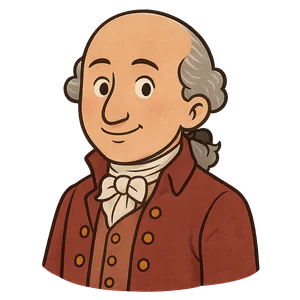
Charles-Augustin de Coulomb
A French military engineer and physicist best known for formulating Coulomb's law…
Reads at Grades 6–8 Listens at Grades 4–8
Print & create
Answer keys·No prep·Free with an account
28 worksheets · answer keys · full story · quiz · Ages 10-12 · CEFR B2
Plus adds 244,000+ more stories in 27 languages, audio for every one, and printables for all of them.
Just want Charles-Augustin de Coulomb?
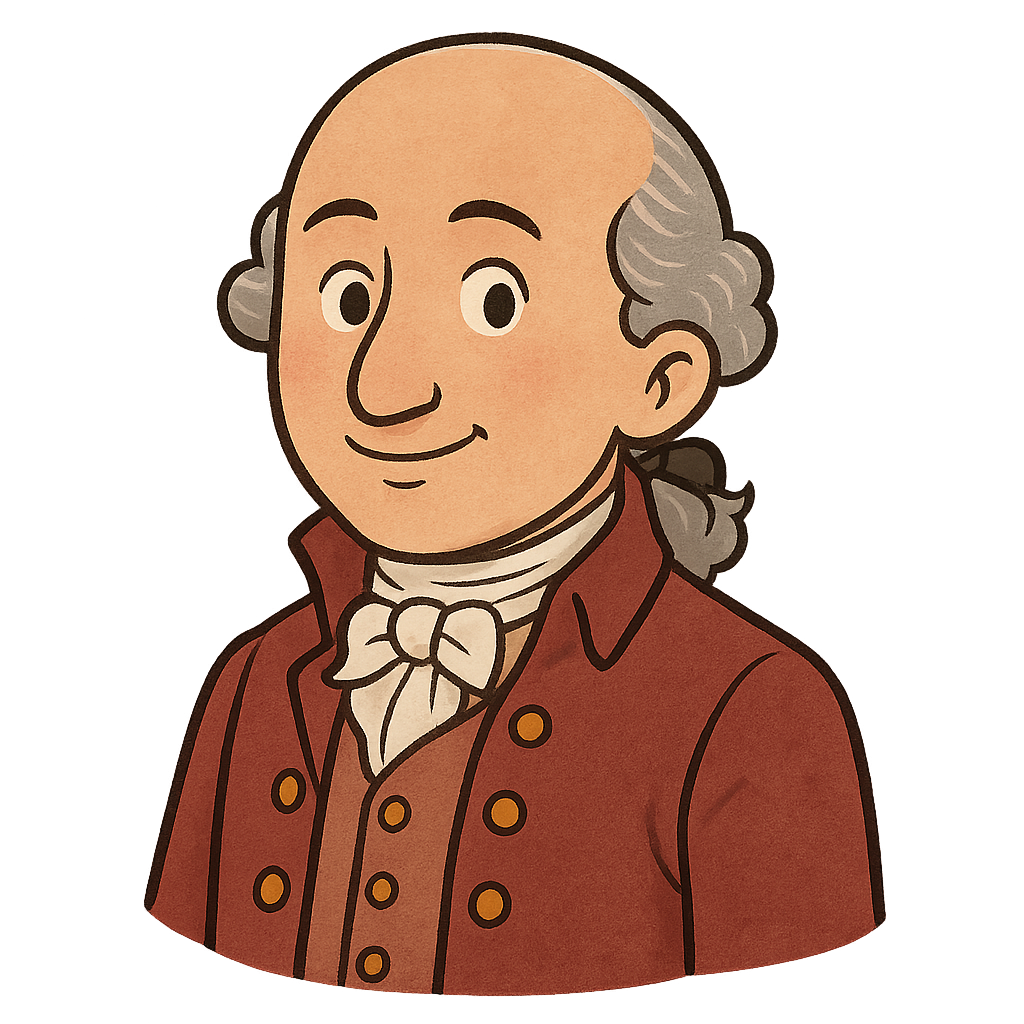
Hello! My name is Charles-Augustin de Coulomb, and I’d like to share my story with you. I was born on June 14th, 1736, in a town called Angoulême in France. My family moved to Paris when I was a boy, and it was there that my love for learning truly blossomed. The city was full of new ideas, and I was fascinated by numbers and how things worked. I decided I wanted to use my love for mathematics to build amazing things, so I set my sights on becoming a military engineer, a profession where I could combine my skills in math with practical construction.
After finishing my studies at the Royal Engineering School of Mézières in 1761, I was ready for an adventure. In 1764, the French army sent me to a faraway island in the Caribbean called Martinique. My job was a big one: to design and build a new fort, called Fort Bourbon, to help protect the island. For nine years, I worked under the hot sun, managing the project and learning about how different materials behave under stress. I had to solve problems about how to build strong structures that could last. It was very difficult work, and it took a toll on my health, but it taught me invaluable lessons about friction and the strength of materials—ideas I would study for the rest of my life.
When I returned to Paris in 1772, I was excited to dedicate more of my time to scientific experiments. I started studying things I had wondered about in Martinique, like how friction affects machines and structures. I wrote a paper on my findings, and in 1781, my work on this topic was recognized by the French Academy of Sciences, which was a great honor! But a new mystery was capturing my attention: the invisible forces of electricity and magnetism. People knew that some objects could attract or repel each other without touching, but no one knew how to measure this mysterious force accurately. I knew this was the next great problem I wanted to solve.
Charles-Augustin de Coulomb
Hello! My name is Charles-Augustin de Coulomb, and I’d like to share my story with you. I was born on June 14th, 1736, in a town called Angoulême in France. My family moved to Paris when I was a boy, and it was there that my love for learning truly blossomed. The city was full of new ideas, and I was fascinated by numbers and how things worked. I decided I wanted to use my love for mathematics to build amazing things, so I set my sights on becoming a military engineer, a profession where I could combine my skills in math with practical construction.
After finishing my studies at the Royal Engineering School of Mézières in 1761, I was ready for an adventure. In 1764, the French army sent me to a faraway island in the Caribbean called Martinique. My job was a big one: to design and build a new fort, called Fort Bourbon, to help protect the island. For nine years, I worked under the hot sun, managing the project and learning about how different materials behave under stress. I had to solve problems about how to build strong structures that could last. It was very difficult work, and it took a toll on my health, but it taught me invaluable lessons about friction and the strength of materials—ideas I would study for the rest of my life.
When I returned to Paris in 1772, I was excited to dedicate more of my time to scientific experiments. I started studying things I had wondered about in Martinique, like how friction affects machines and structures. I wrote a paper on my findings, and in 1781, my work on this topic was recognized by the French Academy of Sciences, which was a great honor! But a new mystery was capturing my attention: the invisible forces of electricity and magnetism. People knew that some objects could attract or repel each other without touching, but no one knew how to measure this mysterious force accurately. I knew this was the next great problem I wanted to solve.
I knew that to understand electricity, I needed a tool that could measure very, very tiny forces. Standard scales and balances were not nearly sensitive enough. So, around 1784, I invented a device called the torsion balance. It was a very delicate instrument designed for precision. Imagine a thin fiber, like a strand of silk or a fine silver wire, hanging from a support. At the bottom of the fiber, I attached a small, lightweight needle. When I brought an electrically charged object near one end of the needle, the invisible electric force would cause the needle to twist the fiber. By measuring the exact angle of the twist, I could calculate the precise strength of the force. It was so sensitive it could measure forces smaller than the weight of a grain of sand!
With my new torsion balance, I spent years, from 1785 to 1789, conducting hundreds of careful experiments. I would charge little metal spheres with static electricity and then use my device to measure the push or pull between them at different distances. I meticulously recorded every result. After all that work, I discovered a consistent pattern—a mathematical rule that nature always seemed to follow. This rule became known as Coulomb's Law. It states that the force between two electric charges gets stronger if the amount of charge is bigger, and it gets much weaker as the charges move farther apart. This law was a huge step in turning the study of electricity into a precise science and helped other scientists build upon my work for centuries to come.
My life saw many changes, including the historic French Revolution, but my passion for science never faded. After a long and fulfilling life of engineering and discovery, I lived to be 70 years old. Today, my work is remembered as a cornerstone of physics, providing the mathematical foundation for the study of electricity. In fact, to honor my discovery, the standard unit used to measure electric charge is called the 'coulomb.' It makes me proud to know that my curiosity about invisible forces helped to light up the world with a new understanding of how our universe works.
Wow facts
About
A French military engineer and physicist best known for formulating Coulomb's law, which describes the electrostatic force of attraction and repulsion. He was the first to use the torsion balance to measure electrical charge.
Take a Quiz
Question 1 of 5
Retell the key steps that led to the discovery of Coulomb's Law.
Explore next






Want to do even more?
Go beyond exploring. Unlock tools that turn every story into real learning.

Storypie Plus for families
Full stories, quizzes, and printables. Nights and car rides, sorted.
- Unlimited audio stories
- Create Mode: your child stars in the story
- Offline downloads
- Printable worksheets & coloring pages

Why Storypie for Schools
Students engaged. Prep in seconds. Evenings back to you.
- Worksheets & Quizzes
- Classroom Management
- Formative Assessment
- Custom Curriculum & Lesson Plans
- 27 Languages

Why Storypie for Homeschool
Curriculum done. They'll ask for more. Hours back in your day.
- Worksheet Generator
- First-Person Audio Stories
- Built-in Comprehension Quizzes
- Custom Curriculum & Lesson Plans
- Print & Go Activities