English

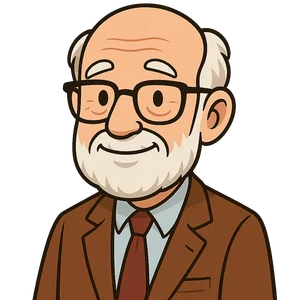
Charles H. Townes
Charles H.
Reads at Grades 6–8 Listens at Grades 4–8
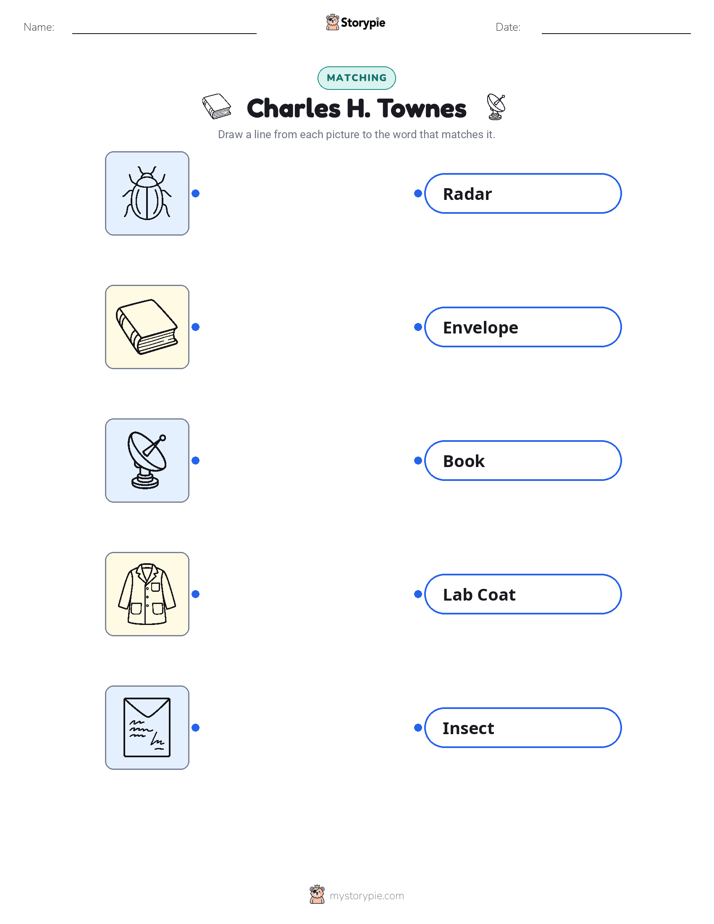
Print & create
Answer keys·No prep·Free with an account
28 worksheets · answer keys · full story · quiz · Ages 10-12 · CEFR B2
Plus adds 244,000+ more stories in 27 languages, audio for every one, and printables for all of them.
Just want Charles H. Townes?
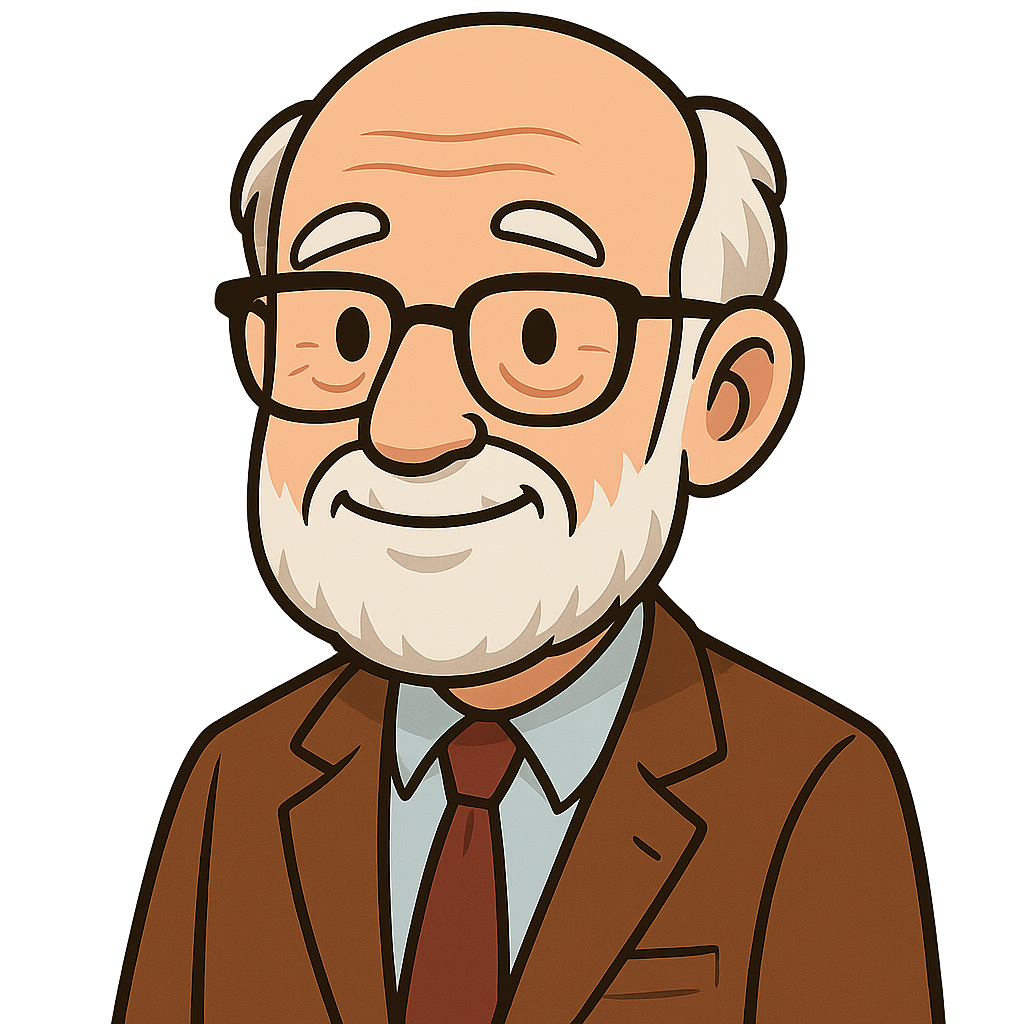
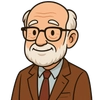
Hello! My name is Charles Townes, and I want to tell you about my journey with science and light. I was born on July 28th, 1915, in Greenville, South Carolina. Growing up in a world that was rapidly changing, I found myself fascinated by everything around me. I spent countless hours exploring the woods near my home, collecting insects, and constantly asking the question 'why?'. My father was a lawyer, and my mother always encouraged my endless curiosity, nurturing the part of me that wanted to understand how the world worked. I loved learning so much that I moved through my studies very quickly. In fact, I graduated from high school when I was only 15 years old and immediately went to college at Furman University, right there in my hometown. It was the beginning of a lifelong adventure in discovery, all powered by the questions I started asking as a child.
After graduating from Furman, my thirst for knowledge was far from quenched, so I continued my studies. I earned a master's degree from Duke University and then moved all the way across the country to California. There, I pursued my Ph.D. in physics, which I received from the prestigious California Institute of Technology in 1939. Just a few years later, the world was in the middle of World War II, and my skills were needed. I went to work at a famous research center called Bell Labs. My job was to help design radar bombing systems. Radar was a critical technology that used invisible radio waves, specifically microwaves, to detect objects from a great distance. This work was incredibly important for the war effort. For me, it was also a deep dive into the world of microwave physics. Working so closely with these special waves taught me an immense amount and laid the foundation for the biggest ideas of my career.
Charles Townes: A Life of Light
Hello! My name is Charles Townes, and I want to tell you about my journey with science and light. I was born on July 28th, 1915, in Greenville, South Carolina. Growing up in a world that was rapidly changing, I found myself fascinated by everything around me. I spent countless hours exploring the woods near my home, collecting insects, and constantly asking the question 'why?'. My father was a lawyer, and my mother always encouraged my endless curiosity, nurturing the part of me that wanted to understand how the world worked. I loved learning so much that I moved through my studies very quickly. In fact, I graduated from high school when I was only 15 years old and immediately went to college at Furman University, right there in my hometown. It was the beginning of a lifelong adventure in discovery, all powered by the questions I started asking as a child.
After graduating from Furman, my thirst for knowledge was far from quenched, so I continued my studies. I earned a master's degree from Duke University and then moved all the way across the country to California. There, I pursued my Ph.D. in physics, which I received from the prestigious California Institute of Technology in 1939. Just a few years later, the world was in the middle of World War II, and my skills were needed. I went to work at a famous research center called Bell Labs. My job was to help design radar bombing systems. Radar was a critical technology that used invisible radio waves, specifically microwaves, to detect objects from a great distance. This work was incredibly important for the war effort. For me, it was also a deep dive into the world of microwave physics. Working so closely with these special waves taught me an immense amount and laid the foundation for the biggest ideas of my career.
Once the war was over, I transitioned from industry back to academia and became a professor at Columbia University in New York. I was put in charge of a committee with a very specific, and very difficult, goal: to figure out how to generate microwaves with a much shorter wavelength than what was currently possible. It was a puzzle that stumped many brilliant minds, and we struggled to find a solution. Then, one beautiful morning in the spring of 1951, I was in Washington, D.C., for a conference. I woke up very early, before the meeting was scheduled to start, and decided to go for a walk. I found a quiet park bench surrounded by blooming azalea flowers and sat down to think. In that peaceful moment, an entire idea suddenly flashed into my mind. I realized that I could use excited molecules to create a pure, intense, and focused beam of microwaves. The idea was so clear and complete that I couldn't risk forgetting it. I pulled an envelope from my pocket and quickly scribbled down the physics and the design. I called my idea 'Microwave Amplification by Stimulated Emission of Radiation'—which was quite a mouthful! We soon shortened it to a simple acronym: 'maser'.
Returning to my laboratory at Columbia University, I was filled with excitement to turn my park-bench idea into a reality. I assembled a team that included two of my brilliant students, James P. Gordon and Herbert J. Zeiger. Together, we began the long and challenging process of building a machine based on my notes. It required countless hours of work, many experiments that didn't go as planned, and a great deal of perseverance. Finally, in 1954, our hard work paid off. We successfully operated the first working maser, and it produced the pure, amplified beam of microwaves exactly as I had imagined on that bench. This success immediately sparked another question in my mind: if we could do this with microwaves, could we apply the same principle to light? I began working on this new concept with my brother-in-law, Arthur Schawlow. In 1958, we co-authored and published a detailed paper explaining how to build an 'optical maser'. Just two years later, in 1960, another talented scientist named Theodore Maiman used our framework to build the first working device, which soon became known by a new name: the laser.
My work on the fundamental principles of the maser and laser was recognized on a global scale. In 1964, I was incredibly honored to share the Nobel Prize in Physics for this achievement. The prize was awarded to me alongside two scientists from the Soviet Union, Nikolay Basov and Aleksandr Prokhorov, who had independently been working on the same principles. It was a powerful moment, showing how science can connect people across the world. When I first had that idea, I never could have imagined all the incredible ways lasers would be used in the future. Today, they are an essential part of our daily lives. Lasers read the barcodes on your groceries at the supermarket, they play movies on Blu-ray discs, and they enable doctors to perform incredibly delicate surgeries with precision. Scientists have even used powerful lasers to measure the exact distance to the moon. It is truly amazing to see how it all started from that single spark of an idea on a park bench.
I continued my work in science for many, many more years, always driven by curiosity. I turned my attention to the cosmos, using the masers and lasers I helped create to study stars and distant galaxies as an astrophysicist. It was a wonderful new chapter in my career. I lived a very full life of discovery and was 99 years old when my journey came to an end. I hope my story shows you that curiosity is one of the most powerful tools we have. A single question, a moment of wonder, or an idea that pops into your head while you're sitting in a park can truly lead to an invention that lights up the entire world.
Wow facts
About
Charles H. Townes was an American physicist and inventor who conceived of the maser and made fundamental contributions to the theory of the laser, for which he shared the 1964 Nobel Prize in Physics.
Take a Quiz
Question 1 of 5
What problem was Charles Townes trying to solve right before he had his idea on the park bench?
Explore next






Want to do even more?
Go beyond exploring. Unlock tools that turn every story into real learning.

Storypie Plus for families
Full stories, quizzes, and printables. Nights and car rides, sorted.
- Unlimited audio stories
- Create Mode: your child stars in the story
- Offline downloads
- Printable worksheets & coloring pages

Why Storypie for Schools
Students engaged. Prep in seconds. Evenings back to you.
- Worksheets & Quizzes
- Classroom Management
- Formative Assessment
- Custom Curriculum & Lesson Plans
- 27 Languages

Why Storypie for Homeschool
Curriculum done. They'll ask for more. Hours back in your day.
- Worksheet Generator
- First-Person Audio Stories
- Built-in Comprehension Quizzes
- Custom Curriculum & Lesson Plans
- Print & Go Activities