English

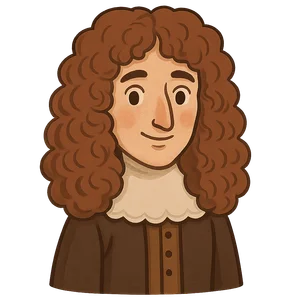
Christiaan Huygens
A Dutch mathematician, physicist, astronomer, and inventor from the 17th century…
Reads at Grades 6–8 Listens at Grades 4–8
Print & create
Answer keys·No prep·Free with an account
28 worksheets · answer keys · full story · quiz · Ages 10-12 · CEFR B2
Plus adds 164,000+ more stories in 27 languages, audio for every one, and printables for all of them.
Just want Christiaan Huygens?
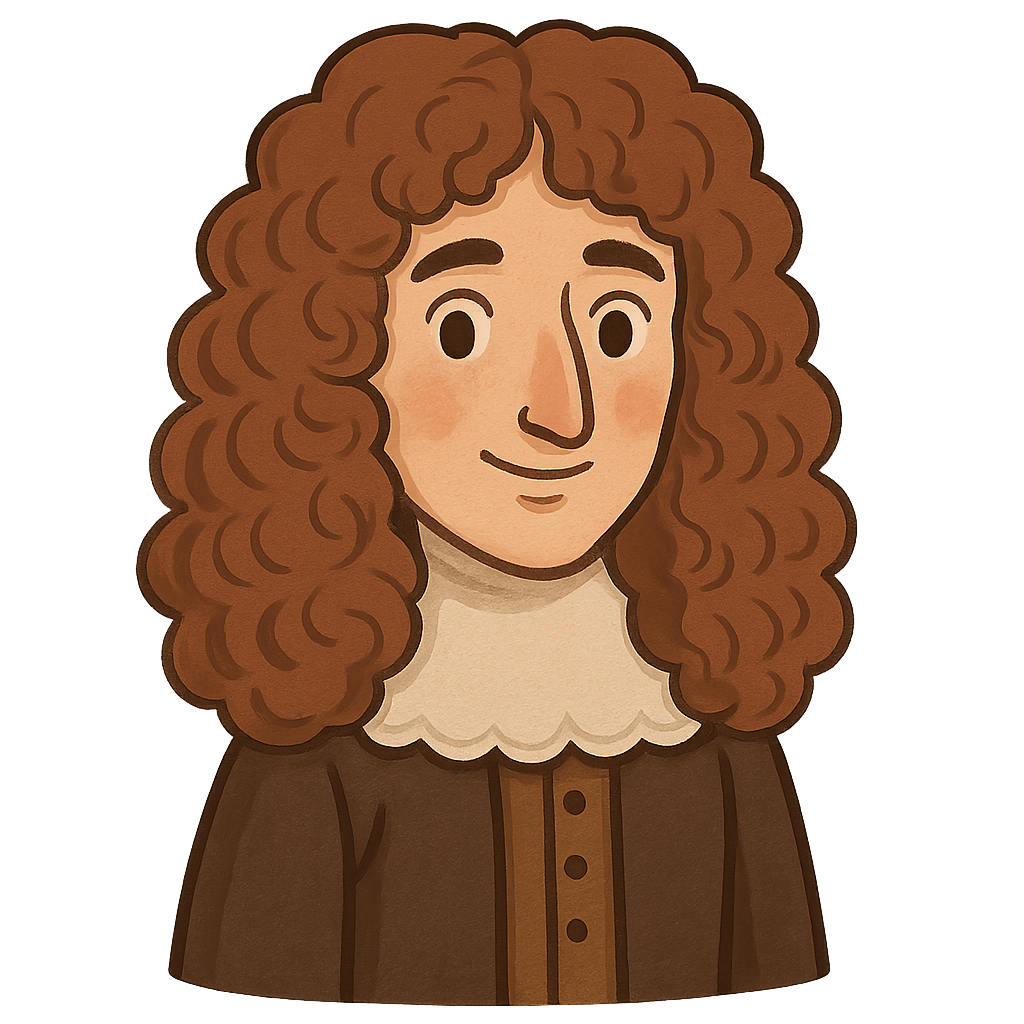
Hello! My name is Christiaan Huygens, and I want to tell you the story of my life, which was filled with stars, inventions, and endless questions. I was born on April 14th, 1629, in The Hague, a busy city in the Netherlands. My father, Constantijn, was a respected diplomat and poet who introduced me to many great thinkers. From a young age, I was more fascinated by how things worked than by simple games. My father saw my passion for mathematics and science and encouraged it, even calling me his 'little Archimedes.' I was educated at home, which allowed me to study my favorite subjects deeply. In 1645, at the age of sixteen, I enrolled at the University of Leiden to study law and mathematics. Two years later, in 1647, I moved to the College of Orange to continue my education. While law was a practical field of study, my true passion was for the numbers and patterns that could explain the universe.
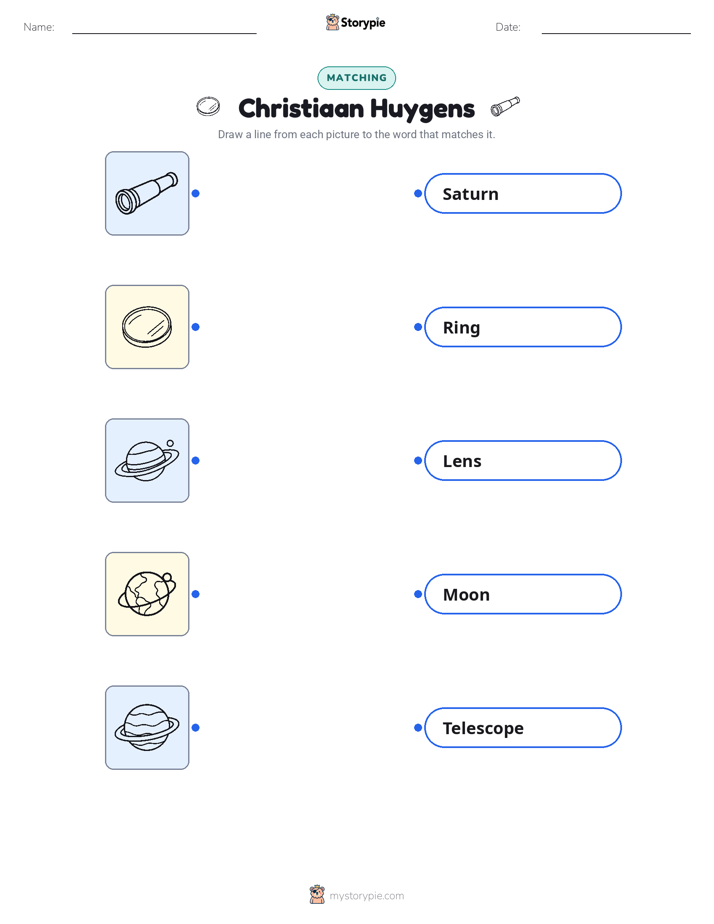
In my time, one of the most exciting fields was astronomy. The telescope was a fairly new invention, and I was convinced that to see deeper into space, we needed to make them better. My brother, Constantijn, and I became dedicated to this goal. We spent countless hours in our workshop, mastering the difficult art of grinding and polishing glass lenses. It was precise, demanding work where even the smallest error could ruin a lens. But we persevered, developing new techniques that allowed us to create lenses that were more powerful and produced clearer images than most others in Europe. Holding a finished lens was an amazing feeling; it was a window to the cosmos that I had made with my own hands. I knew these powerful new 'eyes' were more than just tools for looking—they were keys to unlocking the mysteries of the night sky that had puzzled astronomers for generations.
Christiaan Huygens: A Journey Through Time and Space
Hello! My name is Christiaan Huygens, and I want to tell you the story of my life, which was filled with stars, inventions, and endless questions. I was born on April 14th, 1629, in The Hague, a busy city in the Netherlands. My father, Constantijn, was a respected diplomat and poet who introduced me to many great thinkers. From a young age, I was more fascinated by how things worked than by simple games. My father saw my passion for mathematics and science and encouraged it, even calling me his 'little Archimedes.' I was educated at home, which allowed me to study my favorite subjects deeply. In 1645, at the age of sixteen, I enrolled at the University of Leiden to study law and mathematics. Two years later, in 1647, I moved to the College of Orange to continue my education. While law was a practical field of study, my true passion was for the numbers and patterns that could explain the universe.
In my time, one of the most exciting fields was astronomy. The telescope was a fairly new invention, and I was convinced that to see deeper into space, we needed to make them better. My brother, Constantijn, and I became dedicated to this goal. We spent countless hours in our workshop, mastering the difficult art of grinding and polishing glass lenses. It was precise, demanding work where even the smallest error could ruin a lens. But we persevered, developing new techniques that allowed us to create lenses that were more powerful and produced clearer images than most others in Europe. Holding a finished lens was an amazing feeling; it was a window to the cosmos that I had made with my own hands. I knew these powerful new 'eyes' were more than just tools for looking—they were keys to unlocking the mysteries of the night sky that had puzzled astronomers for generations.
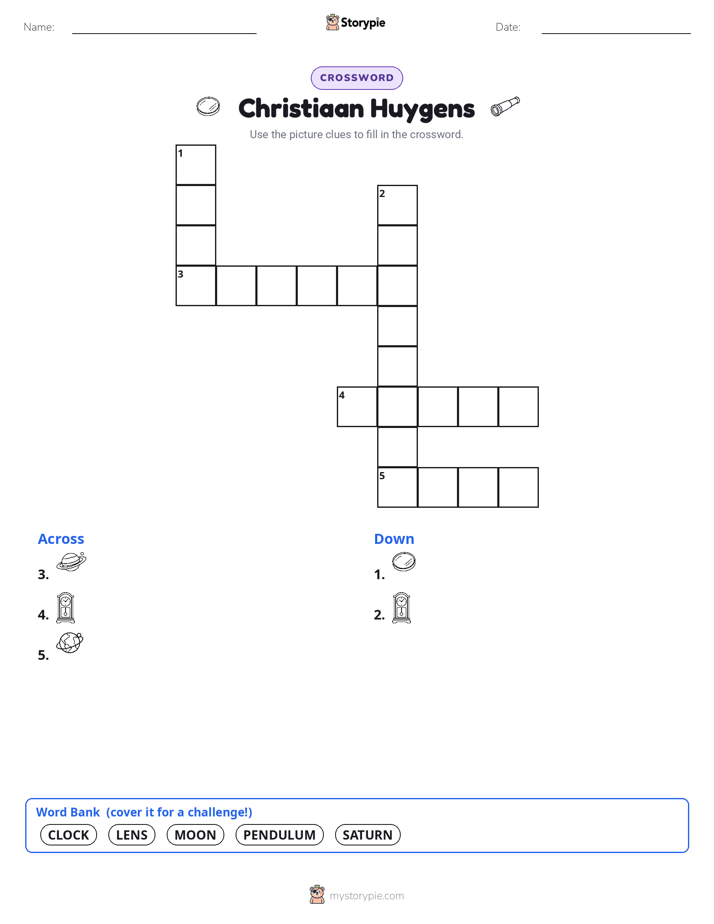
With my new, powerful telescope, I pointed it toward the planet Saturn. It had always been a strange sight in the sky. Earlier astronomers, like Galileo, had noted odd shapes beside it, which they called 'handles' or 'ears,' but no one understood what they were. As I observed the planet night after night, I saw something else: a tiny, bright dot moving in a steady orbit. On March 25th, 1655, I confirmed that this was not a star, but a moon. I had discovered Saturn's first known moon, which is now called Titan. I was thrilled, but the mystery of Saturn's shape still bothered me. After more observation, a bold idea formed in my mind in 1656. The 'handles' were not attached to the planet at all. I theorized that Saturn was surrounded by a thin, flat ring that floated independently in space. This was a radical idea for the time. To ensure I received credit for the discovery, I first published it as a coded puzzle, an anagram. I revealed the full solution later in my 1659 book, Systema Saturnium. I had finally solved the riddle of the ringed planet.
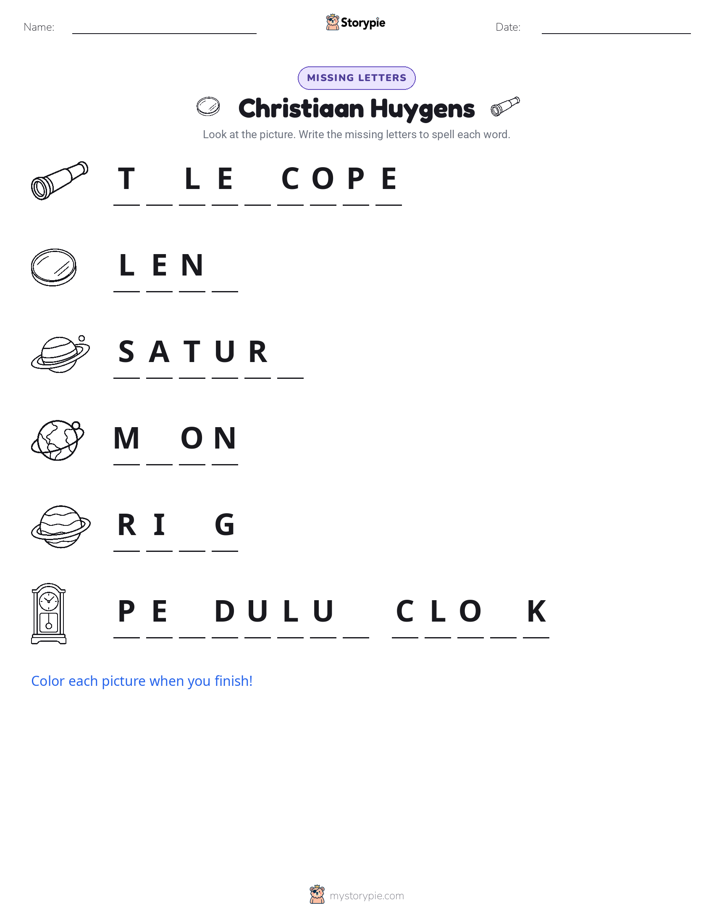
My astronomical work demanded very precise timing, but the clocks available during my era were not very accurate. I was inspired by the steady, rhythmic swing of a pendulum and wondered if it could be used to regulate a clock's movement. In 1656, I designed and built the world's first pendulum clock. It was a revolutionary invention. For the first time, scientists and sailors had a timekeeping device that was incredibly accurate. This innovation transformed science by allowing for more precise experiments, and it helped sailors navigate by allowing them to determine their longitude at sea. I detailed this work in my major book, Horologium Oscillatorium, which was published in 1673. My curiosity also led me to think about the nature of light. While many scientists, including the famous Isaac Newton, believed light was made of particles, I proposed a different theory in 1678. I suggested that light traveled in waves, similar to ripples spreading across a pond. I published this idea in my Treatise on Light in 1690. Although my wave theory wasn't widely accepted during my lifetime, it became a cornerstone of physics centuries later.
I was fortunate to spend many years working alongside other great scientific minds. In 1666, I was deeply honored to become a founding member of the French Academy of Sciences in Paris. I dedicated my entire life to research and invention, always driven by a deep desire to understand the universe. I lived to be 66 years old and passed away in my hometown of The Hague on July 8th, 1695. Today, I am remembered for my discoveries in our solar system, for inventing a way to measure time accurately, and for asking fundamental questions about the nature of light. My work helped build the foundation for modern physics and astronomy. It fills me with pride to know that in 2005, a space probe named Huygens in my honor landed on Titan, the very moon I discovered, continuing the great journey of exploration I started with a simple, homemade telescope.
Wow facts
About
A Dutch mathematician, physicist, astronomer, and inventor from the 17th century, famous for discovering Saturn's moon Titan, explaining its rings, inventing the pendulum clock, and contributing to optics and mechanics.
Take a Quiz
Question 1 of 5
In the story, I mention that my idea about Saturn's rings was 'radical.' What does the word 'radical' mean in this context?
Explore next





Want to do even more?
Go beyond exploring. Unlock tools that turn every story into real learning.

Storypie Plus for families
Full stories, quizzes, and printables. Nights and car rides, sorted.
- Unlimited audio stories
- Create Mode: your child stars in the story
- Offline downloads
- Printable worksheets & coloring pages

Why Storypie for Schools
Students engaged. Prep in seconds. Evenings back to you.
- Worksheets & Quizzes
- Classroom Management
- Formative Assessment
- Custom Curriculum & Lesson Plans
- 27 Languages

Why Storypie for Homeschool
Curriculum done. They'll ask for more. Hours back in your day.
- Worksheet Generator
- First-Person Audio Stories
- Built-in Comprehension Quizzes
- Custom Curriculum & Lesson Plans
- Print & Go Activities